| |
Subhash Chandra, Leo Semashko, Ramesh Kumar Peace Education through Global Peace Science On IAEWP Congress, October 24-26, 2016, Nashik, Maharashtra, India Theme: Peace Education for Schools and Colleges
Abstract
The traditional peace education, which has some positive value, is ineffective and helpless in preventing new wars and growing radical violence. The reason for this is the lack of its scientific foundation. This leads to need for a new fundamental discipline - Global Peace Science (GPS) to deeply analyze, study and solve the Global Peace problems. Any education is effective and has practical value only when it is based on fundamental scientific knowledge. Military science is a major intellectual resource of the wars, spread by hundreds of War research labs, thousands of war Academies with millions of military scientists and educators around globe in different nations. Peace is deprived of this resource so far. In 2016 the Global Harmony Association (GHA) created and published the first ever Global Peace Science (GPS) [1].This science is the Copernican revolution of the social sciences, peacemaking and peace education. The GPS central discovery is the discovery of global harmonious classes of the population - SPHERONS as eternal actors of global peace. GPS and its discovery of SPHERONS are crucial for innovative peace education, good governance and non-violence. Key words: peace, harmony, education, SPHERONS, Global Peace Science, revolution of peace education This paper is our constructive proposal for the IAEWP Congress to recommend to UNESCO to introduce Global Peace Science (GPS) at schools, colleges, universities, Post Graduate and doctorate level in academics. I. SPHERONS as Eternal Actors of Global Peace SPHERONS are the harmonious classes of the population, peace loving human beings, natural and eternal actors of global peace as they are the main productive force of social production, which maybe only in peace and harmony, not in war.The production of human resources is impossible without these key conditions. Therefore SPHERONS never had been at war and are not able to be at war by their objective status. They are permanent actors of global peace, its heart and motor. Axiom of social harmony: The harmonious existence of a society in any place and at any time is defined by the measure in proportion of four necessary and sufficient social resources: People (P), Information (I), Organizations (O) and Things (T). (Things are any material benefits and services). These resources are expressed in the chain: People (P) – Information (I) – Organization (O) – Things (T). In the acronym: P-I-O-T, or: PIOT. This Axiom of social harmony is the source of scientific understanding SPHERONS as the real foundation for Global Peace Science (GPS)[2]. The four necessary and sufficient spheres of social production continually produce four necessary and sufficient for the life of society and for every individual PIOT resources.If we recognize this real objective and universal fact, than we have to recognize the reality of the four necessary and sufficient SPHERONS employed in these spheres of production. The spheres of production cannot exist and be real without SPHERONS. SPHERONS are the main productive force, without which the production of these resources is impossible and which requires peace and harmony. It is logic and ontology of SPHERONS. It's an impeccable truth for all nations and every thinking person. It expresses the eternal harmonious human nature and humanity as a whole. This nature excludes the wars, violence and provides mankind a perpetual global peace, in which the partial historical wars at its early stage are just a deviation from the laws of harmony and a sign of ignorance / immature in their knowledge and education. All other groups and classes of the population are called PARTONS. only PARTONS are able to think and act for war on the infinite number of partial objective and subjective reasons. Therefore all of them are the historically transitory in contrast to the eternal SPHERONS. The SPHERONS discovery became first possible in Tetrasociology[3; 4]which expresses the four-dimensional pluralistic philosophy, on the foundation of which is building a science of social harmony, humanity, harmonious civilization and global peace. SPHERONS perform all the necessary and sufficient functions of production, distribution, exchange and consumption of PIOT resources. Four Spheres of production are: 1. Social sphere, or Sociosphere (S), the subject and the product of which are people (P), society nature, its education etc.; 2. Information sphere, or Infosphere (I), the subject and the product of which is information (I), science, art, religion, philosophy, designing etc.; 3. Organizational sphere, or Orgsphere (O), the subject and the product of which are organization/s (O), political, judiciary, financial, police, security etc.; 4. Technical (economic/ecological) sphere, or Technoecosphere (T), the subject and the product of which are things (T), material subjects and services, technologies etc. Four spheres of production in abbreviation are SIOT [5]. All social resources pass all four productive processes in their respective SPHERES of production. Four SPHERONS, spheral classes, employed in SIOT spheres are: 1. SOCIOCLAS, people who are employed in the Sociosphere = P1; 2. INFOCLASS, people who are employed in the Infosphere = P2; 3. ORGCLASS, people who are employed in the Orgsphere = P3; 4. TECHNOCLASS, people who are employed in the Technoecosphere = P4[6]. SPHERONS are very large groups of people and macrostructure of the population, covering it as a whole and in all its levels, from macro (humanity) to micro (individual).On level of humanity, population and people they are: HUMANITY = SPHERON-1 + SPHERON-2 + SPHERON-3 + SPHERON-4. POPULATION, PEOPLE (P) = P1 + P2 + P3 + P4[7]. SPHERONS Model on Humanity Level
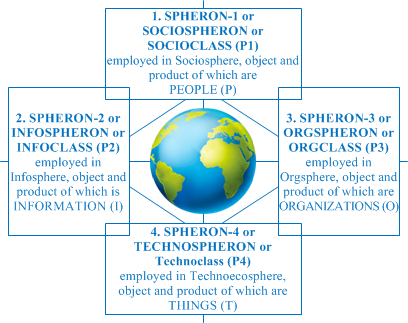
Peace is measurable via SPHERONS statistics
GPS enables to measure peace via harmony of SPHERONS, their resources and products in their statistical surveys in specific spheres, areas and zones. The size of each SPHERON of humanity covering all the population - this is a very difficult question of statistical research, which was conducted only for one country - for Russia and only for 2010, see GPS Chapter 2[8] and summarized here[9].The approximate proportion of SPHERONS on the example of Russia is: 6-0,3-0,7-3 [9]. SPHERONS are four hearts of society; without each of them it is dead. The blood of SPHERONS is a constant flow of services and PIOT resources that they continuously reproduce every second of their life. Destruction or absence of at least one of SPHERONS cripples the society and deprives its life. SPHERONS are the genetic code of society, its social genome – SOCIONOME providing throughout human history reproduction of the deep unchanged structure of harmony of SPHERONS. SPHERONS possess the special universal technologies of harmonization: the spheral technologies of digitizing, statistical information, globalization, pacifization, democratization, institutionalization, monetization, intellectualization, etc.[10]. SPHERONS are of the third way actors. They find scientific harmonious balance of private and state property, the optimization of economic extremes of which creates ineradicable inner antagonism between capitalism and socialism, their violence, constant wars and injustice. For more details, see: [11]. II. GPS: oneness and Peace of Humanity from SPHERONS’ Harmony •GPS overcomes historical limitations and deformation of all human values especially such as: culture, peace, love, freedom, equality, fraternity, justice, faith, democracy, honesty, human rights, openness, friendship, family, cooperation, happiness and others. SPHERONS consciously unite them in harmony providing a new spiritual habit and moral level of humanity. Disharmony of spheres (spheral disharmony) is a source of enmity, violence, inequality and war. •Consciousness and mind as the main source of converting from disharmony to harmony of the spheres (spheral harmony) of society and human. •GPS keeps the principles of traditional wisdom in understanding the oneness of humanity: All people, regardless of nationality, culture, religion, race or ethnic group are members of one human family created by God. •All mankind is one holistic organism; •All people are connected and interdependent; •Vasudhevah Kutumbakam, Indian principle of oneness: World is one family. Globalization once again shows that we are one big village [12]; •We humans are not just physical body, which changes in every birth. We are eternal soul and were created by supreme soul the intelligent designer, the Creator of universe. We have no option but to do only and only good deeds so that our next birth is better than previous. We need to feel love for everyone as in our own family. Six Spiritual Principles of Global Harmony for GPS education 1Principle of Disarmament – Ending War & building bridges of Peace through science, culture of Peace & love 2Principle of Respect – Respect Earth & human being in all its diversity in cultures & religions 3Principle of Love & Compassion – honoring & treating all the people – with dignity, equity and respect for world peace, 4Principle of SPHERONS’ Democracy – Participation by all in discussion & developing solutions and implementation of global peace and holistic sustainable development in the 21st century 5Principle of Harmony – Harmony between earth, nature, humanity & society for creating global peace and nonviolent sustainable society 6. Principle of scientific truth of social Harmony as cultural, spiritual and value heritage for all mankind, for all people and nations without exception. Ecologyconcerns in GPS education •The USA, with less than 5% of the world’s population, consumes 33% of the world’s resources. •Indigenous peoples in many countries have been dispossessed of their land, culture, spiritualityby settler populations from other countries •The use of nuclear materials to generate electricity and create weapons of mass destruction exposes humankind and other species to unnecessary and unacceptable risks of radioactive contamination. •The Earth’s natural processes are being degraded and destroyed by human violence including(but not limited to) the destruction of ecosystems •There is a massive and increasing number of refugees and internally displaced persons caused bythe use of military violence and climatically induced 'natural' disasters •Many people devote their energy to the design, manufacture and/or use of weapons and tortureequipment in order to harm, mutilate or kill fellow human beings III. Yoga: Science of Inner Peace and GPS Practical Tool GPS integrates all constructive peace making ideas and technologies of the past, among which a special place is occupied by the practice and methodology of Yoga. Yoga is a practical tool for the harmonious development of personality, so Yoga is a necessary tool and the addition of GPS as integral part of this science. A mind is the set of cognitive faculties that enables thinking, consciousness, perception, discrimination, judgment, memory of the characteristics of humans and few other life forms. Our minds are endowed with many talents but principal weakness is instability due to unlimited desires and is cause of our pain and sufferings. Mind gets stable only thru practice of Yoga. Stable mind leads to clarity which further enhances intelligence. Practice of Yoga enables one to have healthy body and purify the mind. Pure mind leads to pure thoughts and keeps one away fromevils and one performs satvic(selfless) deeds. Pure thoughts kill the enemy within us i.e. Ego, lust, anger, greed attachment and one becomes calm and humble and respect all as humans irrespective of status, caste, religion and culture. Practice of yoga has been found to be effective in getting rid of bad habits like excessive consumption of drugs/liquor /tobacco by poor males in slums and villages thus improving their economy and life style. The urbanites also get relief from various lifestyle diseases. Yoga is very effective in controlling psycho-somatic (both body and mind) healing of diseases like blood pressure, acidity, digestive, respiratory, excretory systems, circulatory systems, diabetes, headache etc. Yoga is good for modern times for depression, neurosis, mental tensions, insomnia etc. So if practice of Yoga is capable of transforming the people why not adopt them. Transforming the self will lead to transforming the community, society, nation and finally world. Yoga is ocean of great psychic powers hidden within us. Consciousness and mind are the main way from disharmony to spheral harmony of society and human. Thus adoption of yoga enables spheral harmony to harmonize the relations within the family, within the community and within the individual. Adoption of Yoga is the MIND CHANGE FROM VIOLENCE TO NON VIOLENCE and must be adopted by all irrespective of religion to achieve humanity, economy, equality and Global Peace from Harmony in society. Therefore Yoga is the necessary part of peace education in GPS. See in more details: Ramesh Kumar [13] IV. GPS Education The completion of the Peacescience book in GHA is just the beginning of a new, broader development, dissemination and application of the GPS new paradigm of thinking in: *Academic/educational institutions for holistic development * World Economy with aim to end inequality * Good Governance * Fair and selfless politics * Religious Harmony * War, conflict resolution, Terrorism * Targeted disarmament including nuclear weapons * Framing and cultivating universal Ethics * Respecting law of the land and enforcement / implementation * Concern and care for environment respecting earth as mother * Health for all using Yoga and Nature Cure * Better Self life management, relationship and productivity * Promotion of Peace through Art among children. Conclusion The scientific truths are the heritage for all mankind, for all people and nations without exception. This makes GPS by "the mightiest tool of peace." Therefore, only its support and international cooperation in its development creates the first nonviolent insuperable alternative to nuclear war today. The peace education in GPS plays a key decisive role in this process. Bibliography 1.Semashko, Leo and 174 coauthors from 34 countries (2016). Global Peace Science or Peaceloveology, Peacescience: First Common Good and Human Right, Revolution of Social Sciences, Creating Peace from SPHERONS’ Harmony and Nonviolent Victory of Peace over War in XXI Century. World Textbook. First Edition in English, New Delhi, 616 pages, ISBN 978-5-94422-035-6, Sanbun Publishers:http://peacefromharmony.org/docs/global-peace-science-2016.pdf (GPS) 2. Ibid, p. 23-29 3. Semashko, Leo (2002) Tetrasociology: Responses to Challenges. St.-Petersburg State Polytechnic University, 158 p.:http://peacefromharmony.org/?cat=en_c&key=145 4. Semashko, Leo (2016) SPHERONS: Harmony Classes, Heart of Global Peace and its Science Center, St-Petersburg: http://peacefromharmony.org/?cat=en_c&key=423 5. Ibid 6. Ibid 7. Ibid 8. GPS, p. 51-96 9. Ibid, p. 94-96 10. Ibid, p. 268-315 11. Ibid, p. 539-544 and etc. 12. Chandra, Subhash, Ibid, p. 186-188 13. Kumar, Ramesh, Ibid, p. 248-250 Dr. Subhash Chandra, GHA President, India http://peacefromharmony.org/?cat=en_c&key=583, E-mail: schandra101 [@] gmail.com Dr. Leo Semashko, GHA Honorary President, Russia http://peacefromharmony.org/?cat=en_c&key=253, leo.semashko [@] gmail.com Mr. Ramesh Kumar, GHA Executive Director (CEO), India http://peacefromharmony.org/?cat=en_c&key=658, Email: ngocosro [@] gmail.com 28/08/16 -----------------------------------------------------------------------------------
PEACE is from harmony and within harmony.True, indestructible, peace does not exist without and beyond harmony. ==============================================================
Global Harmony Association (GHA)
April 14, 2008==================================== World Harmony/Peace Academyand General Harmonious Education in an Information SocietyReduced titles: Academy, Harmony Academy, WHA, WHPA Conception Projectwas approved by the Board and the Honorary Advisory Committee as the Global Harmony Association Project
on April 14, 2008 (First publication: May 2007) Project publications:
Copyright © 2008 Global Harmony Association
Copyright © 2008 Leo Semashko If we are ever to have real peace in this world we shall have to begin with the childrenMahatma Gandhi Adults, who do not understand and accept peace, must be dealt with like childrenMatjaz Mulej Education is the most powerful weapon which you can use to change the WorldNelson Mandela Never doubt that a small group of thoughtful, committed citizens can change the world.Indeed,it is the only thing that ever has.Margaret Mead The main ideas for the World Harmony Academy in Dr. Leo Semashko’s interpretation A measure is the basis for all. Quaternion is an inexhaustible source of life. Pythagoras (6 BC)– A natural measure of four harmonious spheres is the basis for all. - Three is a symbol of the past disharmonious civilizations, especially the industrial civilization.- Quaternion is a symbol of the harmonious information civilization.------------------------------------ Do not make to another what not wish to make to self. Confucius (5 BC) - Social harmony is the first Golden Rule in human history----------------------------------- Quaternion is a depository of eternal universal order; it is the same thing as God-Creator. Hierocles (5 AD)- The mutually-inclusive four spheres inside cosmos, society and man are a basis and creator of universal harmonious natural order that becomes known to the information civilization only in the new social science of tetrasociology.----------------------------------------- The legislation of human reason (philosophy) has two subjects: nature and freedom in one philosophical system.
Immanuel Kant (1724-1804)- Tetrasociology has one philosophy and two subjects: a harmonious nature, which includes society and man, and natural harmony, which includes social and individual harmony.-------------------------------------------------- Two venerations of soul: the star sky overhead and moral law inside me. Immanuel Kant (1724-1804)- Two venerations of soul: harmony of cosmos overhead and cosmos of harmony inside me and society-------------------------------------------------- The philosophers only explained the world by various ways but the matter consists to change it. Karl Marx (1818 - 1883)- only knowledge of harmonious and equivalent spheres of society will allow humankind’s sphere classes, which are employed within those spheres, to harmoniously change the social world.---------------------------------------------------- If we are ever to have real peace in this world, we shall have to begin with the children. Mahatma Gandhi (1869 – 1948)- If we are ever to have real peace in this world, we shall have to begin with the general harmonious education and upbringing of children.-----------------------------------------------------Education is the most powerful weapon which you can use to change the World. Nelson Mandela (1918-2008)- Harmonious education is the most powerful weapon to harmonize the world, to exclude wars, violence and poverty, and to ensure humankind’s eternal survival and prosperity. ----------------------------------- -------------------
The Project authors:From Russia: 30 persons Leo Semashko, Ph.D.,State Councillor ofSt.Petersburg,Director, International Website "Peace from Harmony": www.peacefromharmony.org,Director, Public Institute of Tetrasociology,Social philosopher and sociologist,Pedagogical experience: 20 years,Author more 200 scientific publications, including 12 books,Member of four International organizations.Address: 7/4-42 Ho-Shi-Min Street, St. Petersburg, 194356, RussiaTel: +7 (812) 513-38-63 Andrei Arsenchuk, Student, St-PetersburgSergei Busoff, Professor, St-PetersburgKonstantin Cheremnykh, Economist, St-PetersburgYuri Dorofeev, Economist, St-PetersburgNatalie Hramikhina, Artist – Designer, St-PetersburgIvan Ivanov, Student, St-PetersburgDimitry Ivashintsov, Professor, St-PetersburgAbram Jusfin, Professor, St-PetersburgVladimir Kavtorin, Writer, St-PetersburgAndrei Semashko, Entrepreneur, St-PetersburgIgor Shadkhan, Professor, St-PetersburgAlexei Shepel, Candidate, Historian, St-PetersburgNatalie Sidorova, Journalist, St-PetersburgGenrih Skvortsov, Professor, St-PetersburgGrigory Toulchinsky, Professor, St-PetersburgTamara Trushnikova, Professor, St-PetersburgOlga Ushakova, Psychologist, St-PetersburgSvetlana Vetrova, Educator and Bard, St-PetersburgAlexander Yuriev, Professor, St-PetersburgTalgat Akbashev, Professor, UfaValery Gergel, Professor, MoskowNina Goncharova, Artist, NovosibirskAlexander Olshanski, Writer, MoskowIgor Prihodkin, Educator, CheliabinskAlexander Semashko, Economist, KalugaPetr Semashko, Lawyer, KalugaAndrei Smirnov, Professor, NovgorodNikolay Strelkov, Bisnessman, UlianovskTatiana Tselutina, Dr. Sociology, Belgorod
+1.Vladimir Bizianov, Dr., Economist, St-Petersburg, since 05/10/082.Vadim Trifanov, Dr., Mathematician, St-Petersburg, since 05/10/083.Peter Sergienko, Mathematician, Serpuhov, since 05/10/084.Sergey Sukhonos, DSc, Moscow, since 05/06/085.Basil Smirnov, Candidate, Historian, Novgorod, since 05/06/08
From other countries: 35 persons:
Dr. Ghassan Abdallah, CARE Director, Palestine
Prof. Ada Aharoni, IFLAC President, Israel and France Dr. Maria Cristina Azcona, ArgentinaProf. Reimon Bachika, Japan Prof. Ammar Banni, AlgeriaMr Jean de Dieu Basabose, Educator, Director, Shalom Centre for Africa, Rwanda Dr. Tholana Chakravarthy, IndiaDr. Renato Corsetti, UAE President, ItalyDr. Guy Crequie, Poet and Philosopher, FranceRosa Dalmiglio, Intercultural Peace Art Manager, Italy Dr. Martha Ross DeWitt, USAProf. John W. Forje, CameroonDr. Mona Gamal-El Dina, FranceDr. Stephen Gill, Poet and Writer, CanadaProf. Ananta Giri, IndiaProf. Will Hoonaard, CanadaTakis Ioannides, Poet and Writer, Greece Tatomir Ion-Marius, Poet and Writer, RomaniaMuhammad Iqbal, Poet and Writer, Pakistan Prof. Ernesto Kahan, IsraelHelene F. Klingberg, Poet and Writer, NorwayDr. Dimitris P. Kraniotis, President of World Poets Society, GreeceDr. Rose Lord, Poet and Writer, USA Prof. Charles Mercieca, IAEWP President, USADr. Nina Meyerhof, President, Children of the Earth, USAKae Morii, Poet and Writer, JapanProf. Matjaž Mulej, SloveniaSusana Roberts, Poet and Writer, ArgentinaDr. Maitreyee Roy, IndiaDr. Bernard Scott, England Prof. Rudolf Siebert, USA David Stringer, Poet and Writer, UA President, EnglandClaude Veziau, Composer, Canada Robert M.Weir, Writer,USA Prof. Jiang Yimin, China
+1.Prof. Alexey Stakhov, Canada, since 25/05/082.Prof. Oleg Bodnar, Ukraine, since 07/06/083.Prof. Edward Soroko,Belorussia, since 07/06/084.Prof. Patricia Rife, Ph.D., USA, since 27/08/085.Manager, Rama Narayana, India, since 05/10/086.Poet, Taki Yuriko, Japan, since 05/10/087.Dr. Lana Yang, MBA, USA, since 10/12/088.Dr. Laj Utreja, USA, since 10/12/08
9.Dr. Leonid Beluy, Academician, Ukraine, since 02/02/09 10.GDR. Prof. Sir Varant Seropian, Lebanon, 02/02/09
Co-authors' 20 Countries: Algeria - 1 Argentina - 2 Cameroon -1 Canada - 3 China - 1 England - 2 France - 2 Greece - 2 India - 4 Israel - 2 Italy - 2 Japan – 3 Norway - 1 Pakistan - 1 Palestine -1 Romania - 1 Russia - 37 Rwanda - 1 Slovenia - 1 USA – 7
+ Ukraine -1 Byelorussia - 1
Abstract
1. The World Harmony Academy (WHA) idea was stated and discussed among the Magna Carta of Harmony co-authors for the first time in the time period of March through May 2007. The WHA first variantwas discussed by 19 Russian members of the Global Harmony Association (GHA) from November 14, 2007, to January 28, 2008, when it was sent to the Russian leaders: President Vladimir Putin, Russian presidential candidate Dmitry Medvedev, and Governor Valentine Matvienko of St.-Petersburg with the offer to create the first WHA in St.-Petersburg. The WHA would require six years and about $1 billion in Russian currency (for the first two years of practical check and approbation of this project it is required $3 million). Since January 28, 2008, the Russian co-authors number has grown to 30. After project discussion by the GHA foreign members since March 4 up to April 14, 2008 to Russian authors was joined 35 the foreign authors. The total number of the authors is now 65, representing 20 countries. The discussion during 5 months generated more 200 offers, remarks and additions. As a result, the project has grown up to 74 pages. Upon the conclusion of discussion, the project will be edited in its final form, published as a book, dispatched to the authors as well as to other NGOs for support and to businesses, foundations and governments for realization. 2. The basic advantage of the project is to incorporate the natural laws of social harmony among spheres into society and people. These laws comprise the key universal components within the contents of general harmonious education. These laws are unfolded in a new social science: tetrasociology. The main purpose of general harmonious education and the World Harmony Peace Academy is to transfer and to apply scientific knowledge about these laws and technologies for the benefit of new generations. Knowledge of the harmony laws as well as technologies regarding their use are necessary for all societies and for all conscious people. This global scientific knowledge (the new universal social information) provides sustainable development, common good, prosperity and harmonious peace on the Earth and it excludes violence, wars, and poverty. The world consciousness of the social harmony laws qualitatively distinguishes general harmonious education from industrial education and elevates it to a new level in every aspect: moral, social, cultural, political, economic and ecological. 3. The Conception project provides a basis for development of the standard projects to be realized: 1. The Academy curricula, 2. Architecture, which includes construction of the academic town, 3. Finance or Business to fund and fiscally manage the project. The conceptual project is supplemented by practical projects, which also brings them to life. For these purposes the Transnational Educational Building Corporation could be created. This corporation would build the WHA standard academic towns worldwide as well as the standard atomic power stations. With this will begin globalization of harmonious education. 4. The WHA project was elaborated with a focus on localization of the first standard Academy in St.-Petersburg, Russian Federation. However the WHA branches could be created simultaneously worldwide especially in large cities. The full realization of this project on a global scale will require from 30 to 60 years.
5. The WHA project is a key, long-term and strategic project for Global Harmony Association. This Project unites the Association’s other projects and expresses its basic way to harmonious peace and society through harmonious education.
6. Sixty five co-authors from the Global Harmony Association created this fundamental, historical and innovative project, which will have worldwide meaning and impact. This project provides the mechanism through which general harmonious education can begin to create globalization of harmony. The project will start the world process of consciously mastering natural social harmony as well as a harmonious peace culture for an information society. Mastering social harmony is more difficult and important than space exploration because omly harmony provides for survival and prosperity of humankind within each country and among all people. Our project opens a conscious portal in the cosmos of social harmony and harmonious peace. April 14, 2008 will go down in history as a date of the first intelligent step in this unknown for humankind cosmos inside it.
Contents 1.Definition 2.Objective tendencies of harmonization, generating necessity of harmonious education and Harmony Academy 3.Historical bases for the Academy: religious, philosophical, pedagogical and scientific 4. From liberty to harmony: a deep revision of value priorities 5.Mission, purposes, motivation, ideological platform, staff and founders of the Academy 6.Structure of the Academy, new specialities, disciplines and features of educational process 7.Harmonious peace culture: comparison of the World Harmony/Peace Academy with the nearest global/local analogues 8.Localization, design, architecture and international recognition of the Academy 9.Stages of development and financing of the Academy. 10.GHA organizations list, potentially capable to participate in creation of the Academy 11.Lecture courses offered by the authors of the Harmony Academy project 12.Bibliography and websites 13.Some responses and variants of the WHPA project realization 14.Strategies for practical realization of the WHPA project 1. Definition
1. World Harmony Academy (WHA) Main Idea: The information society that is soon to replace the industrial society requires not traditional one-sided but all-sided harmonious education appropriate to a new society of universal information and new priority value of harmony. The scientific theory of this society is tetrasociology, which unfolds the laws of social harmony by determining its harmonious nature, which is distinct from the disharmonious nature of an industrial society. The harmony of this information society (civilization) is defined by harmony of its four necessary and sufficient spheres (social, information/cultural, organizational/political, economic/technical) and harmony of the appropriate four classes of the population engaged in these spheres. These classes first realize themselves, their own priority role, and their nature as the harmonious social actors only in an information society. They realize themselves on the basis of the universal information (universal scientific knowledge) of four harmonious social spheres, their laws, a value priority, and the infinite process of social and individual harmonization. This information becomes a general resource accessible to all the population of an information society, but the possession of this information can only occur in a context of continuous harmonious education. The harmonious classes of this society require adequate general harmonious education of the population on the basis of the universal scientific information in its appropriate system. The system of general continuous harmonious education begins with its source and constant generator: the World Harmony Academy (WHA). This academy should come into existence in various places on the planet in the coming years, as humankind prepares all necessary bases for its birth. Its realized survival and prosperity will begin from now on: the purposeful harmonious and sustainable development of global spheres of humankind, during which all global problems remaining from an industrial society are solved. The world harmonious peace—excluding arms, wars, enmity and violence—is established here too. New humankind and a new era begin from now on: the HARMONIOUS ERA of HARMONIOUS HUMANKIND. 2. Brief definition. The World Harmony Academy is the beginning, source and generator of general harmonious education all over the world in this new century. General harmonious education is an education of children, youth and new generations as harmonious world citizens on a global scale. It is a long-term project, yet it is also the most effective way to achieve indestructible harmonious culture of peace. The distribution of WHA and harmonious education worldwide can bring about, within 15 to 20 years, the cessation of all modern wars as well as the prevention of all wars in the future. The WHA is the most effective action for peace, for common good and prosperity. Therefore the WHA is the most effective World Peace Academy simultaneously.
2. Objective tendencies of harmonization, generating necessity of harmonious education and World Harmony Academy (WHA): 2.1. Objective tendencies of harmonization: 1.Russia is a country of many peoples, cultures and religions. For most of a millennium, they lived in the harmonious peace: "sobornost". This harmony is a tendency that is not clear to the mind, but it could be Russia’s world mission. The deep comprehension of this tendency and the laws of social harmony require fundamental harmonious education with WHA as its beginning and generator. 2.This tendency was not conceived by chance in Russia or in St.-Petersburg, which is the country’s cultural capital. Rather, it wasbirthed in 2007 as one of the basic preconditions for the Global Harmony Association as expressed in the Magna Carta of Harmony, where it is written that, at the end of the 20th century, "humankind began to realize that it either will survive in harmony or will destroy itself ". 3.Europe realized this tendency, having begun in 1992 (or 1957) a wide and purposeful formation of the European Union on the basis of the motto "United in Diversity”, which serves as a main principle of harmony as well as the requirement of appropriate education. 4.Singapore, after the 1964 Race Riots, established annual Racial Harmony Day on July 21, accepted a Declaration of Religious Harmony, and began to teach its study in all schools. All this allowed the country to now recognize itself "as a racially harmonious nation and society built on a rich diversity of culture and heritage”. 5.Kazakhstan, realizing itself as the centre of Eurasia, now promotes a policy that Europe and Asia will form an association on the basis of a principle of harmony. This also is the grounds for similar education. 6.In the USA, 13 towns are called "Harmony”. Since 2000, that country has developed "the Harmony Science Academy school system”, which has 14 schools and is an embryo of harmonious education. 7.In October, 2007, the Chinese Communist Party Congress confirmed a course, begun in 2005, on "building a society of social harmony”. Preparing the population for it will require harmonious education. 8.In Latvia, the political "Harmony Centre" was formed in 2005 and won 17 seats out of 100 in the country’s parliament in 2006. This “Harmony Centre” expresses the tendency of political harmonization, impossible without harmonious education. 9.The St.-Petersburg Government, facing the intensification of inter ethnic enmity in connection with the growth of the immigrants flows, approved, in their 2006-2010, urban program: "Tolerance: A Great city requires harmony in diversity”. This program presents certain results for inter ethnic harmonization and requires development of harmonious education. 10.Obviously, there are also other displays of this objective tendency, of which yet we do not know. Conclusion: The World Harmony Academy will inevitably be created. The only question is: where and when? The country that creates the first WHA will ensure its recognition as an innovative, harmonious, leading developer in the 21st century and as a cradle of world harmony. 2.2. Prizes for the country that creates the first WHA: 1.Global leadership in the field of super technologies of harmonious education will ensure leadership in the development of an innovative, harmonious way with the additional benefit of gaining social capital among a new quality of the world’s population. 2.World priority in development of the scientific theory of harmonization, standards of harmonious education, and preparation of the appropriate staff. 3.The mission of being the world leader in global harmonization of multi-polar development as well as the privilege to offer to the G8 and United Nations appropriate initiatives to ensure harmonious peace on the planet. 4.Overcoming a deficiency in the new humanitarian, educational and social technologies. 5.Fulfilling state policy by a new quality of economic, political and social harmonization, which can become a national ideal for any country. 6.Generating new state educational and social strategies of the 21st century on the basis of uniting and inspiring the value of harmony as happiness among youth who feel demoralized. This value provides the highest motivation for harmonious innovation behaviour. 7.Rapid growth of a positive international image. 8.Harmonization of inter-ethnic relations in the country and also eradication of the ideology of genocide, divisionism, xenophobia and fundamentalism through general harmonious education and investments in the social capital. 9.Free-of-charge schools that teach harmonious education, which will lead to eradication of illiteracy among all children, including those of poverty-ridden families. The creation of WHA requires a maximum of six years and US$1 to 2 billions. Any country "Having saved" this money today, will spend ten times more in 10 to 15 years annually for the purpose of harmonious education. 3. WHA historical bases: religious, philosophical, pedagogical and scientific 3.1. The Golden Rule of religions as the WHA historical-religious basis. The Golden Rule was formulated by Confucius 2500 years ago. When it came into all world religions, it created the basis for their harmony. The Golden Rule of religions: "Do unto others as you would have them do unto you" is the first ethical expression of social harmony in a human history. It was established by many researchers, among which the greatest contribution was made by the American Professor Rudolf Siebert, who devoted more than 100 scientific publications to this subject over a period of more than three decades (http://www.rudolfjsiebert.org/, http://www.peacefromharmony.org/?cat=en_c&key=51). All religions recognize a basic principle of harmony. In any religion, God is creator of harmony of the world, society and humankind. The Golden Rule, the basic moral requirement of world religions, is also WHA’s ethical base.
3.2. The WHA historical-philosophical basis follows an almost unbroken chain of philosophical ideas of harmony in the history of European thinking. In Homer’s poems, the comprehension of harmony begins with its first vague images as “clan”, “connection”, “consent”, and ‘peaceful cohabitation”. In the Pythagoras school, at Philolaus, harmony is understood as one of the original laws of things along with necessity: "All occurred by necessity and in accord with harmony”. Heraclitus defines harmony as "unity of opposites”. He spoke: "Out of discord comes the fairest harmony”. and "Veiled harmony better obvious”. Plato develops Heraclitus’ idea of "harmony of opposites”. In particular, he says the soul, as a unity of reason, courage and sensuality, is harmony of these opposites. Reason and knowledge in general are a source of harmony and of the highest virtue. The harmony of soul defines the harmony and health of a body. Ignorance, on the contrary, is the cause of disharmony as are defective behavior, illness and evil. Plato, for the first time, transfers the idea of harmony onto social ground. Plato’s ideal state is harmonious, and its social structure (three opposite classes-estates subordinated to a principle of justice) corresponds to three harmonious opposites of human soul. Reason is a source of soul harmony, therefore it governs a body. Similarly: the philosophers’ estate makes a true and harmonizing authority of the state. Harmony can be both a cause and a consequence in the development of a person or society. Harmony differs in size: it can be more or less, especially in art. It can be qualitatively different: good, i.e. outgoing from the soul within or bad, superficial, outgoing from a sensual matter. Plato develops the dialectics of harmony of universal opposites: four ultimate elements that make all the structures in the world—fire, air, water, earth; soul and body; parts of soul etc. He gives a priority to this dialectics and subordinates to it disharmony and struggle of the individual and private opposites. Through the World Harmony Peace Academy, Plato’s dialectics of harmony of universal opposites are restored and rise to a new level within tetrasociology (see below).
Aristotle considers harmony as universal "unity in diversity", as "completeness and unity of a whole", as concordance in movement, rhythms, sounds, forms and proportions. He developed Plato’s aesthetic representations of harmony. The aesthetic understanding of harmony as a source of perfection and beauty in all that prevails in antiquity. This understanding finds a new development in aesthetics during the Renaissance. Leonardo da Vinci unfurls the scientific laws of harmony in the human body proportions. This epoch introduced a concept of “the harmonious, comprehensively developed person”, which became the ideological expression of humanism or love of fellow-men. This concept in modern tetrasociological interpretation (see below) is one of the corner stones for harmonious education and WHA. Gottfried Leibniz lifts harmony up to the level of divine law in his "Pre-established harmony". The Age of Enlightenment, especially as defined in the writings of English philosopher Anthony Shaftesbury (1671-1713), expands the humanistic and educational meaning of harmony, considering it to be an ideal of a person’s harmonious steadiness (balance) of complete feelings, which is true. Shaftesbury asserts that "harmonious unity in diversity" is a creative principle developed from God. This principle defines morality, which requires harmony of individual attractions and social propensities, which are inherent to human nature. He brings together ethics with aesthetics and emphasizes the aesthetic character of moral bliss (happiness) "of harmonious life". Tetrasociology includes these definitions of harmony as truth and happiness within the concept of harmonious education. Kant widely develops Aristotle’s concept of harmony as "unity in diversity" and adds to it "consent (harmony) of mind and feelings". Though he denies Leibniz’s "Pre-established harmony", he recognized the reasonable harmony of nature in its eternal order. Beauty, in his opinion, both derivates from harmony and occurs as a result of it. Harmony, as he sees it, holds the qualities of apriority and expediency and also the meaning of aesthetic feeling as expressions of the aesthetic idea. Hegel’s theory of harmony presents a narrower sense. Harmony is limited in his view by external and individual relations. According to Hegel, internal universal relations are subordinated not to harmony but to a struggle of opposites, i.e. antagonism and disharmony, which dominate in bourgeois (industrial) society. In his opinion, such a society, its people and art irrevocably lose harmony under the pressure of the struggle of general opposites. Tetrasociology holds this estimation of an industrial society as disharmonious. Marx continues Hegel’s tradition of struggle (enmity, antagonism) of general opposites, discarding the antique tradition of harmony of general opposites that corresponded to antagonistic and disharmonious essence of an industrial society. Marx, after Hegel, rejects Plato’s priority of harmony of universal opposites and replaces it with a priority of struggle/antagonism of the private class and property opposites, giving them universal meaning. He, thus, discards harmony from an industrial society both in reality and in philosophy. In its place, he sees only struggle and antagonism. But Marx has the historical merit of presenting four spheres of social production, which represent the cornerstone of tetrasociology. However, here they are equally necessary (i.e. are pluralist) and are deprived by Marx’s primacy of economy (i.e. monism). However, the bourgeois society has thinkers who connect the transformation of that society as well as the rescue of humankind with harmony. For example, Fyodor Dostoevsky estimates harmony is a way of rescue for humankind with the words: "beauty (harmony) will save the world". Tetrasociology includes a saving mission of harmony. History presents harmony as an integral value that includes and determines all other values. Throughout history, harmony has experienced many definitions: "peaceful cohabitation" or "sobornost", natural law, unity of opposites, justice, wholeness, holism, unity in diversity, beauty, common good, perfection, virtue, humanism, proportionality, all-round development, steadiness, completeness of feelings, love, health, true, best authority, true or ideal state, true order as opposed to chaos. Its opposites aredisharmony, antagonism, violence, war, defectiveness, disorder, illness, evil and so on. All these definition retain their meanings in tetrasociology and get special priority in our time. Each new historical epoch interprets the contents and social meaning of harmony. only postindustrial (information) society gives to it the adequate social contents and meaning, scientifically defining it in tetrasociology through the general/universal spheres and sphere classes of humankind. only this society requires the scientific definition of harmony and only this society creates the information preconditions for its scientific understanding. on this basis, aninformation society restores, in the frames of tetrasociological theory, the antique priority of harmony of universal opposites. The struggle of private opposites is understood in tetrasociology (see below) as a limiting case of harmony of general opposites. All philosophical riches of the European culture of harmony make the ideological base for WHA. The substantiation of the philosophy of harmony of opposites, as presented in this section requires a brief review of the Eastern, including Muslim, philosophies of harmony as well as analysis of the harmonious theories of Chinese, Indian, Japanese, Arabian and other philosophers. We invite appropriate experts to provide this perspective.
3.3. The pedagogical preconditions and embryos of harmonious education. While harmonious education is not accepted in a pedagogical science today, the aspiration to harmonious education has existed since ancient times in various pedagogical schools of the world. There is not adequate space to present their history here, even briefly. But we will name displays of harmonious education in different pedagogical directions.
1. Liberal education. one example is Bard College in USA, which was open in 1860 and continues to successfully exist today. It aspires to associate science and art education and to blend their harmonization (http://www.bard.edu/). This style of training is an alternative to the narrow system of preparing professionals, which is practiced by large "universities-supermarkets" of Europe and USA. 2. Leo Tolstoy’s pedagogical system and school in Russia since 1862.
3. Integral Elementary School in San Diego, California, USA has the intention of "Creating Lifelong Learners – Mind, Body, Heart & Soul". The school’s vision is to allow the integration of each child's mind, body, heart and soul, thus inspiring the inner joy of learning. The school uses innovative holistic education approaches and methodologies inspired by the Integral Education philosophy of Sri Aurobindo and Mirra Alfassa (a.k.a., The Mother). For more than a half century, the school has accumulated a highly developed body of theory and successful practice at the Sri Aurobindo International Centre of Education in Pondicherry, India
(http://en.wikipedia.org/wiki/Integral_Elementary_School_of_La_Jolla). 4. The Sri Aurobindo International Centre of Education, established in India in 1943 has as its, basic purpose the development of an integral education system. This education is based on understanding that the person is an integral essence who unites five aspects: physical, vital, psychic, mental and spiritual. While the harmonious development of all five aspects is an essence of integral education, it is first and foremost a religious education based on integral Yogi and on Sri Aurobindo’s sanctity. 5. Holistic (or alternative and humanistic) education is a philosophy of education based on the premise that each person finds identity, meaning, and purpose in life through connections to the community, to the natural world, and to spiritual values, such as compassion and peace. Holistic education aims to call forth from people an intrinsic reverence for life and a passionate love of learning. The roots of holistic education can be traced back to several major contributors. Originating theorists include Jean-Jacques Rousseau, Ralph Waldo Emerson, Henry David Thoreau, Bronson Alcott, Johann Pestalozzi, Friedrich Froebel, and Francisco Ferrer. More recent theorists are Rudolf Steiner, Maria Montessori, Francis Parker, John Dewey, John Caldwell Holt, George Dennison Kieran Egan, Howard Gardner, Jiddu Krishnamurti, Carl Jung, Abraham Maslow, Carl Rogers, Paul Goodman, Ivan Illich, and Paulo Freire. With the ideas of these pioneers in mind, many people feel that the core ideas of holistic education did not truly take form until the cultural paradigm shift that began in the 1960s (Forbes, 1996[1]) http://en.wikipedia.org/wiki/Holistic_education. 6. City Montessori School (CMS), Lucknow, India, founded in 1959 by Jagdish Gandhi has an enrollment of 32,000 pupils. This school is the most outstanding modern practical example of an embodiment of holistic education. CMS strives to inculcate in students the philosophy of 'Jai Jagat' (Glory Be to the World!). This thought empowers them with a global perspective and the concept of world citizenship. CMS promotes the ideals of peace, religious harmony, tolerance and co-existence among children of the next generation. In doing so, the school gives priority to children and establishes the Children’s World Parliament: http://www.jagdishgandhi.org/index.html. 7. Harmony Science Academy (also known as Harmony Science Academies) is a college-preparatory charter school system in Texas and Louisiana, USA. Harmony Science Academy has experienced a period of rapid expansion during the last six years, since the opening of its first school in Houston, for the 2000-2001 school year, followed by the opening of Harmony Science Academy Austin the next year and Harmony Science Academy Dallas two years later. Currently, the Harmony Science Academy school system has 14 schools, including locations in El Paso, Austin, Dallas, Houston, Beaumont, Lubbock, Waco, and San Antonio, Texas, with plans to open more for the 2008-2009 school year, including a school in New Orleans, Louisiana (http://en.wikipedia.org/wiki/Harmony_Science_Academy). Each of these educational directions contains the seeds of harmonious education. However, they do not have the scientific theory and, therefore, do not realize by themselves the system of harmonious organization. Harmonious education, constructed on tetrasociology, could tentatively be named "TetraEducation" because it unites, orders and continues the direction of the above named institutions. Being essentially new, tetrasociology develops progressive forms of liberal, holistic and integral education in a harmoniously organized educational space. But first of all, tetrasociology seeks to develop holistic education as the most fundamental direction of world education systems today.
3.4. Tetrasociology as the WHA scientific basis. Tetrasociology unfolds the natural harmony of four universal spheres of societies and persons. Tetrasociology also shows four universal sphere classes of humankind within all countries and all human communities. Tetrasociology is a synthesis of the numerous structural concepts of spheres and value ideas of harmony of the West and East. Tetrasociology restores the priority of Plato’s harmony of universal opposites, which Hegel and Marx rejected, but it expands this priority with the scientific content of objective social spheres and sphere classes.
Tetrasociology was developed in St.-Petersburg by the social philosopher and sociologist Dr Leo Semashko in 1976 and is published in many languages in his more than 200 scientific publications, including 12 books. To mention a few of the major contributions: "Sphere Approach" (1992), "Tetrasociology: Responses to challenges" (2002), "Harmonious Era Calendar" (2006, with 38 co-authors from 17 countries), and "Magna Carta of Harmony for an Information Civilization" (2007, with 42 co-authors from 16 countries). These last works gave birth to an "International Tetrasociological Scientific School". As conscious social harmony becomes necessary and accessible only in an information civilization, the social science of harmony—tetrasociology—also becomes possible and necessary only in this type of civilization. Tetrasociology is the scientific theory of the natural harmony of the sphere classes of an information civilization. As such, it can become the property of the population and offer that population a scientific knowledge of the laws and ways of social and individual harmonization only through a system of general harmonious education. Therefore, tetrasociology is simultaneously the philosophy and theory of this education. The natural harmony of humankind and the tetrasociological science of that natural harmony are as complex and difficult as fundamental physics. Therefore, they require the same basic research and fundamental education as physics. The main means for social harmonization is the general harmonious education and development of the new generations.The Convention of the Rights of the Child (1989). In its Preamble, requires recognizing "the full and harmonious development" of children as a norm. This norm can be ensured only through general harmonious education, which will establish an information society. Harmonious education on a basis of tetrasociology has two historical examples. The first example is the youth worker-student's club "Demiurge" for harmonious development of the person created in St.-Petersburg, which was active for five years from 1976 to 1980: http://www.peacefromharmony.org/?cat=ru_c&key=305. The second example is a studio of all-round (harmonious) development of preschool age children in St.-Petersburg in 1985 and 1986: http://www.peacefromharmony.org/?cat=ru_c&key=295. Certainly, even though limited in scope, these were the first steps of harmonious education. The people of an information society should receive an essentially new scientific social knowledge of the harmonious depths of human nature, society and laws of harmony. This knowledge cannot be given by the traditional industrial educational system. It can be given only through a new system of general harmonious education of an information society based on tetrasociology. Certainly, the new education retains and develops within itself all the viable and useful elements of old education systems. only harmonious education is capable of ensuring a "soft" evolutionary turn of humankind from inevitable industrial self-destruction to the realized (conscious) natural social harmony of an information society as the sole form of human survival and prosperity. only harmonious education and tetrasociology are capable to ensure an integral approach to global awakening. Tetrasociology unfolds the necessity of harmonious education in the new age and ensures its structural organization (see below). The first, most common attempt to systematize the fundamental bases and laws of tetrasociology is as follows: Tetrasociology: Fundamental Bases and Laws. A brief list. (The bases of tetrasociology are underlined and appear in bold letters. The laws are written in italics. The new terms of tetrasociology are in capital letters. The sources or basic authors of ideas are in brackets) Definition: Tetrasociology is the pluralist four-dimensional scientific MACRO-SOCIOLOGICAL theory of a harmonious information society, as well as its social and individual harmony Note: MACRO is equivalent to SPHERE Ontological Bases and Laws: 1.There are four equally necessary and sufficient, universal and opposite spheres (realms) of being: individual (or existence as in existentialism),information, organization and matter. This is the first philosophical (ontological) basis of tetrasociology (History of philosophy and culture) Law: The absence of even one sphere makes being impossible, therefore these spheres mutually include and condition each other and create a world of harmonious unity through their diversity. This is the eternal objective law of harmony of the spheres of being. It is the law that says they can only exist in harmony. It is the law of all laws (History of philosophy and culture). 2.There are different variable priorities of the spheres of being in different places and times excluding a constant primordial sphere. This is the second ontological basis of tetrasociology (History of philosophy and culture). Law:Any primordial sphere excludes their (spheres) harmony and opportunity of their existence in unity through theirdiversity. (History of philosophy and culture). 3.Harmony as the mutually balanced (coordinated) movement and development of the spheres of being is the way of their existence, which creates a universal order of the universe. This is the third ontological basis of tetrasociology (History of philosophy and culture) Law:Each phenomenon of being has a special form and measure of sphere harmony (History of philosophy and culture) 4.The spheres of being are subordinated to the dialectics of harmony of universal opposites and they (spheres) are mutually inclusive. This is the fourth ontological basis of tetrasociology (History of philosophy and culture) Law:Within the harmony of universal opposites, the unity and struggle of private opposites are merely an extreme case of harmony, serving to destroy disharmonious private unity and transform it to harmonious private unity. (History of philosophy and culture) Tetrasociological laws of deep (sphere) structure of social and individual harmony: 1.There is a fundamental similarity of the spheres of being, their universal qualities, structures and laws with the spheres of humankind, society and individual persons. (History of philosophy and culture). The society spheres are named “societal” (fundamental and universal), and their quality, structures and laws are named “sphere”. 2.All societal spheres, sphere qualities and structures are necessary and sufficient (natural and universal), each with different priorities and aspiring to harmony as the common good; they exist only in mutual inclusion and do not exist separately. 3.Social harmony is a balance, consent and mutual coordination of the societal spheres for the common good as well as for indestructible harmonious peace and prosperity. 4.Individual harmony is a balance, consent and mutual coordination of the individual spheres that ensures individual health, happiness, truth, love, justice, peace, positive liberty, all rights, meaning and fullness of life. 5.People, Information, Organization and Things (material benefits) (PIOT) are the sphere resources needed for the survival and sustainable development and prosperity of any person, society as well ashumankind. (Toffler, Semashko) 6.Production, Distribution, Exchange and Consumption (PDEC) are the sphere processes of social reproduction that result from PIOT. (Adam Smith, Semashko) 7.PIOT resources in conjunction with PDEC processes compose the following societal spheres: ·Social sphere (SOCIOSPHERE), in which the subject and product are PEOPLE; ·Information sphere (INFOSPHERE), in which the subject and product are INFORMATION; ·Organizational sphere (Orgsphere), in which the subject and product are ORGANIZATIONS (political, legal, financial etc.); ·Economic or Technical sphere (TECHNOSPHERE), in which the subject and product are THINGS that provide all variety of material benefits. (Marx, Parsons, Bourdieu, Semashko). Socio, Info, Org and Techno spheres are the SIOT spheres. 8.SPHERE CLASSES of the population employed in the SIOT spheres are: ·SOCIOCLASS people aree mployed in the sociosphere; ·INFOCLASS people aree mployed in the infosphere; ·ORGCLASS people aree mployed in the orgsphere; ·TECHNOCLASS people are employed in technosphere. Sphere classes cover all population and differ on the general spheres of employment (SIOT), instead of the private and temporary attributes of property or stratification. Sphere classes are the sphere actors of social harmony 9.Corresponding to the spheres and sphere classes of harmony are the sphere needs, abilities, labor, employment, property, money and markets, which also aspire to harmony. 10.Society and people coincide in the most fundamental, harmonious, sphere structure. Therefore, corresponding to the four societal spheres are four spheres of the individual (person): ·CHARACTER is the relationship of a personto people including oneself, ·CONSCIOUSNESS is the relationship of a personto information, ·WILL is the relationship of a personto organization), ·BODY is the relationship of a person to things. 11.Irregular evolutionary and spontaneous development of the societal spheres directs concrete societies and local civilizations through the following stages: HARMONY (balance and prosperity), DECELERATION, DECLINE, DYING (HDDD). (History of philosophy and culture) 12.Harmony, prosperity, consent and harmonious indestructible peace are the adequate states of a society, rather than war, violence, enmity and poverty. Among all societies, only an information society that ensures universal information and the conscious (controlled) development of societal spheres holds an infinite potential of development at a stage of harmony (prosperity) that cantransform an information society into a harmonious one. 13.Harmonization of the societal spheres and their branches is provided by sphere management (government) and by conscious (scientific) regulation during their development. 14.Harmonization of the Sociosphere and its branches is achieved by legislating children as a priority in society and by establishing their harmonious education in order to elevate social harmony as a personal way of life, beginning in childhood.
15.Harmonization of the Infosphere and its branches is achieved by legislating establishment of harmonious culture as a priority, thus orienting all MASS-MEDIA regarding ideologies and sources of information on harmony and instructing them to give that information the highest communication value in order to create a harmonious civilization of humankind.
16.Harmonization of the Orgsphere and its branches is achieved by legislating establishment of SPHERE DEMOCRACY (TETRADEMOCRACY), which bases itself on an equal distribution of state authority between four sphere classes of the people; on the creation of FOUR-PARTY (TETRA-PARTY) harmonious political system of SPHERE PARTIES; on social discussion within a FOUR-SPHERE PARLIAMENT (TETRAPARLIAMENT); and on governance through a FOUR-SPHERE GOVERNMENT (TETRAGOVERNMENT). Sphere democracy provides conscious management of spheres and their continuous harmonization by these harmonious political institutions. 17. Harmonization of Technosphere (economy) and its branches is achieved by legislating establishment of a dynamic proportional dependence between levels of economic riches and poverty, which is necessary for the maintenance of social harmony in each society. 18. Conscious harmonization of the societal spheres requires harmonious education of the social actors, the sphere classes of the population and their managers, and the administrative staff of all levels. 19. Harmonious education involves balanced and coordinated informing, nurturing, learning, thinking and development of each person in all four spheres of society. 20. Harmonious education ensures deep comprehension of the laws of sphere (social and individual) harmony, creates a way of harmonious and nonviolent disobedience and resistance to all types of internal and external disharmony: war, violence, enmity, arms, evil and all extremes and pathologies. 21.Humankind will survive in conscious harmony, or it will destroy itself. only through general harmonious/peaceful education will people and society learn harmony that will lead to harmony. The bases and laws listed above are presented in greater details in more than 200 authors’ works, the most important of which are named above and are published on the web site "Peace from harmony": http://www.peacefromharmony.org/. Terminological note. By way of analogy with traditional and industrial terms, tetrasociology and its philosophy could possibly be named "tetrism", "harmonism" or some other new "ism". However, to exclude association with enmity and antagonism of the old trends: liberalism, conservatism, Capitalism, Communism, socialism, Nazism, terrorism, militarism etc., which are at enmity each other and with all: «bellum omnium contra omnes», we prefer to avoid the new "isms". The new society requires a new terminology. So, tetrasociology, in unity of its fundamental bases and laws, which are listed above, is a philosophy, ideology, scientific theory and methodology of general harmonious education as a whole, with the particular purpose of creating a World Harmony Academy. Many of the tetrasociology bases and laws are remain, in various measures, hypotheses. (As to its ontological sources, we should notice that ALL philosophical bases ALWAYS remain hypotheses because ANY philosophy is a hypothesis). However, a number of the tetrasociological laws, in fact, already have sufficient scientific substantiation. The proof of the tetrasociology hypotheses and their transformation into the scientifically proved bases and laws is a task to be completed during subsequent development of this science. Any science in the beginnings never has a fullness of proven bases and laws, which are constantly improved upon. Therefore the listed definitions are not final. Yet, the achieved level of scientific comprehension of fundamental positions of tetrasociology is sufficient to begin their practical social and individual realization. And as tetrasociology is realized, it will be further specified and developed and will receive deeper substantiation and detailed confirmation.
Addition of Prof. Alexey Stakhov. We share the main ideas and philosophy of the project “World Harmony/Peace Academy” in the whole, but we consider to necessary to supplement this project with the Golden Section Law for tetrary social structures in the following generalized form. Recent years two important generalizations of the Fibonacci numbers and the golden section appeared. They got a wide recognition and dissemination in modern science. The generalized Fibonacci p-numbers (Alexey Stakhov, 1977) are the first of them. For a given integer р=0, 1, 2, 3, ... they are given by the following recurrence relation: Fp(n)= Fp(n-1)+ Fp(n-p-1), Fp(1)= Fp(2)=…= Fp(p+1)=1 This recurrence relation arises directly from Pascal Triangle (diagonal sums of Pascal Triangle). This recurrence relation leads to the following algebraic equation: xp+1- xp-1=0, whose roots are new mathematical constants called the “golden p-proportions”. Another direction is connected with the following recurrence relation, which gives the generalized Fibonacci l-numbers (l is a given positive real number): Fl(n)= lFl(n-1)+ Fl(n-2), Fl(0)=0, Fl(1)=1. This recurrence relation results in the following algebraic equation: x2- lx-1=0. A positive root of this equation generates a new class of mathematical constants called the “metallic means” (Spinadel, Tatrenko, Gazale): 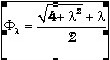
For the case l=1 the “metallic means” are reduced to the classical “golden mean”.
Recently it was proved that the new mathematical constants are the base of the “Law of Structural Harmony of Systems” (Soroko, 1984), a new theory of hyperbolic functions based on the golden and metallic means (Stakhov, Rozin) and a new approach to Einstein’s theory of relativity (Stakhov, Aranson). Foundations of the generalized golden proportions and their applications are described in Alexey Stakhov’s book “The Mathematics of Harmony. From Euclid to Contemporary Mathematics and Computer Science”, World Scientific, 2008. Dr. Leo Semashko comment. Together with the Gold Sections sphere harmony of society and man expressed in tetrasociology by qualitative language of concepts and quantitative language of sphere macro-statistics, receives powerful toolkit for quantitative calculation, which can name as "mathematics of tetrasociology" or by "mathematics of sphere harmony". It opens before harmony and tetrasociology unlimited opportunities for practical application in the newest information technologies of humanitarian harmonization. With it comes a new technological era. 25/05/08
All the above listed bases—religious, philosophical, pedagogical and scientific—bring about the united fundamental precondition of a global culture of harmony for WHA. The international site "Peace from Harmony", which is devoted to this culture, was created three years agoin 2004 through the initiative of St-Petersburg scientists. It now unites more than 250 authors from more 40 countries and is published in 17 languages. This site collects ideas from people of harmony from all countries and continents. The global culture of harmony has found generalization in the world humanitarian documents, created by its authors and published in St.-Petersburg: "Harmonious Era Calendar" (2006-2007), "Magna Carta of Harmony" (2007), Global Harmony Association Statutes (2007), the lecture course "Harmonious Peace Culture" (2006), and also in other authors' projects. Therefore WHA will be created not in an empty space but on the basis of a global culture of harmony, of which the first information portal is this Internet web site. It will be also the first information Internet resource for WHA and general harmonious education. on this web site, in March through May 2007, the WHA project initial variant was published during discussion of the Magna Carta of Harmony by 43 its authors. Within the Magna Carta, a modern social need in harmonious education (clause 27) and a need for a World Harmony/Peace Academy (clause 54) are formulated for the first time. 4. From Liberty to Harmony: A deep revision of value priorities 4.1. From Liberty to Harmony. Any new historical civilization requires essentially new education that gives priority to its new philosophy and its new value. We showed above that the information society creates both need (necessity) and preconditions for new, harmonious education. This society creates social science about itself as a harmonious information civilization. This science is tetrasociology, which simultaneously becomes philosophy of harmonious education. The core of this philosophy establishes proof of its value and priority for harmonious education, which is in contrast to former values and priorities of industrial education and its society. The value of liberty was proclaimed for the first time in 1215 in the English Magna Carta, which marked an historical turn from slavery. In 1789, the Great French Bourgeois Revolution proclaimed liberty as its highest value and a priority of an industrial society. Two other values of this revolution, equality and brotherhood, were lost in a shadow of liberty and in the subsequent history of its strengthening and expansion. Liberty has played a colossal positive role in the history of humankind, allowing it to liberate all creative capabilities of nations, groups and individual persons from all types of slavery and forced dependence. The positive tasks of liberty have now been solved. Through infinite positive demonstrations, liberty is provided by infinite national, corporate and international legislation. Liberty is the standard and approved priority value of an industrial society. As the highest value of an industrial society, liberty has exhausted its historical mission as the basis of these recognized values of humankind, thus making room to give up its place to a new value priority of a new civilization. Liberty departs from the top of the value hierarchy along with the society that created that hierarchy. Liberty can not maintain its priority in a new society for two reasons: 1. a new society needs its own new, adequate, value priority, 2. liberty is a limited, unilateral and contradictory value. Liberty is distributed in an equal measure to good and evil; and on the latter even more widely and willingly. Therefore, along with positive aspect of liberty being good, there is also the aspect of liberty being associated with evil, chaos and death; this is the liberty of arbitrariness and tyranny. This is the negative side of liberty that destroys the ethical basis of persons and society. Negative liberty is constantly accompanied by positive liberty, strengthening and threatening the positive. Negative liberty was investigated by Immanuel Kant, Fyodor Dostoevsky, Nicolai Hartmann, Jean-Paul Sartre, Martin Heidegger and many other outstanding thinkers. Negative liberty established money and bean counting (gain, love of gain) as a priority in the world, superseding the former priority of spirituality and humanism. Negative freedom resulted in an infinite turn of more and more monstrous wars, crimes, violence and in the constant growth of social pathologies: poverty, super riches, alcoholism, drugs, the arms race, environmental pollution, corruption, terrorism and so on. The epoch of liberty is an epoch of wars and a wave of "wars of all against all" (Hobbes). The last century presented to humankind the most abominable displays of negative liberty: world wars, the Holocaust, fascist and Soviet death camps, Hiroshima, genocide and so on. Negative liberty is the bloodiest value of all. The ominous potential of this liberty is far from being exhausted, rather, just the opposite, it expands as a cancerous tumour and threatens all of humankind with self-destruction. The ongoing change from an industrial civilization to an information civilization brings with it a new appropriate value priority: harmony. Harmony has always been a value in all cultures, but only the new society makes it apriority and puts it on top of the hierarchy of values. The objective necessity of a harmonious value hierarchy is clear: the current colossal cultural diversity of humankind, resulting from conditions of globalization and world unity, can survive only in harmony, can survive only with the deep internal consent based on the natural harmony of the spheres and sphere classes of humankind. Harmony, in contrast to liberty, has integrated value. Liberty answers only one, albeit very important, aspect of life of persons and society: independence of action and choice. But liberty does not answer all questions in regard to society’s blend of unity and its deep and qualitative diversity. Harmony, in contrast, is appropriate to the unity of diversity in both people and society. Therefore harmony’s value is that it includes all other human values and does not exist without them. Harmony can not be without liberty, justice, equality, brotherhood, love, peace and others. In the past, the values existed in human consciousness and ethics, but, as a rule, were isolated. In an information society, the universality of information provides for their integration within harmony. In contrast, liberty, in any society, can exist without harmony. For example, all industrial society is liberty beyond harmony. The principle of negative liberty is express as "all is allowed" or "liberty without borders". The principle of positive freedom is expressed as "restriction and self-restriction for liberty" or "liberty of one is limited by liberty of others ". Liberty without borders is liberty for wars, crimes and conflicts; it is their infinite source. Peace requires restriction and self-restriction of liberty in and through harmony. Harmony, as a principle of unity and consent of diversity, allows it to bring together and coordinate the liberty of different peoples, groups, nations, cultures and so on. However, harmony requires knowledge and skills in order to limit liberty but not suppress it and keep it in from being an optimum condition in all borders. This knowledge and skills of harmonious restriction and self-restrictions of liberty can be given only by general harmonious education. Liberty can exist irrespective from other values: justice, equality, brotherhood, love, peace and so on. Liberty excludes them from itself. Liberty very often tramples them and deprives their right to life (the examples of it are infinite) In contrast, harmony includes these other values in itself, promotes them, and acts as a source for their full life and prosperity. At the same time, liberty includes violence, enmity, aggression and wars, while harmony excludes them. Liberty does not require unity and consent of diversity; rather, liberty always sacrifices unity and consent for the sake of itself (please, recollect the slogan: "Liberty or Death! "); and harmony requires unity, consent and so on. Harmony includes liberty, orders it, subordinates it to the higher values, harmonizes it and limits negative liberty, aspiring to its conscious neutralization. Liberty has private value; it is necessary but insufficient; while harmony has integral value, it is necessary and sufficient, i.e. it is universal. Liberty presently is personified in a faster traditional industrial, than in innovative an information society. Harmony is the best of all possible innovations, because it serves the interests of the common good for all humankind and also all its parts as well as each individual. In contrast, liberty is one-sided; it serves private rather than universal interests. However, we should emphasize that harmony priority is at first educational. Harmony will become recognized, and even legislated by governments when it becomes shared by the majority of the population. This change of priorities can occur only through general harmonious education of the population, starting with children. This change can not occur through government administration. So, evolutionary change of civilizations defines evolutionary change of value priorities. Now, the main task of free people and nations is to learn to live in harmony, consent and peace, and this requires harmonious education. Value basis of this education can only occur by placing harmony as the highest value of an information society appropriate to and including other values. This is the ideological basis of harmonious education from the point of view of tetrasociology. The mission of WHA and general harmonious education is formulated on this basis. 4.2. Harmony: identities and distinctions with other values. (Identity is expressed by an equal sign " = " and can be replaced by words: "is, coincides with, is equivalent to," and so on.) Harmony = love; love = a necessary aspect of harmony, but not any love = harmony. (All the subsequent values are also necessary aspects of harmony.) Harmony = true eternal peace (that is, harmonious peace), which exists only within harmony and is exclusive of war and enmity; any peace without harmony = temporary and not true peace, = a pseudo-peace, = only a break between wars and preparation for more wars according to the principle: "want peace therefore prepare for war ". Harmony = positive freedom, which limits itself for the sake of harmony and freedom of others; freedom without harmony = arbitrariness, permissiveness and negative freedom. Harmony = justice, expressed in all aspects that are acceptable and clear to all people a MEASURE of distinction, necessary and sufficient for conscious harmony; justice without harmony = only Utopian dream. Harmony = just equality of people and groups, based on different abilities, needs, employment, knowledge, culture, faith, riches, communications, and so on, which are always consciously regulated by a harmonious society and state; equality without harmony = narrow and limited social space. Harmony = law subordinated to harmony, thus ensuring justice, equality and order; a law without harmony = source of injustice, inequality and disorder. Harmony = brotherhood of people and nations on an equal and friendly foundation found only inside harmony; brotherhood without harmony = only Utopian dream. Harmony = human rights, which serve to foster and promote social and individual harmony; human rights without harmony = formal right, a practical fiction and a humiliation of natural human dignity. Harmony = children’s priority, instead of another other social group such as the rich, noble, imperious, wise, sacred, and so on, because only the quality of children (that is, the quality of their education and upbringing) determines the quality of society as a whole and all of its values; children living in disharmony = source of all challenges and threats to humankind. Harmony = the common good existing only in harmony; the common good without harmony = only Utopian dream. Harmony = unity in diversity, including opposites if they are consciously coordinated; uncoordinated diversity = conflict, which makes harmony necessary (diversity cannot always be coordinated, but conflict always finds nonviolent resolution inside harmony). Harmony = existence only through diversity and through coordinated unity; harmony without diversity, through solitary effort = nonsense. Harmony = true democracy (tetra-democracy), created by four sphere classes that have equal political rights and responsibilities; democracy without harmony = formal and limited democracy, a pseudo democracy. Harmony = true economy of four production spheres coordinated for the material well-being of all nations and social groups; economy without harmony = way for enrichment of individual nations and groups at the expense of others trapped in poverty and pauperization; this = the source of social pathology, human degradation and humankind’s self-destruction. Harmony = true money as a means of achieving harmony; money without harmony = the destruction of all other humanistic priorities for a financial gain, = source of social pathology and human degradation. Harmony = true, sphere, state, in which the authority is divided equally and equitablybetween the sphere classes of the population and which (state) serves to social harmony; the state without harmony = tool of violence and restriction of one groups concerning other groups, = source of violence, injustice, poverty and wars. Harmony = true sustainable development; sustainable development without harmony = only Utopian dream. Harmony = prosperity, which for humankind is possible only in a state of harmony; prosperity without harmony = prosperity of a minority of the world’s countries and populations at the expense of the majority. Harmony = true culture, which serves harmony; culture without harmony = destruction, enmity and war. Harmony = true religion, which serves harmony: God of any religion = the creator of harmony from chaos; religion without harmony = religion without God. Harmony = true family, which serves harmony; family without harmony = source of enmity, murders (abortions) and suicides, violence, inequality, injustice and social pathology. Harmony = true (harmonious) education, which serves harmony; education without harmony = harm to man and society, and that harm is not expiated by its private benefits. Harmony = the true, full-dimensional man; man without harmony = a one-dimensional man = half-man = not a full-valuable man. Harmony = happiness, full value, meaning and completeness of human life, which are found only in harmony; happiness without harmony = fiction and an unreal dream. Harmony = true, adequate to all positive opportunities, prospering humankind, its genuine Golden Age. Harmony = multi-polar coordinated in all spheres and between all nations the world order to obtain the common good and global prosperity. Any absolutization = a lie, only absolutization of harmony = true, because harmony = the most fundamental natural law and universal deep structure of the world, society and man. These definitions are a subject of future scientific research and discussions among children, youth, parents, teachers, experts and the public. These definitions are the eternal philosophical problems and challenges for a science of harmony (tetrasociology), for the World Harmony/Peace Academy, and for general harmonious education. These definitions are a source for inexhaustible pluralism of opinions and approaches, riches with information and knowledge. 02/05/08. 5. Mission, purposes, motivation, ideological platform and WHA staff 5.1. Mission of the World Harmony Academy: To scientifically prove the inevitability of a global conscious harmonization of an information civilization through sphere classes, which are the actors and creators of world survival, indestructible peace, harmony and prosperity; To create the worldview and disciplinary bases for formation among youth and future generations of the GREAT DREAM of HARMONY - HAPPINESS as a priority value; To initiate innovation of a super technology of general harmonious education of all people, beginning from birth and continuing in the family and school. Briefly: To create global peace based on the scientifically clear harmony of the sphere classes and through harmonious education of the population beginning with childhood. The dream of harmony - happiness is formed by WHA and a system of general harmonious education supported by states, mass media, humanitarian sciences and arts that will ensure the global peace as the special qualitative condition of humankind excluding wars, armed conflicts and their means. 5.2. The comment to WHA Mission. Harmonious education and WHA are the originator and generator of two social functions. The first function is preventive: to prevent youth from burning life in consumerism, from degradation in drugs, alcoholism and different fanaticisms, from enmity, fascism and violence, including from mutual murders at schools and universities. The number of these murders grows. The second function is constructive: to arm youth with the great positive dream about harmony - happiness through the innovation technologies of social and individual harmonization in a system of general harmonious education. Harmonization is a conscious process of an equilibration of spheres and sphere components, achievement of their optimum measure and coordination. Harmonious education will ensure youth and new generations with necessary technologies for conscious harmonization at all levels, from the individual and family to all humankind. Harmonization technologies express a humanistic and moral mission of the new century. Harmonization is decisive for postindustrial humankind mission. only harmonization is capable to give adequate responses to global challenges because only harmonization provides qualitatively new social capital: a harmoniously and peacefully educated population free from wars, violence and poverty by using the achievements of science, engineering and economy for the common good and global harmonization (or harmonious globalization). The dream of harmony - happiness is universal because it gives a qualitative, synergetic effect in all spheres of society and people. Harmony is global because language of harmony - happiness is a global language of culture, peace and general harmonious education for the entire planet. The dream about harmony - happiness as an educational mission will require a lot of time, energy and expense of many resources. The beginning of its embodiment can be occur in 2008 in the WHA creation in St.-Petersburg (Russia) where all the necessary key conditions have ripened; these are submitted in our project. only the question of support of power remains unsolved. 5.3. Dream about harmony - happiness as source for global economic prosperity. The dream about harmony - happiness holds a colossal spiritual energy due to co-cooperation of different cultures of information in all spheres of humankind. The energy of harmony synthesizes in itself not only the spiritual achievements of humankind but also creates the new, previously unknown sources for global economic prosperity. These sources for prosperity consist in the universal information harmonization of all social conditions of economy: state, markets, management of all branches, spheres and levels, education, families, mass media, ecology, general disarmament and so on. They consist in essentially new, previously unknown class of harmonizing information technologies. Information and the educational harmonizing sources of global economic prosperity repeatedly exceed the efficiency of traditional industrial exploitation of natural resources. Information harmonizing globalization supersedes industrial disharmony and destroys humankind globalization. WHA and general harmonious education, distributing its influence on all social institutes, fills the population, starting with all youth, with great energy harmonization, directed for the common good of humankind and world economic prosperity. Harmonious education is the constant embodiment of the dream of harmony - happiness and eternal aspiration to the "golden age", which is not in the past but in the future. 5.4. The WHA purposes: - Preparation of necessary science, information, personnel and organizational resources for a system of general harmonious education.
- Development within youth and new generations of harmonious consciousness and worldview as submitted in the Magna Carta of Harmony and other documents of the Global Harmony Association.
- Preparation of diplomatic experts on an international level with bachelors, masters and doctorate degrees for all spheres of employment, capable of professionally harmonizing with all branches and institutions of these spheres in any human community in all the different countries and local civilizations of the world.
- Preparation and approval within national and international governmental institutions of the list of new harmonizing specialties that will add to the world list of specialties.
- Preparation and approval within national and international educational institutions of the list of new educational harmonizing disciplines for schools, colleges and universities.
- Retraining and raising the level of educators’ skill in all educational institutions on harmonizing level of humanitarian disciplines.
- Scientific research of spheres of society and persons, sphere classes and appropriate rules of harmonization in order to maintain a high quality of education among harmonization experts.
- Development within WHA of the International Tetrasociological School of scientific researches.
5.5. Result and personality preferences.
The holders of harmonious education degrees favorably differ in the following qualities: they have a universal harmonious worldview, a dream about harmony - happiness as being a top-level vital guide, a priority of harmony values, an aversion to violence and enmity, a desire for a harmonious way of life and harmonious development of the personality, a wish to share ownership of universal information, an ability for integral harmonious decisions, a want for free orientation in any social situation and institution, a skill for innovative harmonious thinking, a respect for social responsibility, an aspiration to harmonious cooperation and partnership, a readiness to engage in a harmonious business activity, and an ability for harmonization in any sphere. 5.6. Peacebuilding motivation and WHA necessity. In the world, there are thousands of military schools and academies, including "Royal", "Imperial", "Presidential" and so on, that teach youth to destroy and kill. At the same time, this same world does not have a World Peace Academy that would teach social harmony to prevent wars, poverty, enmity and other destructive extremes, pathologies and traumas of humankind. The WHA fills this cultural, educational and humanitarian gap. The WHA and harmonious education of children, youth and new generations as world citizens is the most effective way for achievement of a culture of indestructible harmonious peace. (Professor Ada Aharoni stated in 1999 the idea of a harmonious peace culture for the first time). The distribution of the WHA and harmonious education worldwide can, within the next 15 to 20 years, of not only stopping all modern wars but also preventing all wars in the future. A harmonious education is the most effective way to achieve peace building, as described in the writings of the still great Mahatma Gandhi. Therefore WHA in a reality is identical to the World Peace Academy. 5.7. Peace culture and peace education. Traditional peace demonstrations and protests, peace movements, peace researches and peace educations of the industrial society and its industrial “peace” culture were not capable of stopping or preventing any previous wars. At the best this culture is limited by the conflict theory, which provides for temporary conflict resolution and truce but does not extinguish the source of conflict. The highest achievements of industrial peace culture are: Mahatma Gandhi’s commitment to nonviolently strive against the British Empire and Dr. Martin Luther King, Jr.'s, use of nonviolence in the U.S. Civil Rights Movement, but these are defined only by their personal genius and are, therefore, unique. This peace culture, by the United Nations definition, expressed in eight attributes, does not hold the main scientific understanding and definition of the objective bases of true peace. This culture knows the war reasons to avoid war, but does not know the peace reasons to have peace. But it is basic. Therefore the industrial peace culture, by definition, is unable to ensure true peace never in principle. This culture continues to put stake in war as a means to achieve peace. This is apparent in the nationalistic statement: "If you want peace, prepare for war". Here, peace would be created on the basis of a fear of war rather than on its positive understanding of wanting peace. Preparation for war and the arms race do not stop an industrial society for one minute. In an industrial society,peace is subordinated to war and serves to leading to war every minute. An industrial society spends one million dollars for war and munitions while only one dollar goes to peace. In an industrial society, 10,000 people are engaged in war and preparation for war for every one person engaged in peace. Thus, peace is completely suppressed by war. The peace is limited by a simple absence of war in this culture, and the absence of war is a truce or an armistice, but it is not peace. Therefore an industrial society neither knows nor has a true basis of peace and, thus cannot ensure an indestructible peace and effective peace building. An industrial society with its preparation for war cannot be a basis for effective peace education, either. Therefore, an industrial society does not create or promote peace education nor adequate peace practices. In an industrial society, peace education has zero importance. The industrial society does not desire peace, does not require peace, and does not create the scientific basis on which to build or sustain a society of peace or peace education. In contrast, the new information society brings with it a new, true understanding of peace on which it can create a new, true peace culture. This peace culture is based on the scientific theory of spheres and sphere classes as sources and reasons of true—that is, indestructible, global and eternal—peace. only in an information society is it possible to create a culture of harmonious peace based on a scientific definition of the objective sphere reasons for true peace. Peace in a harmonious culture is that state or condition of any society and humankind as a whole that excludes war, the opportunity to create war, and the recourses for conducting war. This state or condition of harmonious culture is true, harmonious peace. Peace can only be provided in a state or condition of conscious social harmony of the spheres and sphere classes of the population. Sphere consciousness is a fundamental reason of true peace. Any other "peace" is a temporary absence of war and preparation for new war, therefore it is a pseudo-peace. Certainly, a culture of harmonious peace includes, in special cases, the highest achievements of an industrial peace culture: the great examples of masters of nonviolent conflict resolution are Mahatma Gandhi and Dr. Martin Luther King, Jr. The industrial peace culture also includes all types of traditional peace education: international, peace through world order studies (Derek Heater, 1984); peace through human rights and justice; development, peace through replacement of violent institutes by nonviolent (Paulo Friere, 1970); peace through nonviolent behaviour and conflict resolution (Ian Harris, 2003); and ecological peace through ecological health (Bowers, 1993). But it puts these on a platform of conscious harmonization, systematizing and including them as a part of a harmonious peace education. Harmonious peace culture is constructed on the principle: "If you want peace, create harmony" or "peace through (from, inside) harmony". The harmonious peace culture unites peace with harmony and makes them the scientific basis for the spheres of natural harmony, which unfolds in tetrasociology. Therefore only a harmonious peace culture can ensure scientific and general peace education, which simultaneously is general harmonious education. These directions of education are, in their scientific contents, identical and thus make two parties of one education. Maria Azcona’s peace definition. We can define Peace as a cultural value that is the most important value consensually because it leads the human society toward the protection of life. Peace allows life to grow, culture to be developed and systematic education and non-systematic education to be forwarded and transmitted. The lack of peace brings humanity to fear, desperation, annoyance, distrust and isolation. Also it destroys any possibility of philosophic development about cherish of life. Lack of Peace is not only the violence, but also the results of a violent environment and a paranoid climate. The effects are devastating for art, science and literature. The economic resources and political decisions and interests are concentrated in defensive or offensive activities and not in the maintenance of education or the aim to assist poor citizens groups. Social Peace is the first and foremost important value to be pursued if humanity is to have any hope of subsistence. We can define harmonious peace as the result of a solid peace state of righteousness where connivance lets culture flourish. It is the result of massive education in nonviolent resolution of conflicts but also in democracy as the unique political way of connivance that will give respect towards individual fulfillment and at the same time social groups fulfillment. Leo Semashko’s comment. Azcona gives a value definition of peace, which have many cultural advantages but it does not unfolds a social basis of peace, those eternal and natural social/sphere classes, which on the objective harmonious position/state exclude wars and among which only and can be an eternal and inevitable peace. only social harmony of these classes is that environment in which inevitable peace lives and of which it constantly grows. Inevitable, true, peace exists only inside social harmony and occurs only from it. Neither general education, nor the best democracies in an industrial society ever were the guarantors of inevitable peace; the proof to that is a history of the 20th century. 5.8. Consolidating scientific platform of the WHA. This platform is made with a new social science of an information society, which is tetrasociology, and the global consciousness (worldview) of social harmony submitted in the Magna Carta of Harmony (). Global consciousness is based on pluralism and keeps a mental and cultural diversity of the world communities within the framework of harmony. The Magna Carta of Harmony is the foundation document for the Academy on the basis of which all other documents are created: Statutes, Curriculums, Internal Norms, Competitive rules of teachers, etc. 5.9. Interconfessional character of the WHA. The importance aspect of the WHA is the interconfessional harmony provided the harmonious organization of education and a life in the Academy. Interconfessional harmony is served in Academy through the special theoretical courses of religious harmonization, fundamental studying of all world religions, practical training in the interconfessional groups, by mastering common languages of communication— Esperanto and English—and creation of the common cultural and art programs and so on. Interconfessional character is made in prayerful places of the basic world religions and in theperformance of daily religious rituals during students’ and teachers’ free time. At the same time in the WHA, there will be respect for the All Religion Prayers and World Unity Prayers per the example of Jagdish Gandhi’s City Montessori School in India. 5.10. Tolerance as an initial step of harmony. Tolerance is the main requirement and a cultural basis of the WHA. Harmony begins with tolerance. Students or teachers who are not capable of establishing harmonious or even tolerant partner relations among themselves and who are constantly conflicting among themselves and with other ethnic and religious groups are excluded from the Academy or assigned by the special commission for a probation and preparatory period (as for this work out the special rules). It is obvious, that not all modern people, including the believers who have been brought up in a traditional industrial spirit, are capable to be trained and to teach in the WHA and to live under laws of harmony in it. 5.11. Staff. The initial heads and teachers of the WHA are selected from members of the Global Harmony Association, first of all from more than 60 ideologically incorporated authors of its basic documents: «Harmonious Era Calendar», «Magna Carta of Harmony», «Global Harmony Association Statutes» and the WHA Project. The heads and teachers staff of the Academy can enter through a competition in which each expert shares the Magna Carta of Harmony and passes an examination on accordance to a post. The WHA staff will be replenished among university teachers passed retraining in the Academy. More 40 outstanding domestic and foreign professors and heads of the largest international organizations, which are included in the GHA, could take part in work of the Academy. 5.12.Founders of the WHA. The WHA should be State and Public and Private educational establishment that harmoniously unites the potential of the state, civil society and business-community. Therefore founders of the WHA are the government bodies, business-structures and civil organizations in the person of the GHA as author and initiator of the WHA project. The founders’ staff and a proportional ratio of their parts in the WHA constituent capital to meet the requirements of harmony. For its observance, the WHA founders on the equal rights and with equal shares’ are included into the WHA constituent capital: the state and business have 33 % of the constituent capital, the GHA, as the representative of civil society and as the initiator and author of the WHA project (i.e. as the owner of a Know-how and Hi-tech) has 34 % of the constituent capital. Founders could pay in WHA constituent capital the following shares: 1.The statebrings in the ground area 2-4 sq. km.:the architectural project of the WHA Buildings Complex (WHABC) will specify the ground area; rooms in 1500 sq. m. for the first stages (4 years), exempted from rent and municipal services; and 8 % from the WHA common financing: from 25 billion rubles (Note: one US dollar is equal approximately to 25 Russian rubles); 2.Business pay in 92 % of common financing (from 25 billion rubles); 3.The Global Harmony Association (GHA)brings in innovative idea, educational hi-tech and know-how of the WHA project and also provides attraction and training of the necessary staff. Legal-organizing form. In composition of the named founders, the WHA’s best and steadiest legal-organizing form is the Closed Joint-stock Company: WHA CJC Ltd (the title will be specified). WHA CJC Ltd issues the shares on the sum of the constituent capital and distributes them between the founders according to their quota: State - 33 %, Business - 33 %, GHA (Global Harmony Association) - 34 %. GHA is presented by the WHA co-authors and its Initiator and Manager Dr Leo Semashko. He as the author of its theoretical base, key ideas and first practical applications since 1976 and receives not less than 30 % of the WHA CJC Ltd shares. 4 % of the shares from GHA quota are distributed between the WHA project co-authors. 4 % from the WHA project minimal cost in $1 billion make $40 millions and form the co-authors fund. (At cost of the project in 2-3 times more the co-authors fund is increased accordingly more.) The co-authors fund is divided into 1000 minimal shares by denomination in $40,000. Depending on the contribution, the co-author receives from one to 50 shares. Distribution of the shares between the co-authors is made by the Project Manager on the basis of approved "Participation Criteria". The manager solely knows and can estimate the comparative contribution to the project of each co-author. It is natural that WHA CJC Ltd can begin to distribute profits only after full commissioning of the first WHA project. Distribution of the shares and profits are a transparent process. WHA CJC Ltd excludes commercial classified information and makes all financial operations by fully transparent in the internal relations. WHA CJC Ltd in the long-term perspective turns to the Global Educational Corporation with representations worldwide. These representations will ensure introduction of the WHA projects and technologies of harmonious education worldwide. Infinity of this task provides practically infinite existence and development of this humanitarian global corporation and also appropriate dividends. 5.13.Harmonization as an innovative way of humanity development.Realization of harmonization as an innovative way for each country and humanity development requires a powerful modern pedagogical and research center in the WHA, capable to be the generator of general harmonious education and to train experts on harmonization for all spheres, including for various structures of authority. The WHA is the first educational establishment of new system of general harmonious education, its source and generator. 5.14. What to teach children in the 21st century? Traditional industrial education separates, more than it connects, the people. Traditional industrial education teaches o enmity and national superiority rather than world peace and harmony. Harmonious education in an information society can not teach children and youth this. It can not teach their Marx’s economy, which kindles the class enmity. It can not teach the racial theory, which kindles genocide and xenophobia. It can not teach nationalism, which kindles ethnic enmity. It can not teach gender or elite superiority, which kindle enmity of sexes and also poor and rich. It can not teach the world military history, which constantly reminds each new generation of any country when it was victorious or when it was humiliated and disgraced in any military defeats, occupations and violations. This history constantly warms up the smoldering carbons of interethnic enmity of all with all. To whom is such history necessary? History should teach peace and harmony, instead of war. It is obvious that it is more useful and a priority to give back to that history that gives knowledge of those its islands, on which prospered, fell short in regard to cooperation, friendship, peace and harmony of the different social groups and the nations of those islands. It is necessary to teach these examples of history to future generations. Harmonization of all types, in all times and in all countries advanced on a modern scientific basis of social and individual harmony should become the key subject of WHA and world harmonious education of children in our century. Prof. Jiang Yimin’s addition. In my opinion, harmony is not an absolute coherent situation but a balance of many opposites. As Plato said, ignorance is a root of disharmony. If a people don’t know defects, illnesses and evil during their childhood, how will they handle or avoid some negative aspects of human society after they grow up?If having only one dimension is a characteristic of industrial society, then having multiple dimensions should become an indicator of information society. The education in the information era should not remain one-dimensional education as before but advocate holistic education. Leo Semashko’s comment. I fully share this opinion about holistic and multidimensional harmonious education as it is expressed above in # 3.2; 3.3 and 3.4. Certainly, family upbringing and scholastic education should provide knowledge about defects, illnesses and evil (including war) as well as about their reasons and roots. I do not object to people and children learning this knowledge, and I consider such knowledge to be a necessary educational measurement.I emphasize only this one point: this knowledge should not teach children to employ or inflict defects and evil on themselves or others and should not suppress other educational benefits and measurements. When history textbooks and television channels are filled with violence, defects and evil, knowledge from those sources can, too often and too easily, teach violence, defects and evil in a manner that supersedes knowledge about virtues, peace and harmony 5.15. Conscious creativity of a harmonious peace culture in the WHA. Within the Academy framework, the various art studios for conscious development of a harmonious peace culture are created: 1. Composition of the Hymns of Harmony and Peace by renowned poets and composers of the world; 2. Documentary films about daily life of the Academy with participation of children, and also documentary films about harmonious peace in different countries on CDs and DVDs; 3. Harmonious and peaceful music, including the appropriate songs and hymns, on CDs and DVDs; and other studios. All studies in Academy should be accompanied by the appropriate music and short documentary films. 6. WHA structure, new specialities, disciplines and features of educationalprocess 6.1. The WHA structure is the four Faculties of Harmonization, appropriate to four spheres and sphere classes of humankind and each society and community. The tetrasociological laws system, formulated above, is a scientific basis of WHA structure and teaching contents in it. Social and individual harmony is defined by four spheres, which correspond to four faculties of Academy, and also organization of knowledge in sphere blocks (groups, complexes) and its teaching by each faculty member each year. Each faculty member prepares the new experts and teachers on harmonization within the framework of traditional professions (see list of professions and specialties below). Raising the level of one’s skill of the school and university teachers on harmonizing block of the humanitarian disciplines are realize at the first stage (2 years). Each faculty member unites a number of the Departments of Harmonization. Each department is a sub-faculty as the basic block of profiling disciplines, which unites a complex of the specialized subject’s lecture courses of harmonization. The departments list expresses a conscious and active development of new scientific disciplines and directions of teaching in an information society as opposed to their chaotic occurrence and passive development in an industrial society. The list of departments and main subjects/disciplines of Academy indicates the maximum desired goal, for today. Their practical introduction will be realized within the Academy’s annual development plans. The basic blocks filling vary with time in connection with shifting social and scientific conditions. 6.2.General list of the Departments (basic blocks of main subjects/disciplines) on the WHA Faculties: Faculty 1: Harmonization of Sociosphere (Sociosphere Harmonization): 1.Theory of social harmony and harmonization of social institutions 2.Theory of individual harmony and harmonization 3.Harmonization of social anthropology 4.Acting technique for harmonization of behavior 5.Psychological harmonization (TetraPsychology) 6.Harmonious education and harmonization of education (TetraEducation) 7.Harmonization of Pedagogics and Pedagogics of harmony (TetraPedagogics) 8.Harmonization of social work 9.Harmonization of children's preschool education, upbringing and development 10.Harmonization of school education, upbringing and development 11.Harmonization of university education), upbringing and development 12.Family harmonization and harmony of family 13.Harmonization of medicine and harmonious medicine 14.Aikido as harmonization of physical resistance 15.Harmonization of sports and sports harmony 16.Harmonizing kinds of sports (Sports Department) 17.Harmonization of unity of four spheres, markets and classes by social resources and technologies. Faculty 2: Harmonization of Infosphere (Infosphere Harmonization): 1.Culture of harmonious peace and tolerance 2.Golden Rule and harmonization of the world religions 3.History of world culture of harmony 4.Philosophy of harmony and harmonization 5.History of harmonious epochs, peoples and cultures of humankind 6.Dialectic modeling for harmony and harmonization; harmony of dialectic modeling 7.Tetrasociology: the scientific theory and sociology of harmony of an information society 8.Tetrasociological studies 9.History and importance of the site "Peace from harmony" 10."Magna Carta of Harmony": the contents and global meaning 11."Harmonious Era Calendar": the contents, world importance and development 12.International bilingualism of Esperanto and English: +Russian (for the WHA Russian branch) 13.System linguistics and harmonization 14.Art of harmony and harmonization of art 15.Harmonization of dialogue and dialogue in harmony 16.Harmonization of mass media 17.Information theory in harmonization 18.Sphere Statistics of harmonization (TetraStatistics) 19.Harmonizing information technologies for youth 10-25 years 20.Harmonization of consciousness (TetraConsciousness) 21.Natural-science and mathematical bases of harmony and harmonization 22.Synergetics of harmony and harmonization of Synergetics (TetraSynergetics) 23.Sociocybernetics of harmony and harmonization of Sociocybernetics 24.Socionics of harmony and harmonization of Socionics 25.Consulting harmonization and harmonization of Consulting 26.Harmonizing creativity (literature, poetry, painting, music, design …) 27.Harmonization of unity of four spheres, markets and classes by informational resources and technologies. Faculty 3. Harmonization of Orgsphere (Orgsphere Harmonization): 1.Theory of harmonizing and harmonious organizations (TetraOrganizations) 2.Harmonization of democracy (TetraDemocracy) 3.Harmonization of law (TetraLaw) 4.Suffrage of children 5.Harmonization of disarmament and international security 6.Political harmonization (TetraPolicy) 7.Governmental and Parliamentary harmonization (TetraGovernment, TetraParliament) 8.Harmonization of management (TetraManagement) 9.Financial harmonization (TetraFinance) 10.Harmonization of PR 11.Harmonization of conflict resolution and conflict resolution in harmony 12.Harmonization of political psychology and psychology of political harmony 13.Harmonization of the multipolar global order and international relations 14.Global Harmony Association: importance for social гармонизации 15.Building of social harmony in the European Union 16.Building of social harmony in China 17.Building of the Eurasian harmony 18.Building of social - political “sobornost” (harmony) in Russia 19.Specificity of transition to social harmony of different groups of the countries 20.Leadership in social harmony 21.Practice of harmonization in various organizations of the Global Harmony Association 22.Harmonization of unity of four spheres, markets and classes by organizational resources and technologies. Faculty 4. Harmonization of TechnoSphere (Economic Harmonization): 1.Economic harmonization (TetraEconomics) 2.Marketing harmonization (TetraMarketing) 3.Harmonization of consumption (TetraConsumption) 4.Harmonization of export and import (TetraExportImport) 5.Ecological harmonization (TetraEcology) 6.Harmonization of Technics and harmonious Technics (TetraTechnics) 7.Harmonizing technical creativity (home crafts, needlework, technical modeling etc.) 8.Harmonization of unity of four spheres, markets and classes by economic resources and technologies. 6.3. New specialities of the harmonizing block prepared in WHA (at the first stages) Spheres | Profession | Speciality | Social | Teacher of high school Teacher of special school Teacher of a higher school Psychologist Organizer of education Social worker | Harmonization of social establishments Individual harmonization Family harmonization Preschool harmonization Psychological harmonization Sports harmonization Harmonization of educational establishments Harmonization of social work | Informational | Culture science Philosophy History Sociology Sociological researches Languages Religious science Mass media Statistics Information technologies Consulting | Culture of harmony and harmonization Philosophy of harmony and harmonization History of social harmony Tetrasociology Tetrasociological researches Harmonizing bilingualism: Esperanto and English Religious harmonization MASS-MEDIA harmonization Sphere statistics harmonization Harmonizing IT Consulting harmonization | Organizational | Policy State Law Finance Management International relations | Political harmonization Harmonization of the state Harmonization of the right Financial harmonization Management harmonization Harmonization of the international relations | Economic | Economy (as a whole and on the basic branches) Marketing Consumption Export - import Engineering Ecology | Harmonization of economy (as a whole and on the basic branches) Harmonization of marketing Harmonization of consumption Harmonization of export - import Harmonization of engineering Ecological harmonization |
Harmonization experts are necessary not only for the social sphere—education, public health services, psychotherapy, sports and so on—but also for other spheres, including industrial structures of all branches, political organizations, power bodies and so on. Harmonization experts provide a significant increase of efficiency of any activity at the expense of the new approach to its organization, motivation and information maintenance. 6.4. List of new educational disciplines of the harmonizing block for schools and universities on nearest 5-10 years with their gradual introduction and subsequent expansion: 1.Theory of individual harmonization and harmony of the person 2.Theory of social harmonization 3.Culture of harmonious peace and tolerance 4.History of world culture of harmony 5.Philosophy of harmony and harmonization 6.Tetrasociology: the scientific theory and sociology of harmony of an information society 7.International bilingualism of Esperanto and English 8.Golden Rule and harmonization of the world religions 9.Harmonizing information technologies for youth 10.Political harmonization 11.Harmonization of the law 12.Suffrage of children 13.Harmonization of management and management harmonization 14.Financial harmonization 15.Economic harmonization 16.Harmonization of marketing 17.Harmonization of consumption, 18.Ecological harmonization 6.5. Educational process. The primary requirement of the WHA consists to subordinate all of its educational process and life to the aspiration of social and individual harmony. It is necessary that the Academy not only teaches harmonization but also lives for it, that each student and teacher aspires to harmonious development at each lecture and each studies, to become harmonious as a person in all ways of life, feeling, thinking and behavior; that they submit to being each other’s example of harmonization. 6.6. The curriculum of training on all specialties of the Academy should include 4 sphere basic complexes / blocks of the educational discipline corresponding to spheres of the society / person, but in a different time proportion in limits from 25 to 100% depending on specialization. Such construction of curricula provides harmonious education on all spheres as well as intensive (priority) training on one sphere and specialty. 6.7. Change of studies in educational process. In each block is distinguished the set of obligatory disciplines / courses that are supplemented by 25% a set of disciplines / courses at the choice of students. The 4-day cycle of studies’ change is established: every day disciplines of one block are studied. Change of studies harmonizes a way of life and studies of the Academy students. Every day students have 3 pair (for 90 minutes) of theoretical disciplines and one pair of practical studies (sports, technical and art creation, and so on.), that harmonizes theoretical knowledge and practical skills. Additional studies can be introduced at the request of students for their harmonization but within the framework of the Academy opportunities. 6.8. Terms, languages and special studies. The common term of training for all faculty members: 5 years for bachelor; 6 years for master; 9 years for doctor. The first year for all students is the preparatory year devoted first of all to language training in three languages: Russian, English and Esperanto, and also common training on a history of the world culture of harmony, tetrasociologyand actor's skill. Esperantois introduced for overcoming language discrimination and maintening universal bilingualism.It is supposed that lecture courses will be read equally in each of these three languages. Actor's skill is introduced for gaining skills of emotions management and interethnic cultural relations of the Academy students. 6.9.Dialogue and game character of studies. Instead of examinations students prepare and defend academic year projects of harmonization on each discipline in the intercultural and interethnic environment. Teachers give lecture-dialogues aimed at working out student's projects of harmonization. The basic mission of the teacher is adviser, assistant of student in the preparation of harmonization projects, and superior comrade. Seminar studies on theoretical disciplines are carried on style of command business games (dialogues) and creative tasks among which can be student's reports. The teacher carries out sociological poll of students and reveals their evaluation at the end of each course. While studying, the basic accent is not on memorization but on practical application of knowledge and finding necessary information on the Internet. 6.10. Number. It is proposed that the total number of the WHA students, from ecological and harmonious considerations, should not exceed 10,000, on 2500 at each faculty, with acceptance every year on the first year of 2,000 students (on 500 on each faculty). The number of students learning professional skills will be 1,000. The number of doctor's degree students will be 250 to 500. The number of permanent and invited foreign teachers will be about 1,000, on the basis of 1 teacher per 10 students. The maintenance staff from cleaners to laboratory assistants and secretaries will number about 1,500. The total number of persons at the Academy when it reaches full growth will be about 14,000. Taking into account teachers’ families, maintenance staff, students and doctor’s degree students, the total population will be about 16,000 to 18,000. 6.11.Fee for training. Training in the Academy is paid at a level comparable to elite universities of the world in time. Fee for training assumes that from 25 to 50% of places in the Academy can be budgetary, i.e. paid of different states’ budgets for appropriate quotas of the students training at the expense of state.
6.12. The Academy branches. After putting into the WHA in operation, which will require about six years, the First Academy of Harmony will begin an active policy of introduction of its branches in all countries and continents with sale of its licenses and educational standards as educational "know-how" on the world prices. (In more details about it look in "Stages" section below). 6.13. Sources of financing and disarmament. WHA and harmonious education (tetraeducation) can be financed in the different countries from many sources: state, business, foundations and foreign sources. The best and most effective source of their financing would be an annual reduction of the military charges worldwide by 2%. From these, 1% is directed to financing tetraeducation in the country, and another 1% is directed to the World Foundation of Harmonious Education and is spent for the purpose of tetraeducation in the developing countries. It will be by an example of the international cooperation in humanitarian sphere similar to the international cooperation in cosmos, but more important for a survival of humankind. The strategy of a joint disarmament/tetraeducation will allow for 50 years to achieve full disarmament and on a place of the world military machine to construct the world system of harmonious education, which will exclude the opportunity of war and means of conducting war. The Military Academies will be transformed into the Harmony Academies. Certainly, similar long-term strategy and radical reform of the international relations can be accepted only by the United Nations. This strategy will lead to true healing of humankind within 50 years. The Global Harmony Association, together with other peacemaking organizations, could initiate this strategy in the UN. This idea is submitted in more details in the Magna Carta of Harmony (2007) clause 36а. The question of financing of the first WHA is considered in more concrete terms in section "Stages" (below). 7.Harmonious peace culture: comparison of the World Harmony/Peace Academy with the nearest global/local analogues 7.1. Comparison criteria. Above we defined the key system characteristics or criteria of the Harmony Academy: educational mission, basis (tetrasociology and harmonious peace culture) and social role. Now it is time for a comparison with its nearest world analogues by these criteria. Thisrequire a preliminary brief definition. Educational mission: to create and promote the highest values and final social outcome for education by both individual educational institutions and the entire educational system. Educational basis. The basis of any education, first of all, is the dominant peace culture. Each epoch (civilization or type of society) of humankind creates its own dominant peace culture. The greater the civilization, the greater the peace culture. The information harmonious civilization creates a culture of harmonious peace. The last cultures are estimated from positions of the highest culture. Harmonious peace culture, as a general concept, includes the following interconnected attributes: - Recognition of an opportunity and necessity of the true or harmonious (eternal, inevitable, global, indestructible, universal etc.) peace as a natural law and a natural state of prosperity that will take humankind beyond wars, armed conflicts, violence and poverty;
- Definition of the true peace actors: harmonious sphere classes of populations as the largest social groups at all levels: humankind, region, country, each city and settlement;
- Highest integral value of the true peace: social harmony and its scientific theory: tetrasociology; and also constant sociological researches of the varying harmonious sphere classes of the population at all levels: global, local and in each settlement;
- Understanding that children are humankind’s highest priority social group: unable to stop war, powerless against war, equally valuable for all nations, ensuring as a continuation of a human life in whole so and the highest humanistic and moral meaning for the true peace;
- General scientific consciousness (knowledge, understanding and culture) of the true peace, which is transferred to the population, first of all to children and youth, by the institutions that make general harmonious/peace education a priority, excepting any "knowledge," kindling any enmity between social groups and nations, and forming harmonious world citizens;
- International bilingualism of two languages: Esperanto and English, excluding linguistic and communication disharmony between the world citizens and ensuring a language harmony for the true peace;
- General and complete disarmament as practical criterion of the true peace, as an attribute of general security and abilities of all the peoples to live without war, in consent and mutual trust, without fear of aggression, and in reliance for their ability to harmonize any disagreement and contention;
- Secondary or derivative qualities: peace conflict resolution; positive process of cooperation and dialogue in spirit of tolerance, solidarity, mutual respect and understanding; exception of all forms of discrimination and xenophobia; recognition of the important role of scientific and cultural organizations subordinated to a priority of educational organizations; sustainable economic and social development; guarantee of all human rights; equality between women and men; fostering democratic participation; free flow of information and knowledge; international security.
The given definition of peace culture corresponds to an information (harmonious) society; therefore it gives us a concept of essentially new, harmonious, peace culture. Any peace culture that utilizes only a part of its listed attributes is private, historically limited and transient. Such is the case with the industrial peace culture, which is limited only by one, 8th item (See: The UN Declaration and Programme of Action on a Culture of Peace, 1999). In connection with a new definition of peace culture, there is a sharp necessity of the UN reforming as the top global institute of industrial peace culture of the world and all of its documents devoted to this culture, according to the requirements of a new society and its peace culture. But it is other question. Role of education: The role of education can be different in a society, depending on the quality of its peace culture. In a harmonious (information) society, education plays a general and priority role; in industrial and transitive societies: general or private and always secondary. 7.2. Comparison directions. The comparison also requires allocation of the basic educational directions, differing by a quality of the peace cultures. In the modern transitive epoch of humankind from an industrial society to an information society (civilization), three basic educational directions differ: 1. traditional or industrial, 2. information or harmonious, and 3. mixed or transitive. We shall define them briefly. 1. Traditional educational direction or industrial education depends on an industrial, private (limited) peace culture, which in principle is unable to ensure global peace and does not aspire to global peace (the past history proved it), thus it is limitedto merely resolution of local conflicts. This peace culture is expressed by the UN "Declaration on a Culture of Peace" (1999). Its top criterion and achievement is conflict resolution. Its critical analysis, which is given in the Magna Carta of Harmony (2007), does not reject its huge moral importance and that understanding, that "wars begin in the minds of men, it is in the minds of men that the defences of peace must be constructed". However universal scientific content of peace mind, peace consciousness/worldview and peace education are not unfolded in it or are reduced to particulars. This is because the industrial society is not capable of creating it and does not create it because it is not a requirement for this society (in more details see above #5.7). Peace in this society is reduced to absence of the conflicts and to important, but private and external characteristics: tolerance, respect, understanding, dialogue, human rights, freedom etc. However, true peace is the special qualitative state of mankind, unknown in an industrial society, which absence continuously derivates the conflicts and detonates all external peace characteristics. In this society, which continues to prevail, industrial education comprises an overwhelming percentage—more than 99 percent—and the most conservative part of modern education. Industrial education is, maybe, the most powerful threat and challenge to existence for modern humankind, as it does not give people the consciousness and knowledge of peace as qualitative state of humankind. Transformation of industrial education in a harmonious culture is the first requirement of survival for humankind.The decision of all other global challenges and threats—ecological, energy, food, demographic, poverty, nuclear, terrorist and so on—depends on education. Educational challenge has become a priority for survival of humankind and for for a global shift to an information civilization. 2. Harmonious educational direction or harmonious education also has qualitatively new ground: a universal harmonious peace culture is born by an information (global and harmonious) civilization. The concept "harmonious peace culture," for the first time, was put forward by Prof. Ada Aharoni. Its scientific universal contents was unfolded in Dr. Leo Semashko’s tetrasociology and it was expressed for the first time in Magna Carta of Harmony by 43 authors of International site "Peace from Harmony" (http://peacefromharmony.org/?cat=en_c&key=3). The top practical criterion of harmonious peace culture is general disarmament, which is not even mentioned in industrial culture and without which the true peace is impossible. This culture is submitted in totality in the formulated above 8 criteria, from which only one is created by an industrial society. Certainly, we shall repeat once again, a harmonious peace culture includes and keeps in itself all advantages of industrial peace culture but it puts them on the universal scientific basis, which was not known to an industrial culture. A harmonious peace culture qualitatively expands industrial peace culture and it lifts education on an essentially new level appropriate to requirements of a new information society, which gives it a priority role. The seeds of harmonious education spontaneously sprouted at schools of integral and holistic education (see #3.3.). It finds the conscious embodiment in educational examples on a basis of tetrasociology especially in the project of WHPA and general harmonious education. 3. Mixed educational direction or mixed (transitive) education is characterized by birth of the harmonious education elements inside industrial education. Its examples are the local schools of liberal, integral and holistic education and scientific harmony academies (see #3.3.). Starting from this classification of educational directions, we shall try to allocate, to compare and to estimate some of the most important examples of world scale of each direction by three basic criteria: educational mission, basis and social role (importance and place). This task is reduced, as a matter of fact, to comparison of the WHPA project as a sole and conscious example of harmonious education on a world scale with similar examples of the industrial and mixed education. We included in the list also some Centres of peace researches, as the WHPA is not only educational, but also research institute of global scale. We included in the list also some local educational establishments in view of their special originality and importance, which elements can be used in the WHPA. Now we shall compare its mission, basis and role with the allocated examples. 7.3. Comparison examples. 1. World Harmony/Peace Academy (WHPA, 2008), Russia, Global Mission. "Scientifically to prove inevitability global conscious harmonization of the sphere classes of an information humankind as actors of its survival, indestructible peace, harmony and prosperity; to create the worldview and disciplinary bases for formation at youth and future generations of GREAT DREAM about HARMONY - HAPPINESS as priority value and to put a beginning of innovation supertechnology of general harmonious education of a human from birth, family and school." Briefly: "Global peace on a basis of the scientifically clear harmony of the sphere classes and through harmonious education of the population since childhood." Basis: Tetrasociology as the pluralist four-dimensional scientific MACRO-SOCIOLOGICAL theory of a harmonious information society, as global scientific harmonious consciousness and worldview, and as innovation multilateral approach to peace and security issues. (Harmonious peace culture). Role: universal and priority. 2. The United Nations-mandated University for Peace (UPEACE,1980), USA, Global http://www.upeace.org, Mission: "to provide humanity with an international institution of higher education for peace with the aim of promoting among all human beings the spirit of understanding, tolerance and peaceful coexistence, to stimulate cooperation among peoples and to help lessen obstacles and threats to world peace and progress…." Basis: Charter of the United Nations (industrial peace culture). Role: Private and secondary. 3.Transcend Peace University (2003), Norway, Global http://www.transcend.org/tpu; Johan Galtung: Rector, TRANSCEND Peace University Founder and Director, TRANSCEND (http://www.transcend-nordic.org/) Mission: to bring about a more peaceful world, using action, training, dissemination and research to handle conflicts with nonviolence, empathy and creativity, for acceptable and sustainable outcomes. Basis: Conflict Transformation by Peaceful Means (industrial peace culture). Role: Private and secondary. Note. The colossal role in creation of this University (2003) belongs to Prof. Johan Galtung, who is widely regarded as the founder of the academic discipline of peace research and one of the leading pioneers of peace and conflict transformation in theory and practice. Prof. Galtung has played an active role in helping mediate and prevent violence in 45 major conflicts around the world over the past four decades, and is author of the United Nations' first ever manual for trainers and participants on "Conflict Transformation by Peaceful Means: The TRANSCEND Approach" (UNDP 2000). Johan Galtung is founder and Director of TRANSCEND (1993) - A Peace and Development Network for Conflict Transformation by Peaceful Means, with more than 300 members from over 80 countries around the world and Rector of TRANSCEND Peace University (TPU). He has published more than 1,000 articles covering a wide-range of fields, including peaceful conflict transformation, deep culture, peace pedagogy, reconciliation, development,peace building and empowerment, global governance, direct structural and cultural peace/violence, peace journalism, and reflections on current events, and more than 100 books translated into dozens of languages. Сomment. Despite the importance of TRANSCEND Peace University, Prof. Johan Galtung and TRANSCEND’s powerful system and its huge efforts, it, unfortunately, has appeared obviously insufficiently for resolution of the military conflicts, the number of which continues to grows in the world. Prof. Galtung is on top of the western branch of industrial peace culture, similar to the role of Dr. Martin Luther King, Jr. But this culture as a whole is powerless against war and conflicts in general in an industrial society. The transition to the other harmonious culture is necessary. However, Prof. Galtung’s great contribution, as well as Dr King’s, should be kept in a new peace culture. Therefore, we invite Prof. Galtung to cooperation in the WHPA project. We shall be happy, if he morally will support our project. We shall be twice happy, if he will find an opportunity to include its "Advanced Course on Peaceful Conflict Transformation" in the WHPA project. His concepts "deep structure" and "deep culture" open an output on the sphere structures, sphere classes and sphere culture, which are extreme deep in a society. In turn, we would be glad to carry out our courses at TPU. 4.The Institute at GlobalShift University (GSU, 2009), USA http://www.globalshiftu.org/mission.html; Dr. Ervin Laszlo, GSU Chancellor, founder and president of the Club of Budapest, co-chair of the World Wisdom Council and etc. He is the author of over thirty books translated into as many as twenty one languages and of four hundred papers, editor of two dozen other books including a four-volume encyclopedia. Laszlo has a Ph.D. from the Sorbonne and is recipient of four honorary Ph.D.s from the United States, Canada, Finland and Hungary. GSU Mission: «to enable lasting world peace,… advancing the value of living in the harmony,… to transform a conflict-riddled world to one of sustainability and peace,…. global consciousness and social and ecological sustainability,….» GSU Basis: MacroShift Scientific Concept or Fundamental Shift or GlobalShift (mixed or intermediate peace culture) GSU Role: Universal and secondary. Comment. The GSU and WHPA comparison has much in common in their scientific bases. Dr. Ervin Laszlo speaks about "the shift from scientific materialism to a multidimensional worldview in harmony with the world's great spiritual traditions", which, in full measure, is possible to relate and the evolution of tetrasociology. As it is by being four-dimensional and "MacroShift Scientific Concept " or "evolutional and integral theory" also is by four-dimensional. Dr. Laszlo allocates in it "four fundamental elements", four "reorganizations: cultural, social, political and economic", "four focal areas constitute necessity four MacroShift: economic, ecological, social and cultural" and so on. In our understanding, the global or MACRO shift is a shift of a priority of four spheres and them value orientation: the priority passes from economy to sociosphere and from the economic profit to social and individual harmony. Dr. Laszlo recognizes "global consciousness", and we recognize global, but harmonious consciousness, which through general harmonious education reaches all the nations and people of the world. We also coincide in a recognition "global stability" and "global peace", which we determine through conscious harmony of the global sphere classes, and Dr. Laszlo through global shifts. We fully share his key idea: "the lack of a systemic, commonly held, values-driven Strategy formaking positive change, one grounded in altruism, spirituality and kindness, diminishes and undermines the possibility for effective, planet-saving collective action." We together work for overcoming this global lack and we share the common value of harmony. Our visions and theories are two parties of one model. All this creates powerful ground for cooperation: I have supported the GSU creation and I am ready to read in it a lecture course, if I shall be invited. In turn we hope for support of our WHPA project by Dr. Laszlo and on his course in it. 5. International Peace Institute (IPI) formerly International Peace Academy, USA, Global http://www.ipacademy.org/about-ipi, Work in close association with the United Nations. Founded in 1970.Principal inspiration came from then UN Secretary-General U Thant and Ruth Forbes Young, a deeply committed philanthropist. Mission: to promoting the prevention and settlement of armed conflict between and within states through policy research and development; or to resolve global conflicts and crises through policy research and development; or to help build a more secure and peaceful world. IPI accompanied and supported the UN reform process through the Coping with Crisis program. Basis: Specializing in multilateral approaches to peace and security issues (industrial peace culture). Role: Private and secondary. 6.Soka University (SU, 1971), Japan, Global http://www.soka.ac.jp; Soka University's educational philosophy was established by Tsunesaburo Makiguchi who was a principal of elementary school. Makiguchi published the Value Creating Educational System based on his belief that "the purpose of education is to lead students' happiness," and developed humanistic education pedagogy. His value creating educational philosophy based on a belief in the infinite potential of the individual was carried on to his successor, Josei Toda who was also an elementary school teacher. It was Daisaku Ikeda who inherited their dreams and established Soka University to realize the value creating educational system. The 21st century to be a "century of education"- Aiming to be the highest seat of learning for humanistic education (note: it is harmonious education – L.S.). The Founding Principles: “Be the highest seat of learning for humanistic education. Be the cradle of a new culture. Be a fortress for the peace of humankind.” Daisaku Ikeda - Founder of Soka University. Daisaku Ikeda, honorary president of Soka Gakkai and president of Soka Gakkai International, was born in Tokyo on January 2, 1928. He is a graduate of Fuji Junior College. In addition to Soka University, Dr. Ikeda has also founded other numerous institutions, including the Soka schools, Min-On Concert Association, Tokyo Fuji Art Museum, the Institute of Oriental Philosophy, and the Toda Institute for Global Peace and Policy Research. Through such institutions and his various activities he aims to promote peace, culture, and education and to encourage dialogue among educational, cultural, and political leaders around the world. Recognition of Dr. Ikeda's efforts has come in the form of many awards, such as the United Nations Peace Award, the Kenya Oral Literature Association Award, and the Poet Laureate Award of the World Poets Association. He has also received honorary doctorates and the professorships from a total of over 200 overseas universities, including Moscow State University and the University of Glasgow. Dr. Ikeda's many published works include The Human Revolution (12 volumes) and dialogues such as Choose life: A Dialogue (with A. Toynbee), Dawn After Dark (with R. Huyghe), and Before It Is Too Late (with A. Peccei), A Lifelong Quest for Peace (with L. Pauling), Dialogue between Citizens of the World: on Peace, Humankind and the United Nations (with N. Cousins), and Spiritual Lessons of the Twentieth Century (with M. Gorbachev). «A great human revolution is just a single individual …. will enable a change in the destiny of all humankind» Daisaku Ikeda, SGI President. SU Mission: To promote peace, culture, and education SU Base: Value creating educational philosophy and system (mixed or intermediate peace culture) SU Role: Universal and secondary Comment. The importance of Soka University and other numerous educational institutions created by Dr. Ikeda in the world (mainly in East) is difficult to overestimate. However, it is necessary to recognize, and his powerful efforts were insufficient for maintenance of global peace. Dr Ikeda, certainly, is a top of east branch of industrial peace culture, which due to his powerful theoretical, cultural and educational influence for almost 50 years was enriched by many elements of harmonious peace culture: value Buddhist orientation on happiness, harmony, peace, love, sanctity of life and so on. Dr. Ikeda’s great contribution shifted industrial culture in direction of its harmonization and transformed it into transitive culture. This historical cultural shift receives a substantiation and new development in tetrasociology, in its philosophy and theory of harmonious education and in the WHPA. These innovations provide education and peace culture not only universal, but also priority role in a survival, sustainable development and prosperity of humankind in the future. Harmonious education including values of peace, harmony as happiness (or happiness as harmonies) etc. overcomes a secondary role of industrial education and industrial peace culture, from which peace practically does not depend and wars begin despite of them and contrary to them. only a new shift to harmonious peace culture and to its generator: to general harmonious education provides to them a priority and power capable to overcome power of war, to result in general disarmament and to establish global peace. Therefore Dr. Ikeda’s great contribution is fully kept in the WHPA project and receives in it new development. Therefore we hope for support of our project by Dr. Ikeda and on close cooperation with him and all his educational institutions. We hope for an exchange of lecture courses between them and our WHPA. We would be happy if Dr Ikeda has found possible joint realization of the WHPA project that would create synergetic multiplex effect in creation of global harmonious peace culture and general harmonious education. Others Peace Global/Local Academies/Institutes Them number is significant. We shall consider the following: 7.Soka University of America (2001), USA http://www.soka.edu/page.cfm?p=3; The mission of Soka University of America is to foster a steady stream of global citizens committed to living a contributive life. Daisaku Ikeda, Founder, SUA Soka University of America (SUA) is an independent, non-profit, public-benefit, co-educational, comprehensive institution of higher learning. SUA serves both national and international students. Founded on the Buddhist principles of peace, human rights and the sanctity of life, SUA is open to students of all beliefs and is committed to diversity in its academic community. Mottos: “Be philosophers of a renaissance of life; Be world citizens in solidarity for peace; Be the pioneers of a global civilization.” “What our world most requires now is the kind of education that fosters love for humankind, that develops character – that provides an intellectual basis for the realization of peace and empowers learners to contribute to and improve society.” Daisaku Ikeda. 8.Peace Boat Global University, Japan and USA, Global http://www.peaceboat.org/english/index.html; Global University is a peace education programme which fully utilizes the dynamic onboard environment of the Global Voyages organized by Peace Boat. The Global University offers a unique curriculum combining exposure programmes in port and workshops and seminars onboard, addressing a variety of global issues, including but not limited to, peace, human rights, and environment. The Global University courses are designed to equip students with the knowledge and means to actively engage in fields of non-government organizations, journalism, education, and community service. The Global University aims to train individuals in becoming “builders of peace” inside and outside of Japan. 9.Intercultural Open University (1980), Netherlands, Global http://www.iouedu.com/index.php?option=com_content&task=view&id=60&Itemid=232, Prof. dr. J.R. Hakemulder D.Ed., Ph.D., Psy.D., D.Litt (Hon), International President of the Intercultural Open University. The work started in 1980 with one of the agencies, namely Educational & Cultural Task Forces (Ecutaf). After 10 years of experience with development work in Africa for United Nations (Unesco, Unicef and the UN Economic Commission of Africa) it was decided to establish an organization aiming at educational development based on the cultural background of the particular countries. The terminology 'task forces' was chosen because we wanted to point at the fact that Ecutaf aims at reacting efficiently, effectively and without the time consuming bureaucracy of most organizations receiving special requests from schools, universities, educational decision makers and governments. With around 80 specialists in their field of expertise, I am proud to say that Ecutaf was the first private foundation in the world with this philosophy. IOU is not just another open university assisting students in various continents. In the critical situations our world is experiencing, we are convinced that humanity not only needs political programs and actions, but also a vision of a peaceful living together of peoples, ethnic and ethical groups, and religions. In January 1996 we decided to enter the Super Highway of Internet. We found that Internet contains sufficient scientific information for IOU learners for a number of selected subjects. Next to assisting learners to make good use of the computer in general and of the Internet information in particular, we aim at using the compiled information as an enormous global library. In a lecture of the International Council for Innovation of Higher Education (Budapest, 1990), I summarized the philosophical task for higher education: "The consciousness of the 21st century will be global from two perspectives: from a horizontal perspective, cultures are meeting each other … will produce a complexified collective consciousness;from a vertical perspective, they must plunge their roots deep into the earth and reach out far into the universe in order to provide a stable and secure base for future development. This global consciousness must be organically ecological, supported by structures that will insure justice and peace." Comment: the similar global and scientific consciousness in both perspectives is created tetrasociology as the theory of a harmonious information society (above). 10.Academy of Our Lady of Peace (locally called "OLP", USA), is a Catholic high school for young women in San Diego, founded in 1882: http://www.aolp.org/; 11.Professors World Peace Academy, Korea, Global http://www.pwpa.org/main/ “Developing scholarly knowledge and values for world peace” The Professors World Peace Academy (PWPA) is a tax-exempt non-profit educational organization founded to support the academic community’s role in the pursuit of world peace. PWPA publishes books, publishes the International Journal on World Peace, organizes conferences, and is forming a world academic network. It was founded in Korea in 1973 and presently has chapters in over 100 countries. PWPA has received major support from the International Cultural Foundation and the Unversal Peace Federation. 12.Tegla Loroupe Peace Academy, Kenya http://www.teglaloroupepeacefoundation.org/tegla%20Loroupe%20Academy.htm The Tegla Loroupe Peace Foundation is named for Tegla Loroupe, the world-champion marathon runner from Kapenguria, Kenya. The Foundation is building a school for orphans affected by the violence in the cattle raising areas of north-west Kenya, eastern Uganda, southern Ethiopia and southern Sudan. Phase one of the curriculum be for primary levels, with children from six years old to fourteen years old. 13.Haven of Peace Academy (HOPAC), Dar es Salaam is a Christian International School situated in Dar-es-Salaam, Tanzania, East Africa with over 290 students from Kindergarten to Grade 12. HOPAC brings together a rich blend of students from 30 different countries and a variety of religious backgrounds including Christian, Muslim and Hindu. While the majority of students come from families of missionaries, diplomats and the international business community, 32% are Tanzanian. Haven of Peace Academy was founded in 1994. http://en.wikipedia.org/wiki/Haven_of_Peace_Academy 14.Community of Peace Academy (CPA, USA) is a chartered public school located in the East Side of Saint Paul, Minnesota. Founded in 1995. http://cpa.charter.k12.mn.us/; VISION STATEMENT At Community of Peace Academy, our desired outcome is to educate the whole person; mind, body and will; for peace, justice, freedom, compassion, wholeness and fullness of life for all. MISSION STATEMENT The mission of Community of Peace Academy is to be a racially and culturally diverse community of students, parents, and staff, dedicated to creating a peaceful environment in which each person is treated with unconditional positive regard and acceptance. Comment. The CPA’s vision and mission are very important and harmonious. Three of four spheres of the whole person, selected in tetrasociology, are foreseen: character, mind (or consciousness), will and body. To compare: Dr Ikeda give a priority to character; at the Integral school in San Diego education is directed on development of "Mind, Body, Heart & Soul" of the learners etc. 15.European University Center for Peace Studies (EPU), Austria, European To study peace and conflict resolution, Austria. www.epu.ac.at, 16.The United States Institute of Peace (USIP), USA, Global http://www.usip.org/; USIP is an independent, nonpartisan, national institution established and funded by Congress (1984). Its goals are to help prevent and resolve violent international conflicts, promote post-conflict stability and development, and increase conflict management capacity, tools, and intellectual capital worldwide. The Institute does this by empowering others with knowledge, skills, and resources, as well as by directly engaging in peacebuilding efforts around the globe. 17.Vermont Peace Academy, USA www.vermontpeaceacademy.org, It has been important throughout the history of the United States to maintain military academies for teaching the skills and protocols of waging war.As Wendell Berry noted, “Authentic peace is no more passive than war.Like war, it calls for discipline and intelligence and strength of character, though it calls also for higher principles and aims.If we are serious about peace, then we must work for it as ardently, seriously, continuously,carefully,andbravely as we have ever prepared for war.” Children of the Earth joined with others at the 2002 We the Peoples Summit for Peace in Burlington to establish a National Peace Academy based in Vermont.The basic intent is to promote non-violence and to create conditions for a more peaceful world in keeping with the principles of the Earth Charter. Premises presented (July 11, 2001) in Congressman Dennis Kucinich’s bill, H.R. 2459, proposing a Department of Peace, were also taken into consideration.The Vermont Peace Academy was officiallyestablished, June, 2003, using space donated by Goddard College. Comment. Wendell Berry puts peace on a level with war; he approaches peace with war measures. This is a typical expression of industrial peace culture, in which a war acts as a peace standard, because other measures are simply unknown for this culture. If to continue Berry’s parallel, it is necessary to create peace armies, peace arms, and a peace industry that lead peace wars. This is nonsense because peace lays not in material-coercive sphere, as war, but in the absolutely others, deeper spheres: value-cultural and educational. A culture of war is lowest, and culture of true peace is highest, up to which humankind not grown yet but in the WHPA project it has risen on a way to it. Berry is right in one aspect: true, harmonious peace requires expenses and resources not less than war. But peace expenses and resources should go first of all on a creation in whole world of the schools and academies of harmonious peace under the WHPA project and similar, which ensures peace harmonious education for all the planet’s people who are deprived. on harmonious education, we should direct all military charges and "work for it as (more- L.S.) ardently, seriously, continuously,carefully,andbravely as we have ever prepared for war." only through this will peace triumph over war. And still. This Peace Academy, as well as the Earth Charter, does not put the purpose of achievement of peace, they are limited by the narrow and uncertain purpose "to create conditions for a more peaceful world". (What conditions? What is criterion "more" or "less" peaceful world etc.?) This is an expression of powerlessness and weakness of the industrial peace culture in the achievement of peace. This purpose is absent in it. 18.Tai Ji Men Qigong Academy (1996), USA www.fowpal.org; http://www.peacefromharmony.org/?cat=en_c&key=298; Dr. Hong, Tao-Tze: President, Tai Ji Men Qigong Academy; President. Federation of World Peace and Love Humanity’s growing desire to discover the world and the satisfaction that comes along with a deeper understanding of the world is becoming more pronounced. This is a progressive evolution for humanity. The search for the deeper origin of the soul helps people face a future with uncertainty. The creation of a world citizenship education system is the synopsis of this global trend. Everyone is now a global citizen. However, the concept of the rights and obligations of world citizenship has not yet prevailed. The state of the world will continue to move without reference to people’s hearts. To turn the new generation into world citizens with healthy minds and bodies requires massive efforts and endeavors. 19.National Peace Academy, USA http://www.peacepartintl.org/content/blogcategory/104/128/, Violence pervades American and world culture, and its impact is devastating. Consider just a few sobering statistics: •The World Health Organization estimates the cost of interpersonal violence in the U.S. at $300 billion per year – excluding war-related costs.(1) •U.S. youth homicide rates are more than 10 times that of other leading industrial nations.(2) •Direct expenditures for corrections by local, state, and federal governments between 1982 and 2004 increased 585 percent to $62 billion per year.(3) •In 2006, worldwide terrorist incidents increased 25 percent to 14,000, and deaths caused increased 40 percent to 20,000 persons.(4) Tremendous effort is being made at all levels of society to address these trends, with primary focus on addressing the symptoms of violence, both international and domestic. We need to be just as focused on addressing the root causes. Peace Partnership International, Business as an Agent of World Benefit (a center within the Weatherhead School of Management at Case Western Reserve University, and The Biosophical Institute are initiating a process that will lead to establishment of a National Peace Academy. As a first step, we are convening a small gathering of advocates, educators, corporate leaders, and policy makers from around the world. The intended outcomes of this Vision Meeting, to be held in April at Case in Ohio, are: 1.A vision and general operational scope for a National Peace Academy 2.A timeline of the process to bring it about 3.Scope and objectives of a much larger Global Stakeholder Summit, to be held in the fall, to further the design of the National Peace Academy and articulate the needs of bringing it to fruition. Comment. This US National Peace Academy, in contrast to many other US Peace Academies, could be created in its mission (vision), cultural basis and operational scope under the WHPA project. We offer to the founders of this Academy to consider a given question to create Academy of not leaving industrial peace culture but a new culture of harmonious peace. 20.Center for Applied Research in Education (CARE, 1989)Palestine http://www.care-palestine.com/, Dr.Ghassan Abdallah, Director CARE was established in 1989, through the initiative of educationalists and intellectuals. The foundation’s legal status being based on the Israeli legislation ( Reg. No. 511 59343-6) and later on ( 7-25/106) the Palestinian legislation and International Conventions. It is a nonprofit, voluntary institution whose objective is to initiate and promote activities that lead to the development of democracy, civic society, culture, and a more human world. Our means are workshops, round tables or seminars, and exhibitions organized in cooperation with local or international institutions. A courageous vision. Establishing a permanent peace in the Middle East has proven to be a difficult and complicated undertaking. Today much of Israeli and Palestinian interaction occurs within the context of confrontation and is perceived through the lens of political conflicts. Beyond the difficult and sensitive modalities of peace making, the lingering effects of half a century, filled with animosities, fear, and mutual distrust have added a meaningful obstacle to the peace process. The conflict has embodied itself within the social structure of both people and had hindered any true cooperation, trust, tolerance, and accepting the other cannot be taken for granted just tried to be settled. Educational efforts in both sides would begin to bring near and to humanize the other party through communication and understanding. Education has a meaningful and formative impact on Palestinian and Israeli identity and perception of the other. Since the beginning of the Arab- Israeli conflict, education has been a tool for promoting different ideologies. As a result, the curriculum on both sides evokes cognitive and emotional reactions that reinforce adversarial attitudes. Consequently, the "knowledge" and perception of the other is often limited to selected the negative images, harmful stereotypes and at best, a diametral distorted understanding of the other's culture and religion. The ultimate success of peace will be depending on the capability of both ethnic groups to live and work together, not just side by side, but in close cooperation of amicable interaction and in mutual respect. Any attempt to establish a permanent peace in the middle east will have to address education as an influential factor, and this requires sensitive and flexible educational planning on both sides. Comment. Dr Abdallah has given the most exact and deepest diagnosis of the main source of the Arab-Israeli conflict: education was a tool for promoting different ideologies and a source of such knowledge and emotions, which reinforce adversarial attitudes. Such education creates a negative image, the negative images of each other, harmful stereotypes and a diametrical distorted understanding of the other's culture and religion. Therefore any attempt to establish a permanent peace in the Middle East should include qualitative reformation of education by both parties. This will be a long process, requiring 10, 20 or 30 years, but it is still the most effective one. Otherwise, conflict will burn many times for 60 years. This and all similar conflicts show that the industrial peace culture and its education system are not capable of offering reconciliation to the adversarial parties. The industrial culture has no similar knowledge. It has only deformed and limited peace knowledge. Other knowledge is necessary: scientific knowledge of social harmony of sphere classes as its natural actors. This knowledge is given with harmonious peace culture and harmonious education submitted in the WHPA project. While traditional “knowledge” dominates at schools of Israel and Palestine, their conflict continues. This conflict will be stopped if their schools and universities will teach harmonious peace culture (see above its definition) that is acceptable and necessary for both parties. This means that Israel and Palestine, if they want to put the end to their conflict within even 15 to 30 years, should already now transfer the schools and universities on the educational programs of harmonious peace culture, which we offer in the WHPA project. Conclusions. We considered 20 examples, to which it is necessary to add still, at least, four examples from # 3.3.: The Sri Aurobindo International Centre of Education (India); Integral Elementary School's (USA); Jagdish Gandhi’s City Montessori School (CMS)(India); and Harmony Science Academy school system (USA). These schools comprise a large potential of peace and harmonious education, which should be taken into account for the WHPA. The comparative analysis of the 24 allocated Academies, Institutes and schools of the world requires the large special work. Therefore we shall be limited only by some conclusions. 1.Industrial peace culture and industrial education do not give that knowledge that is capable of overcoming, preventing and excluding wars and armed conflicts from the lives of humankind. The industrial culture has no a representation about this knowledge, therefore its peace efficiency is close to zero. It brightly confirms the 60 years enmity of Israel and Palestine, which end it is not visible. The hope for its end is given only harmonious/peace education and political will, which is putting forward this education by a priority way of the conflict peace resolution (see: comment above). 2.The paradox of industrial peace culture is its coexistence with wars and armed conflicts and its powerlessness in relation to them. Moreover, we see presently, that than more warlike there is a country, than more peace academies and institutes arise in it, that does not make it less warlike or more peaceful. 3.Contradiction: on the one hand, as much exists and arises of peace organizations and academies and as peace remains a little, this does not increase with their growth. on the other hand, as the peacemakers are not sufficient in number in comparison to those employed in a military-industrial complex: for one peacemaker, there are tens and hundreds of thousand working on war have and a number of them does not decrease and grows. As well the charges, they decrease on peace and grow on war, and the break between them makes millions times. 4.Given, not complete, the list of peace educational institutions that expresses a huge variety of peace education as the nutritious ground for birth of harmonious education. Each of them, though they are within the framework of industrial or transitive peace culture, has the valuable features and unique experience, which are interesting for the WHPA and could add its project by new lecture rates, the programs and so on. In this project will be worthy work for all supporters of harmony and true peace. Therefore Global Harmony Association, inside which was born the WHPA project, invites these and other educational establishments to participation in this project, and also to mutual cooperation, that will help to overcome isolation in itself or in the nearest environment of some of them and to leave from private on a global level. 5.If we would unite our efforts in research of the global spheres and sphere classes of humankind our result would surpass all our expectations. We would receive the proved scientific and detailed knowledge of those sources and actors of harmonious peace on all continents and in all countries and corners of a planet, which exclude any wars, armed conflicts and all means of their conducting from life of humankind. These questions put and give on them the scientific answer a harmonious peace culture and general harmonious education in the WHPA project. GHA calls to create a global network of academies, institutes and schools creating harmonious peace culture and generating general harmonious education, by which the first expression is the WHPA project. It is possible to name approximately so: "Educational Institutions WorldNet for Harmonious Peace" or "Harmonious Peace Culture International for Global Education". This Network or International could head the outstanding and innovative leaders of modern peace education: Dr. Ikeda, Dr. Johan Galtung and Dr. Ervin Laszlo. The creation of such organization will be a powerful step to a new culture of peace in harmony, because true peace exists in harmony and occurs from harmony. Mastering of harmonious peace culture and social harmony is a process more difficult and important, than space exploration as it provides a survival and prosperity for humankind. 8. Localization, design, architecture and international recognition of the Academy 8.1.Localization. The choice of country and city for WHPA and headquarters of the Global Harmony Association (GHA): Since they are indissoluble by ideas and organizationally, they are indissoluble spatially. Location has extremely great importance and is determined by the following criteria: 1. Comprehensive support by local and state (city and country) authorities, 2. Optimum conditions, e.g., in financing and allocation of necessary rooms for the first two stages, 3. Allocation of two to four square kilometers in a non-polluting wood, suburban zone, on the coast of a lake, river or sea with good transport entrances for construction of the WHPA Building Complex (Academic town). Naturally, in the Russian variant the substantiation for Russian (Saint Petersburg) location of WHPA is offered. However, each author of the project can either support location of the first Academy in St.-Petersburg, Russia, or argue location in another country and city. 8.2.Saint Petersburg or where? Ideas for GHA and WHPA were generated in Saint Petersburg, Russia. This city (population 4.5 million) has the cultural potential, communication and ecological opportunities to qualify as one of the most optimum locations for them. Saint Petersburg is a progressive, European city of harmony and innovation, where Utopias can be realized. It is the best place in Russia for WHPA. As the city program "Tolerance" authors write: “Ideas of national, racial and religious tolerance have penetrated the life’s atmosphere of Saint Petersburg from the moment of its foundation. Saint Petersburg’s originality is determined in many respects by “harmony of diversity:” a surprising combination of architectural styles, of social and spiritual life achievements and examples of many nations’ cultures. Continuation and development of these traditions is one of the tasks of this Program realization.” Therefore initiators, first of all, will try to find understanding and support from city and country authorities for location of the WHPA and GHA in Saint Petersburg. It will be very sad if Russia, having set a priority for these very perspectives and influential global projects of the future, will refuse their realization. In this case, the Global Harmony Association should consider other countries and cities’ offers for the first Academy location. 8.3.Saint Petersburg possesses the most favorable educational prerequisites for the WHPA. There are tens of universities and hundreds of schools in the city. Here have arisen more than 200 original, effective methods of training which have no analogues globally, certain parts of which can be used in the WHPA. Here are powerfully presented educational establishments providing development both in art and in rational, practical skills. These educational experiences will find application in the WHPA. Therefore, Saint Petersburg presents a favorable educational environment for the WHPA. 8.4.The spatial design. During the first and second stages (four years) the Academy can operate in any rooms of area up to two thousand sq. meters suitable for processes of training. But in the full development at the third stage, it is necessary that the WHPA Building Complex, or Academic town ‘Harmony,’ be suitable for all of the ecological, sanitary, household and other requirements of a “HARMONY Academy.” 8.5.The WHPA Buildings Complex or Academic town, area 2 to 4 sq. km., includes nine buildings minimum:
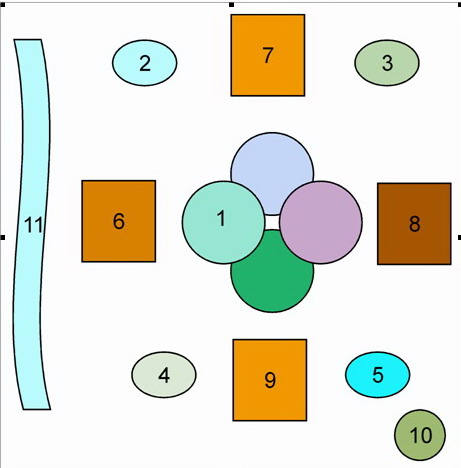
1. The Main Building: four overlapping hemispheres for offices of four faculties for 10,000 students. Also in this building: space for 1000 teachers in training (250 for each faculty). Also: approximately 80 to100 departments, with 20 to 25 for each of the four faculties, with approximately 12 to 14 teachers in each department. A ground level for central administration: Rector's office, four Dean's offices, entrance examination hall, and space for cafeteria, formal dining and other common services. 2. to 5. Four residence halls: three dormitories for 3000 to 4000 students, each, and housing for 2500 teachers and support personnel and their families, or approximately 5000 to 7000 persons. 6. A children's center for 1,000 children of employees and students, including secondary school, children's and school libraries, children's sports and entertainment center, kindergarten, a children's primary care clinic and emergency care hospital, and other attendant services. 7. A building for the Sports complex: covered stadium, practice fields, courts, pool, medical center with pharmacy and emergency care, training halls, fitness center, etc. 8. A Cultural Arts & Information Center: auditorium for 1500; cinema for 500; 20 to 30 rooms: capacity 75 to 100, for meetings, conferences, cultural events, prayer meetings or group meditations, library, theatre, internet-halls, studios for music, photography, and other artistic activities. 9. A Trading & Consumer Services Complex: hotels for 1500, restaurants for 1500, cafeterias, shops of all types, other consumer services. 10. A large wooded area or forest preserve, including nature areas and play grounds for children. 11. A river, lake or sea coast. 8.6.Architectural design. Nine buildings intended for training 11 thousand persons (10 thousand students and 1000 teachers in training), including residences and services for 15-18 thousand persons (together with teachers and support personnel), should be constructed in a uniform, harmonious style. The most adequate expression is the spatial sphere or hemisphere. The sphere (spherical) architectural design will be an appropriate architectural expression for the World Harmony/Peace Academies. 8.7. Ecological design of the WHPA Building Complex and adjacent areas. This Complex (Academic town) should be situated in an ecologically faultless (truly harmonious) place: in the suburb of a city, in a wooded zone near an extensive reservoir: a large lake, a river or a seacoast. The area of this Complex should be not less than two to four square kilometers, which should be equipped in accordance with all the rules of park zones that include natural forests and coastal areas. The exact area of this space will be determined by architectural design. 8.8. International recognition. The WHPA will find International recognition in due course, in the process of its development. The first action on a global scale could be arranging an International Conference of 2010, under the aegis of the United Nations, in preparation for a “Harmonious Peace Culture for Children in 2011-2020.” The Decade of the United Nations “Peace Culture for Children in 2000-2010” will end in 2010, and a question will arise as to a new Peace Decade for children. The offered Conference, carried out in Saint Petersburg on the basis of the WHPA, will advance the cultural and peaceful role of Russia and Saint Petersburg, and will showcase the WHPA as an educational development of international importance. Upon construction of the WHPA Complex, in a special ecological area by 2013, a second, similar World Conference could be offered on the new WHPA campus. Following this Conference, sponsorship of the WHPA under the aegis of the United Nations and UNESCO might be assured, including help with on-going financing, until WHPA can become self-supporting. The WHPA might also play a role in preparation and carrying out the Summit APEC in 2012 as “Summit of Eastern (or Eurasian) Harmony,” and winter Olympic Games in Sochi in 2014, providing a new sense of harmony in international sports with “The First Olympiad of Harmony.” 9. Stages of development and financing of the Academy (Using the example of Saint Petersburg, Russia. Note: 1$US is equal to about 25 Russian rubles) A project of such global importance and vast complexity cannot be realized quickly and in one stage. It is necessary to distinguish precisely the strategic purposes of WHPA submitted above, in stage-by-stage tasks for their realization. Three stages of the WHPA creation are in Saint Petersburg, and the fourth stage assumes its wide popularization in the nation, together with the introduction of a harmonious educational system world-wide. The last stages suppose mastering an Open University (distance training) by the Academy. 9.1. Stage 1: 2008-2009. The political decision to found the WHPA in Saint Petersburg: Include WHPA in the national project “Education” of Russia. Make an assessment by experts of the WHPA project. Register WHPA and headquarters “Global Harmony Association” in Saint Petersburg. Identify a geographic area and allocate sufficient funding for the first stage of the WHPA. The goal of WHPA during the first stage is to improve the qualifications of teachers of humanitarian disciplines in schools and universities throughout the city. Retrain teaching and scientific staff for WHPA. Carry out fundamental sociological research on the dynamics of naturally occurring “sphere social structures” of Russia, Kazakhstan, China, the European Union and the city of Saint Petersburg since 1950. Designate criteria for harmonious education in schools and universities. Cultivate new professions and specializations within each of the four spheres designed to strengthen their harmonious, cooperative interaction. Enhance sphere social structure of Academy faculties and their associated departments. Initiate affiliates of WHPA in Kazakhstan, China, Singapore and Europe. Approve the WHPA Building Complex for a suburb of Saint Petersburg. Publish manuals and materials for the academic disciplines of WHPA in a master edition, with translations for Russian schools and universities, and also for affiliates of WHPA elsewhere. Develop, register and patent educational technologies of harmonization. Create an educational TV-program “Harmonization of the individual,” and an interactive, discussion program: “Universal techniques of harmonization.” 9.2. Stage 2: 2010-2011. Approve standards and technologies of harmonious education for schools and universities. Evaluate new professions and specializations of harmonization for the various societal spheres. Create new departments to reflect these new developments. Admit 250 students for the first course of each of the four faculties of the Academy. Train 100 teachers for each affiliate of WHPA. Publish and sell information about, and educational technologies for, harmonization of naturally occurring social spheres in Russia and elsewhere. Construct the first stage of the WHPA Building Complex. Prepare the basics of harmonious education standards for Russian schools and universities. Sell harmonious education standards for foreign schools and universities. Form of new departments. Develop and publish new manuals. Initiate new affiliates of the WHPA. Obtain aegis and sponsorship of the United Nations and UNESCO. 9.3. Stage 3: 2012-2013. Complete construction of the WHPA Building Complex. Admit 500 students for the first course of each of four faculties of the Academy. Train and retrain 200 teachers for each affiliate of the Academy. Publish and sell information and educational technologies of harmonization in Russia and abroad. Initiate new Russian and foreign affiliates of WHPA. Develop and approve systems of harmonious elementary, secondary and higher education for Russia. 9.4. Stage 4: 2014 - 2024. Publicize WHPA at the Winter Olympic Games in Sochi, 2014, to provide a new sense of harmony in international sports with “The First Olympiad of Harmony.” Complete a system of harmonious education in Russia: advance and construct WHPA affiliates and schools of harmonious education throughout Russia. Realize a goal to advance and construct WHPA affiliates worldwide, like foreign construction of the atomic power stations: the cost of construction and professional training of one WHPA affiliate is less than the cost of constructing one block of an atomic power station. Continue to train domestic and foreign staff in the St. Petersburg WHPA for affiliates in other countries. During the last two stages (2012-2015) master Open University (distance learning) by WHPA. 9.5. WHPA Departments and Divisions during the first stage: 2008-2009 WHPA’s Eight Departments in 2008-2009: 1. Harmonious peace culture and tolerance (Faculty of Infosphere harmony) 2. Social harmony theory (Faculty of Sociosphere harmony) 3. Individual harmony theory (Faculty of Sociosphere harmony) 4. World culture and history of harmony (Faculty of Infosphere harmony) 5. Tetrasociology (Faculty of Infosphere harmony) 6. Linguistic Department. International bilingualism: Esperanto and English: plus Russian (Faculty of Infosphere harmony) 7. Acting technique for harmonization of behavior (Faculty of Sociosphere harmony) 8. Psychological harmonization (Faculty of Sociosphere harmony) 9.6. Department tasks: A. Raise the level of one's skill (or retraining) of social science teachers of secondary schools and colleges in teaching all cycles of this discipline on the basis of a profile department, from 2008 B. Raise the level of one's skill (or retraining) of humanitarian discipline teachers (philosophy, sociology, history, psychology, etc.) of universities in teaching all humanitarian cycles of the higher school on the basis of a profile department, from 2008 C. Train secondary schools and college teachers, and also the higher school teachers on appropriate department, from 2009 D. Research work on disciplines of appropriate department, from 2009. E. Defense of masters and doctors degree thesis on disciplines of appropriate department, from 2010 F. Make an income from pedagogical and scientific activity for development of department and Academy, from 2010. 9.7. Note. Together with the beginning of WHPA foundation, insert for educational schools two new humanitarian disciplines: “Harmonious peace culture and tolerance” and “Social and individual harmonization” for 2 hours per week everyone for a half-year at the expense of reduction of time for other disciplines or as elective. Put a half-yearly retraining of humanitarian disciplines teachers on the basis of WHPA for providing these disciplines with teachers. 9.8. WHPA 7 Divisions on 2008-2009: 1st Division: Educational department: raising the level of one's skill of schools and universities teachers. Tasks: А. 2008. Half-yearly raising the level of one's skill of schools and universities teachers in teaching all cycle of social science disciplines on basis of WHPA disciplines; 2008, since September, 160 teachers, 8 groups of 20 persons: 320 teachers for the year. B. 2009. Half-yearly raising the level of one's skill of schools and universities teachers in all cycle social science disciplines on basis of WHPA disciplines; 2009, since September, 320 teachers, 16 groups on 20 persons: 640 teachers for the year. C. Make an income from improvement of professional skill of schools and universities teachers. 2nd Division: Projection, production and realization of harmonizing informational technology‘s products Tasks: A. Project, mass produce and realize a software product “Individual: harmonization of individual development, age 17 to 25 years;” 2008-2009. B. Project, mass produce and realize other software products of harmonization for different ages (10 to 80 years) and for various spheres and purposes: economy, management, policy, law, international relations, culture, science, social science, education, health, family, individual development: since 2010. C. Service and develop the WHPA information portal “Peace from Harmony” and its adaptation for educational process and distance learning; since 2008 D. Make an income from realization of mass software products of harmonizing informational technology and use this income for development of WHPA and also for investment of “Global Harmony Association” and children's preschool and school establishments; since 2010 3rd Division: Academic Publishing house "Harmony" Tasks: A. Publish a mass edition on the subject “Harmonious Peace Culture” for libraries of schools, colleges and universities, first at Saint Petersburg, and then throughout Russia, with the following names of brochures: “Magna Carta of Harmony for information civilization;” “Harmonious Era Calendar;” “Global Harmony Association: a way of a harmonious civil society’s development” and others; since 2008 B. Publish a mass edition of books, textbooks and brochures on all departments and disciplines of WHPA; since 2008 C. Finance the WHPA development and investment of “Global Harmony Association” and children's preschool and school establishments; since 2010 4th Division: the International communications and investment Tasks: A. Attract foreign students for study in WHPA and foreign teachers for regular or temporary work in the Academy; since 2008 B. Search and register applications for receiving large educational grants (from tens of thousands up to several $US millions) from powerful international funds: Bill and Melinda Gates,’ Rockefeller’s, European Union, UNESCO and others. C. Search and register foreign, private investments for further development of WHPA. D. Organize and carry out large international conferences on themes of WHPA; first of all, on preparation and carrying out the International Conference “Harmonious Peace Culture for children of the world for a decade of the United Nations since 2011 to 2020” in 2010, under the aegis of the United Nations, UNESCO and UNICEF. E. Introduce WHPA affiliates on all continents, and present its standard projects as educational “know-how” for less than world market prices, since 2010. F. Finance development of WHPA and also investment of “Global Harmony Association” and children's preschool and school establishments from incomes of the international activity; since 2009 5th Division: Economic, Financial & Legal administration: Maintenance department, Accounts department, Personnel department, Legal department Tasks: A. Personnel, economic, financial and legal maintenance of WHPA; since 2008 6th Division: the Global Harmony Association (GHA) Board; Tasks: A. Register the Statutes and maintenance of GHA activity in accordance with its Statutes; since 2008 B. GHA Board activity on advertising of WHPA, on attracting to it the most capable students and teachers from all over the world, on searching for international educational grants and on nomination of the most prestigious world awards; since 2008 7th Division: The Organization of designing and construction of the WHPA Building Complex; Tasks: A. Work out a business-project to design and construct the WHPA Building Complex; since 2008 B. Create an architectural draft of the WHPA Building Complex; since 2008 C. Search the design organization for working out the WHPA Building Complex project; since 2008 D. Determine budget cost and terms of the WHPA Building Complex construction; since 2009 E. Find sources of financing to design and construct the WHPA Building Complex; since 2008 F. Hire a building organization. Begin construction of the WHPA Building Complex; since 2009 9.9. Necessary minimal financing (budget) for WHPA in 2008: 1. The salary of teachers and employees of 15 initial departments and divisions of WHPA for an average number of 5 persons with average monthly payment of 15 thousand rubles = 5х15х15х12 = 13 500 000 rubles (thirteen millions five hundred thousand rubles a year). (15 000 rubles a month is the starting average salary which will constantly grow after 2009, when the Academy will start to make its own income from its activities). 2. The salary of support personnel: laboratory assistants, secretaries, security, cleaning, etc.: 25 persons with average monthly payment of 10 thousand rubles = 25х10х12 = 3 million rubles. 3. The equipment: furniture, office goods, computers (51 units) and a communication facilities (phone, fax, copier) on 15 rooms = 7,000,000 (seven million rubles) Financing designing of the WHPA Building Complex: 15 million rubles. TOTAL WHPA BUDGET FOR 2008: 38.5 million rubles. Necessary minimal financing (budget) for WHPA in 2009: 38.5 million rubles. TOTAL WHPA BUDGET FOR 2 years: 77 million rubles = $3 million. 9.10. OFFICE AND CLASS ROOMS for 2008-2009: 1.15 Office rooms for 15 initial departments and divisions of WHPA of 30 sq. m. = 450 sq. m. 2.4 lecture rooms for 80 students of 120 sq. m. = 480 sq. m. 3.16 seminar rooms for 20 persons: 30 sq. m. = 480 sq. m. TOTAL ROOMS FOR 2008-2009: 1410 sq. m. 9.11. Financing stages of the Academy: During the WHPA formative stage in 2008-2013, its greatest financial support is required, first of all for financing, designing and constructing the WHPA Building Complex. In rough estimates, the total amount of investment in construction of the WHPA Building Complex will take 12-25 billion rubles over 6 years. As to self-support of educational, scientific, publishing and international activity of the Academy, it can be achieved in two, a maximum of three years. In two to three years, WHPA will start to make a profit, which will be investment in further development. The variant excluding the WHPA Building Complex construction is possible, then cost of the WHPA project can decrease by 10-5 times: up to $US 100 to 200 million. It is necessary to have 23.5 million rubles for starting the project of WHPA and about 15 million rubles in 2008-2009 for its design: for working out the business-project, for registration and allocation of rooms in an area of 2-4 sq. km. in a Saint Petersburg suburb, for construction of the WHPA Building Complex. ALL FINANCING for 2 YEARS is 77 million rubles. It is possible to cover these costs from the national project of “Education,” off-budget funds of the President and the Government of Russia, the Governor of Saint Petersburg, from means of the Program “Tolerance” partly and also from means of large private sponsors. Probably certain investment from large international funds: Bill and Melinda Gates, Ford, Rockefeller, etc. and from the Governments of rich countries: Norway, Arab Emirates, European Union and others. Financing following stages of WHPA will be planned for 1-2 years from their beginning. 9.12. The common question: what is it better to spend money on? As informed by Dr. Valery Gergel, Moscow alone spends annually more than 20 billion rubles for liquidation the consequences of youth vandalism. It is more than 80% of the cost of WHPA for six years. What is it better to spend this money on? Isn’t it more expedient to use for funding WHPA and a harmonious education in Moscow to eliminate vandalism altogether, and avoid throwing money into the wind? 10. GHA organizations list, potentially capable to participate in the Academy creation The Global Harmony Association (GHA) unites over 25 international and domestic organizations, which are presented on the site “Peace from Harmony.” Authors of this site, including heads of these organizations, became the GHA founders. The WHPA is one of the highest priority projects of GHA. From 25 organizations the following are capable to participate in the WHPA project. We invite these organizations officially and publicly to announce affiliation with GHA and its main project (WHPA). This list is not full and final: any nongovernmental organization, sharing the idea of a harmonious education to rescue humankind and establish global peace may join the WHPA project. The initial list: 10.1. Organizations from Russia: - The international site "A New Culture of Peace from Social Harmony and Children's Priority", it is brief: «Peace from harmony» (http://www.peacefromharmony.org), opened on February, 15, 2005. Now it unites more than 250 authors: scientists, writers, artists, peacemakers from 42 countries of all continents of the world and is published in 17 languages. Its founder and director is the social philosopher and sociologist Dr. Leo Semashko from Saint Petersburg, director of Public Institute of Tetrasociology. Headquarters: Saint Petersburg.
- Association «Russian world». It is founded in 2003. Headquarters: Saint Petersburg. Covers Russian abroad. The co-chairman - coordinator of Association is Dr. Dmitry Ivashintsov: a member of the GHA (http://www.peacefromharmony.org/?cat=ru_c&key=23).
- Movement of young peacemakers. It has received the beginning in 1995г. Covers tens schools of Russia and thousand learning high schools. Headquarters: Moscow. The head of movement is Ph.D. Valery Gergel - a member of the GHA (http://www.peacefromharmony.org/?cat=ru_c&key=337).
- Petersburg Club "Paradise". It is created in 1980. Unites hundreds representatives of creative intellectuals and is «the Petersburg island of Russia harmony». Headquarters: Petersburg. Chairman of this Club is the journalist Natalia Sidorova, a member of GHA Advisory Committee (http://www.peacefromharmony.org/?cat=ru_c&key=41).
- The international movement «Education for Life » and the international project «Planet 3000». Initiator Talgat Akbashev is a member of GHA, Ufa
- Noncommercial Partnership «Siberian Center of the Euroasian Projects». President Nina Goncharova is a member of GHA, Novosibirsk
10.2.Foreign organizations: - Universal Esperanto Association (http://www.uea.org/). It is created in 1908, has national associations in 62 countries of the world, and individual members in 113 countries. The number of members exceeds some millions. Headquarters: Rotterdam, Holland. The UEA President is Dr. Renato Corsetti. He is the GHA Chair of Honorary Advisory Committee (http://www.peacefromharmony.org/?cat=en_c&key=97).
- International Association of Educators for World Peace (IAEWP) (http://www.iaewp.org). It is founded in 1970. It has the branches in more than 80 countries of the world, uniting more than 50 thousand members. Headquarters: USA, Alabama, Huntsville. The IAEWP President is Dr. Charles Mercieca, he is a member of GHA Board (http://www.peacefromharmony.org/?cat=en_c&key=129). Note. IAEWP officially has joined Global Harmony Association in February 2008. The basic subject of cooperation is the World Harmony Academy (http://www.peacefromharmony.org/?cat=en_c&key=316)
- Intercultural Open University (IOU) (http://www.iouedu.com). It is founded in 1981г. It has about 50 affiliated faculties and the connected institutes in 17 countries of the world in which it is trained about 10 thousand students. Headquarters: Opind, Holland. The IOU Founder and is Prof. dr. Jan. R. Hakemulder. H is a member of GHA (http://www.peacefromharmony.org/?cat=en_c&key=297).
- The international scientific seminars «Future of Religion» in Croatia, Dubrovnik University, since 1976 and «Religion and Civil Society» in Yalta, Crimea, Ukraine, since 1999 (http://www.rudolfjsiebert.org). These seminars cover some hundreds researchers of all world religions from many countries. The Founder and Head of the Seminars is Dr., Professor of Western Michigan University, Kalamazoo, Michigan, USA, Rudolf Siebert. He is the GHA member of Advisory Committee (http://www.peacefromharmony.org/?cat=en_c&key=51).
- The International organization «Globalization for the Common Good» (http://www.globalisationforthecommongood.info/). It is created in 2003. It covers thousand scientists and experts in the field of globalization. It carried out six international conferences on this theme worldwide. Headquarters: Oxford, England. The President is Dr. Kamran Mofid, he is the GHA member of Advisory Committee (http://www.peacefromharmony.org/?cat=en_c&key=300).
- Association of World Citizens (AWC) (http://www.worldcitizens.org/). It is created in 1975. It has the branches in 50 countries of the world. Headquarters: San Francisco, USA. The AWC President is Douglas Mattern. He isthe co-author of the site «Peace from Harmony» (http://www.peacefromharmony.org/?cat=en_c&key=284).
- Federation of World Peace and Love (FWPL) (http://fowpal.org). It is created in 2000, includes members from 73 countries. Headquarters: San Jose, California, USA. Dr. Hong Tao-Tze is the FWPL President. He is the co-author of the site «Peace from Harmony»
(http://www.peacefromharmony.org/?cat=en_c&key=298 ). Other international and national organizations also will take part in the WHA project. Association in GHA of listed and other organizations, their personnel, intellectual, information, organizational and other resources for creation of the first WHA will allow to realize successfully this enormous, the world importance project. 11. The lecture courses offered by the WHA project authors We invite the project authors to formulate the titles of your lecture courses in the WHA in accordance with its structure. The first and approximate themes of lecture courses are submitted below. 11.1.The lecture courses offered by the WHA project authors within the framework of 16-90 hours (since January, 10 2008) 1.Leo Semashko, Russia 1.Theory of social harmony and harmonization of social institutions 2.Theory of individual harmony and harmonization of the person 3.Harmonious education and harmonization of education (tetraeducation) 4.Harmonization of unity of four spheres, markets and classes by social resources and technologies. 5.Culture of harmonious peace and tolerance 6.Philosophy of harmony and harmonization 7.Dialectic modeling harmony and harmonization; harmony of dialectic modeling 8.Tetrasociology: the scientific theory and sociology of harmony of an information society 9.Tetrasociological researches 10.History and importance of the site «Peace from harmony» 11.«Magna Carta of Harmony»: contents and importance 12.«Harmonious Era Calendar»: contents, importance and development 13.Spherical statistics of harmonization (tetrastatistics) 14.Harmonizing information technologies for youth of 10-25 years 15.Harmonization of unity of four spheres, markets and classes by information resources and technologies 16.Theory of the harmonizing and harmonious organizations (tetraorganizations) 17.Harmonization of democracy (tetrademocracy) 18.Children's suffrage 19.Political harmonization (tetrapolitics and tetrapolitical science) 20.Governmental and parliamentary harmonization (tetragovernment, tetraparliament) 21.Management harmonization (tetramanagement) 22.Global Harmony Association: importance for social harmonization 23.Building of social - political “sobornost” (harmony) in Russia 24.Specificity of transition to social harmony of different groups of the countries 25.Harmonization of unity of four spheres, markets and classes by organizational resources and technologies. 26.Economic harmonization (tetraeconomics) 27.Marketing harmonization (tetramarketing) 28.Harmonization of unity of four spheres, markets and classes by economic resources and technologies. 2.Alexander Olshansky, Russia Belles-lettres and Harmony. 3.Vladimir Kavtorin, Russia Forming and harmonizing national mentalities, history of interethnicconflicts and methods of their solution. 4.Charles Mercieca, USA Here are some topics which the Harmony Academy Project could develop and I could conduct: 1.China in True Perspective: Transition into a Society of Social Harmony 2.Islands of Peace: Hope to World Stability 3.Coalition of Peaceful Nations: Their Strengths and Assets to the World 4.Crisis in Western Civilization: Absence of Moral Leadership 5.Importance of NGOs: Their Role in the World 6.Children's Human Rights: Analysis and Recognition 7.United Nations Goals for the new Millennium 8.Changing the Role of the Military: Absolute Condition for World Peace 9.Important Role of Senior Citizens in Society 10.Meaning and Purpose of Terrorism: How to Deal with It 11.Role of Diplomats in a 21st Century Society 12.Perspective of Peace Idea in History Each of the above could be developed as a course. They inter-relate but they do not overlap. It's up to you now to make up your mind as to what you really want to see in the Harmony Academy Project. Of course, I can always develop a course on any topic you may wish to propose. Keep up the good work. January 31, 2008 5.Talgat Akbashev, Russia Person from future through a harmonious way 6.Alexander Juriev, Russia Harmonization of political psychology and political psychology of harmony 7.Tamara Trushnikova, Russia System linguistics and language harmonization. 8.Henry Skvortsov, Russia System paradigm: problems, education, harmonization. 9.Konstantin Cheremnykh, Russia Political system harmonization. 10.Abram Yusfin, Russia Harmony of music, society and person. 11.Nina Goncharova, Russia Harmonious world through culture. 12.Nikolay Strelkov, Russia History and importance of the first youth club of harmonious development "Demiurge" (1976-1980) in St.-Petersburg on a basis of tetrasociology 13.Svetlana Vetrova, Russia System of harmonious development of the preschool children in St.-Petersburg: experience of 1985-2002 14.Andrei Smirnov, Russia Modules of harmonious development in business games and teaching in Novgorod: experience 1980-2007 years System of registration for time expenditures of the human and its importance for harmonious development of the person: experience 1976-2007 years 15.Ernesto Kahan, Israel Tolerance. A way to Harmony Humanism in the interaction between science and Art Threat of nuclear war. A threat to human civilization 16.Ada Aharoni, Israel The development of a new harmonious Peace Culture theory and activity throughout IFLAC History. The essential role of an innovative harmonious education, for all ages, through Literature, Culture an Art, and through the Global Television for Peace Culture (PCTV) 17.RudolfSiebert, USA Golden Rule and Peace among the World Religions 18.Maria Cristina Azcona, Argentina Guide to find peace and harmony 19.Reimon Bachica, Japan Religious harmonization The harmonious values and symbols of an information society 20.Bernard Scott, England The Sociocybernetics of harmony 21.Guy Crequie, France Philosophy of peace and harmony in a history of world culture 22.Ammar Banni, Algeria Ideas of harmony and peace in Islamic culture and religion 23.Martha Ross DeWitt, USA Harmony, cultural diversity and power sharing: Involving all population groups in the search for peaceful solutions to global problems 24.Jean Basabose, Rwanda African culture of harmony and its importance for overcoming of genocide and xenophobia 25.Nina Meyerhof, USA Role of children in creation of global harmonious peace 26.Rose Lord, USA Gardening technique as the tool for harmonization of human environment Ways of obliteration of hunger as the first step to peace and harmony Importance of the mothers in education of harmonious peace culture in family 27.Renato Corsetti, Italy International bilingualism of Esperanto and English International language Esperanto and its impact in the international relations 28.Tholana Chakravarthy, India The Indian culture of harmony and its expression in poetry, literature and art of India 29.Muhammad Iqbal, Pakistan Moslem culture of harmony and its expression in poetry and art of Pakistan 30.David Allen Stringer, England The key ideas of peace and harmony in a history of the Universal Alliance 31.Robert M. Weir, USA Ideas of peace and harmony in the USA education and policy 32.Susana Roberts, Argentina The Argentina poetry of peace and harmony for educational process 33.Rosa Dalmiglio, Italy Chinese Culture for peace and harmony in art of the disabled people 34.Kae Morii, Japan The Japanese poetry of peace and harmony 35.Ghassan Abdallah, Palestine History of the CARE educational efforts for an establishment ofpeaceandharmony between Palestine and Israel 36.Tatomir Ion-Marius, Romania The universal ideal of peace: reality of tomorrow 37.Ivan Ivanov, Russia History of origin and development of the Website "Peace from Harmony": questions of design, administration and progress 38.Alexei Shepel, Russia History of harmonious societies in Western Europe 39.Sergey Busov, Russia Synergetics of social harmony 40.Maitreyee Bardhan Roy, India Ways of transition from slums to social harmony in India 41.Helene F. Klingberg, Norway Media-communication and poetry for peace- with a special reference to youth and children 42.Will Hoonaard, Canada Bahai's faith about world harmony and unity of humankind 43.Stephen Gill, Canada Harmonization of the children and youth through poetry 44.Mona Gamal-El Dina, France Harmonization of the children and youth through art 45.John W. Forje, Cameroon African culture of harmony and peace 46.Jiang Yimin, China Chinese culture of harmony and its reflection in educational process 47.Matjaž Mulej, Slovenia Social harmony in a light of the systems theory 48.Ananta Giri, India Spiritual Cultivation and SocialHarmonyin Culture of India 49.Dimitris P. Kraniotis, Greece Harmonization of the children and youth through poetry 50.Takis Ioannides, Greece Aeschylus as the father of Ancient Greek Theater and his contribution to the social harmony 51. Tatiana Tselutina, Russia Optimization of interaction of the sphere classes and bodies of authority in modern Russian practice of management
52. Prof. Patricia Rife, Ph.D., USA Masters Degree Programs: Project Management and E-Business (since 27/08/08)
53. Dr. Lana Yang, USA:
Culture of Peace and Cost of War (since 10/12/08) 54. Dr. Laj Utreja, USA:
Vedic Principles of Harmonious Living for Peace Education (since 10/12/08)
55. Leonid Beluy. Ukraine: Culture as the factor of harmonization of inward world of the person and formation of multidimensional aesthetic vision (since 02/02/09)
11.2.Objective preconditions and scientific requirements of the WHPA lectures 1. The basic precondition for creation of the WHPA lectures is tetra-sociology. It is a new social science, which studies the evidence of a natural harmony of society and man. This harmony is completely determined by natural interacting spheres of society and man and also by sphere classes of the population, for humankind as a whole, and for every country and community. All lectures are to focus on the dynamics of social and/or individual harmony achieved within functional spheres and operating sphere classes. Each lecture will introduce an aspect of social and/or individual harmony, including: a brief history of its study by other disciplines, and/or: evidence of its natural achievement within the unique, four sphere framework of tetra-sociology. It is necessary to keep in mind that the WHPA lecture contents depend on and are defined by "interdependent spheres" as the basis for practical insights of tetra-sociology, universal for all of humankind, identifiable as scientific evidence of a "deep structure" that supports social and individual harmony in all of its infinite variations. 2. The main requirement of the WHPA lectures is to inform and teach students about the natural foundation for social and individual harmony discovered in the science of tetra-sociology. The topic of a lecture can be any aspect of harmony or its application, and may be offered during the course of any activity or at any institute of learning. The key role of tetra-sociology in lectures does not exclude, but assumes the relevance of, all approaches and knowledge that have not specifically rejected the premises of tetra-sociology. The measure and form of tetra-sociology selected for use in each lecture is defined by each lecturer individually and is his or her exclusive right, consistent with the policy of freedom of speech in teaching. 3. All lectures in the WHPA series will be paid, however, the details of payment can be known only when funding is secured, i.e. in 6 to 12 months, if it can be approved by then. Therefore time for preparation of the WHPA lecture courses is about one year. 4. The WHPA does not require the texts of lectures and does not include them in the project. However, each teacher can prepare a syllabus for the lecture course for the manual for WHPA students and publish it in the publishing house of the Academy. 5. For preparation of lectures it is enough for the lecturer to have the program of his/her lecture course summarized in two to four pages, with a brief, maximum one page statement of each individual lecture. 6. The ideal length of a lecture course is from 16 to 60 academic hours, though it can be more: up to 90 or 180 hours. Note. Requirements will be developed, complemented and updated further as a special document, to be approved by the WHPA Social Science Council. 28/04/08
12. Bibliography and websites The WHA project authors could add the bibliography list by your works or the most important works of other authors and the websites list. 12.1.Bibliography 1.Anthology of world philosophy. In four volumes. Moscow, 1969 - 1972 2.ErasmusDesidetius, Querellapacis. DesideriiErasmiRoterodamiOperaOmnia, t.IV, 1703 3.Kant I., Zum ewigen Frieden, Leipzig, 1954 4.Bentham L., Principles of InternationalLaw. Works, v.2, 1843 5.Comenius J.A., The Angel of Peace. N-Y, 1945 6.Penn W., The Peace of Europe and other Writings, N-Y, L, 1916 7.Rousseau J.J.,Jugement sur la paix perpetuelle. Collection..., t.23, Geneve, 1782 8.Saint-Simon C.H., De la reorganisation de la Societe europeenne oeuvres, t.15(1), Paris, 1865 9.Friedrich C., Inevitable Peace. Cambridge Mass., 1948 10.Raumer K., Ewiger Friede, F-M, 1953 11.Souleyman K. V., The Vision of World Peace in 17 and 18 Century France, N-Y, 1941 12.UN Convention on the Rights of the Child // http://www.ohchr.org/english/law/pdf/crc.pdf 13.Magna Carta of Harmony for an Information Civilization: Toward Social Justice and Global Peace (2007), by 43 coauthors from 16 countries in 7 languages, St.-Petersburg, Lita, http://peacefromharmony.org/?cat=en_c&key=3 14.Harmonious Era Calendar: Address to Children, Youth and Future Generations (2006), by 27 coauthors from 12 countries in 12 languages, St.-Petersburg State Polytechnic University, http://www.peacefromharmony.org/?cat=ru_c&key=190 15.Ada Aharoni (2004). The Necessity of a New Multicultural Peace Culture. http://www.peacefromharmony.org/?cat=en_c&key=73 16.Ada Aharoni (2006). Peace Poemsa trilingual edition: Arabic, Hebrew and English (3rd edition).www.iflac.com , www.iflac.com/ada, 17.Ada Aharoni (2005). Women Creating A World Beyond War And Violence. www.iflac.com , www.iflac.com/ada, 18.Ada Aharoni (2004).You and I Can Change the World. www.iflac.com , www.iflac.com/ada, 19.IFLAC PAVE PEACE AnthologiesGALIM - WAVES - Volumes 1 to 10. www.iflac.com , www.iflac.com/ada, 20.Jeffrey Alexander, (2003). The Meanings of Social Life. A Cultural Sociology. Oxford University Press 21.Reimon Bachika (2002), Editor. Traditional Religion & Culture in a New Era. Transaction Publisher 22.Reimon Bachika (2003) Tetrasociology andValues. In: Semashko L. Tetrasociology: from Sociological Imagination through Dialogue to Universal Values and Harmony. St.-Petersburg State Polytechnical University, p.191-195. http://www.peacefromharmony.org/?cat=en_c&key=154 23.Clark Bowers (1993).Education, Cultural Myths, and the Ecological Crisis.Albany, NY 24.Fritiof Capra (2003). The Hidden Connections. A Science for Sustainable Jiving. Flamingo, London 25.Craig Calhoun (2003). Critical Social Theory. Culture, History, and the Challenge of Difference. Blackwell Publisher, USA 26.David Cook (2006). Bill Clinton, George Bush and Craig Scott Nation's Leaders Mislead Youth by Preaching Peace, Practicing War. CommonDreams.org 27.Martha Ross DeWitt (2003). Power sharing of sphere classes as an alternative to armed conflict. http://www.peacefromharmony.org/?cat=en_c&key=156 28.Martha DeWitt (2007). Review of Leo Semashko’s three books on Tetrasociology in the Journal: International Sociology. Reviews of books. Volume 22, # 2, March 2007, http://www.peacefromharmony.org/?cat=en_c&key=15 29.Paulo Friere (1970). Pedagogy of the Oppressed. New York 30.Valerie Isaev (2003). Tetrasociology and socionics: Foundations for harmonious teams of dialog. http://www.peacefromharmony.org/?cat=en_c&key=158 31.Harris, I. & M. Morrison (2003). Peace Education (2nd. Edition) Jefferson, North Carolina: McFarland & Co 32.Derek Heater (1984).Peace through Education.London: Falmer Press 33.Karl Hinrichs(2002). Do the old exploit the young? If so is enfranchising children a good idea?, in: Archieves Europeénnes de sociologie 43, no 1, p.35-58 34.Bernd Hornung and Bernard Scott (2003). Tetrasociology and sociocybernetics. http://www.peacefromharmony.org/?cat=en_c&key=160 35.Evelin Lindner (2006). Making Enemies Unwittingly: Humiliation and International Conflict. Westport, CT: Praeger Publishers 36.Evelin Lindner (2006). A New Culture of Peace: Can We Hope That Global Society Will Enter Into a Harmonious Information Age? http://www.peacefromharmony.org/?cat=en_c&key=74 37.Bernard Phillips (2003). Toward a new Age of Enlightenment. Tetrasociology and Web Approach. http://www.peacefromharmony.org/?cat=en_c&key=153 38.Terrence E. Paupp (2007). Exodus from Empire. The Fall of America’s Empire and the Rise of the Global Community. Pluto Press, London 39.Rudolf Siebert (1995). Kant, Hegel and Habermas: on War and Peace. Ioannina, Greece: Philosophike Schole Panepistemiou Ioanninon 40.Rudolf J. Siebert (2002). From Critical Theory to Critical Political Theology. Personal Autonomy and Universal Solidarity. Peter Lang Publishing, New York 41.Rudolf J. Siebert (2004). Religion:… Jus Talionis – or the Golden Rule? http://www.peacefromharmony.org/?cat=en_c&key=51 42.Rudolf J. Siebert (2006). The Critical Theory of Religion: From Religious Orthodoxy through Mysticism to Secular Enlightenment and Beyond: The totally Other and the Rescue of the Hopeless. Leiden: Brill Academic Publishers 43.Rudolf J. Siebert (2006). Lex Talionis: Religion, force et terreur.France: Abjat Sur Bandiat 44.Robert Weir (2006). A People’s Campaign for Peace in the United States. http://peacefromharmony.org/?cat=en_c&key=239 45.Maria Cristina Azcona(2008).A Guide to find peace. Cyberwit, India Johan Galtung: 46.Transcend and Transform (Pluto Press, 2004), Searching for Peace the Road to TRANSCEND (Pluto, 2000 & 2002), 47.Conflict Transformation by Peaceful Means: The TRANSCEND Approach (UNDP 2000). Peace by Peaceful Means: Peace and Conflict, Development and Civilization.(Sage, 1996) 48.Grasping Peace for the 21st Century, Johan Galtung's Theory of Peace Akifumi Fujita, ed, Kyoto: Horitsu-bunkasha 2003, 220 pp. Ervin Laszlo: 49.Science and the Reenchantment of the Cosmos : The Rise of the Integral Vision of Reality (Inner Traditions, 2006) 50.Science and the Akashic Field: An Integral Theory of Everything (Inner Traditions International, 2004) 51.You Can Change the World: The Global Citizen's Handbook for Living on Planet Earth: A Report of the Club of Budapest (Select Books, 2003) 52.Evolution: The General Theory (Hampton Press, 1996) 53.The Systems View of the World: A Holistic Vision for Our Time (Hampton Press, 1996) 54.Daisaku Ikeda with Joseph Rotblat, A Quest for Global Peace:
Rotblat and Ikeda on War, Ethics and the Nuclear Threat; I. B. Tauris & Co. Ltd., 2007 55.The "Declaration Toward a Global Ethic" from the Parliament of the World's Religions (1993) proclaimed the Golden Rule (both in negative and positive form) as the common principle for many religions. The Initial Declaration was signed by 143 leaders from different faith traditions and spiritual communities. http://en.wikipedia.org/wiki/Ethic_of_reciprocity; http://en.wikipedia.org/wiki/Parliament_of_the_World%E2%80%99s_Religions 56.Sara Zamir and Ada Aharoni (2008). The Voice of Peace in the Process of Education, Achva Academic College of Education, Israel; http://www.iflac.com/ada/books.html#peace_edu 57.Leo Semashko. Interview to Russian newspaper “Evening Petersburg” March 14, 2008: The scientist - sociologist created the theory of a survival and harmony for humankind: http://www.vppress.ru/news/2008/03/14/33/ Leo Semashko’s books: 2007. Magna Carta of Harmony for an Information Civilization: Toward Social Justice and Global Peace, with 42 coauthors from 16 countries in 7 languages, Lita, 228 p. http://www.peacefromharmony.org/?cat=en_c&key=3 2006. Harmonious Era Calendar: Address to Children, Youth and Future Generations, by 27 coauthors from 12 countries in 12 languages, St.-Petersburg State Polytechnic University http://www.peacefromharmony.org/?cat=ru_c&key=190 2004. Children’s Suffrage: Democracy for the 21st Century, Priority Investment in Human Capital as a Way toward Social Harmony, St.-Petersburg State Polytechnic University
http://www.peacefromharmony.org/?cat=en_c&key=211 2003.Tetrasociology: from Sociological Imagination through Dialogue to Universal Values and Harmony, by 14 co-authors, in three languages: Russian, English and Esperanto. St.-Petersburg State Polytechnic University. http://www.peacefromharmony.org/?cat=en_c&key=149 2002. Tetrasociology: Responses to Challenges. St.-Petersburg State Polytechnic University (in Russian and English). http://www.peacefromharmony.org/?cat=en_c&key=145 2000. Tetrasociology as the Revolution of Social Thinking, the Way of Harmony and Prosperity. St.-Petersburg (in Russian) 1999. Sociology for Pragmatists. Textbook for university students. Part 1, St.-Petersburg(in Russian) 1992. Sphere Approach: Philosophy, Democracy, Market and Human. St.-Petersburg(in Russian) 12.2.Websites A New Culture of Peace from Social Harmony and Children’s Priority www.peacefromharmony.org . Aharoni, Ada: www.iflac.com , www.iflac.com/ada,and www.groups.yahoo.com/group/IFLAC; http://www.peacefromharmony.org/?cat=en_c&key=2, Akbashev, Talgat:http://worldwithoutborders.site.voila.fr , http://Planet3000.site.voila.fr Azcona, Maria Cristina:www.azcona.bravehost.com, www.bilingualmca.bravehost.com, www.iflacenarg.bravehost.com Bachika, Reimon: http://www.peacefromharmony.spb.ru/?cat=en_c&key=24 Becker, Harold: www.thelovefoundation.com; http://www.peacefromharmony.org/?cat=en_c&key=100 Corsetti, Renato: http://www.peacefromharmony.org/?cat=en_c&key=97 Crequie, Guy: http://guycrequie.blogspot.com, http://www.peacefromharmony.org/?cat=en_c&key=106 DeWitt, Martha Ross: http://www.peacefromharmony.org/?cat=en_c&key=58 Goncharova, Nina: http://worldwithoutborders.site.voila.fr, http://Planet3000.site.voila.fr, http://happypeopleplanet.site.voila.fr, http://www.peacefromharmony.org/?cat=en_c&key=139 Ioannides, Takis: http://clubs.pathfinder.gr/LOVEandPEACE ; http://www.peacefromharmony.org/?cat=en_c&key=104 Ivashintsov, Dimitry: http://www.russkyformat.ru/; info@russkyformat.ru; http://www.peacefromharmony.org/?cat=en_c&key=23 Lindner, Evelin: www.humiliationstudies.org/ ; http://www.peacefromharmony.org/?cat=en_c&key=74 Lord, Rose:www.globalcoalitionforpeace.net/wsrp;rose@food4peace.com ; http://www.peacefromharmony.org/?cat=en_c&key=16 McConnell, John: www.earthsite.org,www.wowzone.com ; http://peacefromharmony.org/?cat=en_c&key=136 , Phillips, Bernard: www.uab.edu/philosophy/sig; http://www.peacefromharmony.org/?cat=en_c&key=79 Roy, Maitreyee Bardhan: http://www.peacefromharmony.org/?cat=en_c&key=116 Roy, Subir Bardhan: Dr. http://www.peacefromharmony.org/?cat=en_c&key=116 Scott, Bernard: http://www.peacefromharmony.org/?cat=en_c&key=64 Siebert, Rudolf: http://www.peacefromharmony.org/?cat=en_c&key=51 Veziau, Claude:http://troubadourdevie.site.voila.fr . www.world-harmony.com, http://WorldHarmonyNetwork.site.voila.fr ; http://worldwithoutborders.site.voila.fr Jagdish Gandhi:http://www.jagdishgandhi.org/index.html
13. Some responses and variants of the WHPA project realization (The following responses were addressed to Leo Semashko primarily and/or to all. These addresses were excluded in the most cases for economy of space.) The letter on the World Harmony Academy is good and arrives at a good time. The interethnic frictions ripen in connection with an increase of flow of immigrants to Russia from the countries of the CIS. I am ready it to support ….. Dr. Valery Gergel Peace Museum Director, Moscow, Russia 14/12/07 ------------------------------------- An invitation to discuss the Harmony Academy project is a large honour for me, and I am ready to accept feasible participation in it. In my opinion, the idea of the Harmony Academy creation carries in itself a positive charge capable of giving an impulse to formation and development of a harmony culture and harmonization of mutual relations as a whole. Konstantin Cheremnykh Economist, St.-Petersburg, Russia 16/12/07 -------------------------------------- On the Academy idea I notice that it is more logical to form it on the accepted current algorithms. You see now that the solid educational institution necessarily should have a Tutorial Council with desirable participation of foreign representatives. Secondly, there should be funding and sponsors for support of Academy activity. Thirdly, there should be an Academy Council. Simply speaking, to be accepted at Smolny (St.-Petersburg administration), it is necessary that its idea be precisely expressed and its own resources designated. Olga Ushakova Psychologist, St.-Petersburg, Russia 19/12/07 ----------------------------------------------------- I support the Harmony Academy project, and I do not count the need to bring about any changes in it, though it is, certainly, a significant request. Vladimir Kavtorin Writer, St.-Petersburg, Russia 19/12/07 --------------------------------------------- Dear Leo, As we spoke, it seems to me that any pedagogical projects should, first of all, be addressed to the establishments engaged in pedagogical problems. Dr. Abram Jusfin Professor, St.-Petersburg, Russia 07/01/08 ------------------------------------------- You have done huge work, have found the optimum form, and have stated the documents with concrete contents…. The idea of harmonization of Russian life on all sides is to attempt an idea of prosperity and enrichment that prevails in the environment of the so-called elite…. Harmonization of life is of such importance that it can equate to national idea. Harmonization of life is capable of uniting the majority of society in the united purpose that the achievement of Harmony is equated to finding Happiness…. Let's dream of Harmony. Alexander Olshanski Writer, Moscow, Russia 07/01/08 ------------------------------------------- What many people in the different ends of the Earth have come to realize is that the necessity of harmonization of life is a humanitarian revolution, the consequences of which can be compared with occurrence of Christianity. It is the idea and work for centuries. And it is a struggle too. For the subjects of the Mammon demon of unjust riches to transform into Harmonious true believers and to live God’s commandments, is most difficult today for the Russian people to comprehend; that is because he was accustomed to seize and not to look upon morals. We should not flatter ourselves, but we shall believe…. Alexander Olshanski Writer, Moscow, Russia 10/01/08 ----------------------------------------------- I admire your tireless activity to advance your harmonious peace ideas. With excitement and pleasure, I have read the project of creation of the World Harmony Academy. I hope this project will be estimated at its true worth by the political leaders and that they will accept the wisdom of their decision, and that St.-Petersburg will be a capital of Harmonious Peace. Igor Prihodkin Teacher, Chelyabinsk, Russia 12/01/08 ----------------------------------------------- Concerning Academy: 1. The officials will not give such money to this unapproved project. 2. It is necessary to search for private investors. 3. It is expedient to be attached to existing institutes. 4. It is possible to promote the Academy with advertisements such as, "We train the extra chiefs for any branches," or something of that sort (with this, you can appeal to private investors). 5. The final results are dim; the Academy is not concrete but is one of slogans (the officials love figures). Alexander Semashko Economist, Kaluga, Russia 14/01/08 ----------------------------------------------------------------- Dear colleagues! Let me state the POSITIVE RESPONSE to the Academy Project and to express "YES". I am sure our ideas and the plans will find the embodiment in the new year. Dr. Tatiana Tselutina Sociologist, Belgorod, Russia 15/01/08 ------------------------------------------------------ If WE shall accept the idea of NOMADIC seminars from the Academy, it becomes a new model of education on nature: in real union of humanity with itself, with nature, and with other people of all countries! Nina Goncharova Artist, Novosibirsk, Russia 16/01/08 ---------------------------------------------------- Dear Leo: Like with the case of St. Paul, you have been chosen by God to lead not only Russia but the entire world, as a matter of fact, on the road to permanent harmony and peace. Congratulations for informing the leaders of Russia and of St. Petersburg about the noble and great Global Harmony Association. Needless to say, when the time arrives for the International Academy of Harmony to be fully in operation with students becoming an integral part of it, do let me know. I would be more than happy to conduct to this end some important courses in St. Petersburg or anywhere in Russia. Prof. Charles Mercieca IAEWP President, USA January 28, 2008 -------------------------------------------- Nina Goncharova constantly keeps me informed concerning events organized by you for association of the thinkers. I consider myself honoured to participate in the work of the Harmony Academy. I send an article with the Theory of Evolution of Reason, which can be simultaneously material for reflections and discussions and a separate course for Academy participants. It carries many ideas regarding the Earth, but unifying on such a grand scale as you propose is not enough. Good luck to you! Dr. Talgat Akbashev Professor, Ufa, Russia 18/02/08 ------------------------------------------------- Dear Sir Leo, Your work in the history of humankind is unprecedented and unparalleled. I never read and heard so good philosophy in my life from any one. You have laid a great milestone. But there are still some flaws in the philosophy. For example how and why classes come closer to each others? How we can found its way in matter and physics. I think you should contact some material scientists to prove it with science and matter. For example, Karl Marx gathers examples from prehistory and history to prove his thought. Your Magna Carta has inspired us all and we are following your philosophy in our writings and preaching it every where in the globe. Muhammad Iqbal Poet and Writer, Pakistan 20/02/08 ----------------------------------------------------- Considering harmony as a top value at a level of personal and public consciousness, I nevertheless consider it dangerous to put it forward as a top state value at the current given stage, especially in the Russian state. The state is a bureaucracy, which means, alas, it is not thought up in imagination…. Having proclaimed harmony as a top state value, we risk receiving restrictions of personal and public freedom, which will be dictated by interests of bureaucracy while being covered with phrases about harmony as a top value…. Harmony can become a top state value only after it becomes a top value in the consciousness of the majority of society…. Vladimir Kavtorin Writer, St.-Petersburg, Russia 21/02/08 ------------------------------------------------------ Dear Vladimir, Thank you for your remarks concerning the danger of harmony bureaucratization, with which I fully agree. According to those concerns and to specify my position, I added in the 4th section the following lines, which should not leave any doubt on this account: "we should emphasize that harmony priority is at first educational. It will become by state then, when it will be shared by the majority of the population. The change of priorities can occur only through general harmonious education of the population, starting with children. This change can not occur through an administrative process." (Vladimir Kavtorin agreed with this addition). Leo Semashko 23/02/08 ----------------------------------------------------- As to the additional section (From Liberty to Harmony) in the Harmony Academy project, I fully support it and I congratulate you regarding this new contribution to a deed of Harmony. I think you should write about it in detailed scientific or publicistic work. Your challenge is complex because the question of freedom as a priority has, for a long time, become a covering to mask the most unseemly actions: revolutions, wars, army coups.... For the last two centuries, seas of blood have been spilled in the name of freedom. Briefly, freedom today has become the most compromised priority; in hands of politicians, freedom has become the opposite. That does not mean that freedom, as a priority, has become obsolete. With freedom, itself, the idea arises that the principles of harmony can help to separate into heaps that which it is now accepted to call “freedom grains,” or true freedom, from the “darnel” of false freedom. Alexander Olshanski Writer, Moscow, Russia 27/02/08 -------------------------------------------------------- Dear Dr Leo Semashko, I am in receipt of your letter regarding the activities and other work going on or being done in City Montessori School. I am thankful to you for complimenting us for the same. In regard to your compliments for me, in particular, I would say it is very kind of you to have a good opinion about my humble work. Your compliments are highly inspiring to me, though I hardly deserve them. In this context I would like to say that well meaning persons always find goodness in others. You are one of those good persons whose angle of looking at others is positive. Everyone must learn the qualities that inspire others and make them happy. We would also like to cooperate and associate with your organization "Global Harmony Association"…and your project (Academy). Jagdish Gandhi
Founder-Manager, City Montessori School (CMS), Lucknow, India
27/02/08 --------------------------------------------------------- Thank you for the work. It is excellent! As trained educator and peaceworker, I appreciate the vision. Always, my position is that educating people, particularly children, is the best way to build peace and work for harmony for the next generation. I appreciate the proposal. It is relevant to the actual context. However, in my point of view, there is the need to adapt it much more to the global family: I don't know if I am correct with my observation, but I realize that the proposal importantly reflects the realities of Russia. It is true that how we understand things is shaped by who we are. For e.g., if I am the first writer of the proposal, as Rwandan, I cannot miss this sentence: the WHA will significantly contribute to the eradication of the ideology of genocide. Israeli or/and Palestinian will bring other preoccupation. Iraqi will present other different will and conception, etc. We, at Shalom Centre for Africa (SCA), would like to contribute to the success of the project. The SCA has the aim of building and sustaining positive peace in Africa. It pursues the following main objectives: educating for peace, researching for peace and cultivating the culture of nonviolence within African communities. Jean de Dieu Basabose Mr, Educator, Director, Shalom Centre for Africa, Rwanda 04/03/08 ------------------------------------------------------- I walk with you...please look at enclosed... NINA Dr. Nina Meyerhof President, Children of the Earth, UN NGO, South Burlington, VT, USA 04/03/08 ------------------------------------------------------ Dear Leo and all, Congratulations for the great work. I appreciate this research. I agree with WHA and GHA. It is with great pleasure that I present my project as I think he needs a merger with work and enrich your academic project. Dr. Ammar Banni Professor, Poet, Writer, Algeria 05/03/08 ----------------------------------------------------- I totally and unconditionally agree with the WHA Project and I will do my best to make Esperanto speaking people especially in Russia to cooperate with you. Dr. Renato Corsetti, President, Universal Esperanto Association, Italy 09/03/08 ----------------------------------------------------- I red with enormous interest your project for World Harmony/Peace Academy, that you posted in IFLAC Forum. I agree with all what you wrote, specially I am very impress with the historical philosophical review. The WHA educational project is a tremendously hope for humankind, a light for peace and harmony. I agree with you that an inter-religious way of respect and tolerance is essential for the success of the program, but I am afraid that the dogmatic fundamental nature of many metaphysical positions will be an obstacle for their acceptance of a humanistic approach. Anyway we don't have alternative. Following the developments of the last 20 years, and the renaissance of pseudoscience's conceptions worldwide, I believe, old thinkers like Descartes and Kant need to receive a new respectable podium. This is an unexpected new spiral in the dialectic of ideas! Thank you very much for your letter and especially for the honor you gave me with my inclusion as co-author of the WHA educational project. I will collaborate with you as much as I can because you are a very serious leader and an inspiration for all of us. Ernesto Kahan Professor, Tel Aviv University, Israel, Vice President, World Academy of Arts and Culture 11/03/08 ---------------------------------------------------------- Dear Leo, Dear Colleagues, I’m sending you very much renewed appreciation for your tetrasociology on which (y)our WHA is based, and again great admiration for your hard work, your determination to implement the Harmony Magna Carta. I’m sending great appreciation and admiration for point No. 4: From Liberty to Harmony: change of the value priorities. However I feel that the theoretical implications of this text would profit from greater refinement. Also the general list of 6.2 (the organizational dimension) would profit, I think, from stating a few priorities we focus on for the time being. Reimon Bachika
Professor, Dept of Sociology, Bukkyo University, Kyoto, Japan 15/03/08 --------------------------------------------------- I read the WHA project and it is truly fantastic! I simply love the project. It seems truly perfect. Please tell me what kind of addition you want me to do. I can send you parts of my articles that suit with the project. I will need some time to study it better but this version is almost perfect. Maria Cristina Azcona Professor, Poet and Writer, Argentina 16/03/08 ----------------------------------------------------------- Dear Friends and Colleagues on Education, I carry great esteem for the WHA project of our Global Harmony Association (GHA) on the following key bases: 1. It has the deep historical, cultural, spiritual, moral, philosophical and pedagogical preconditions, incorporating in itself practically all the past achievements. 2. It is constructed on the new original scientific bases of the tetra-sociological theory of social sphere harmony. 3. It gives a scientific substantiation to a new value priority of harmony in an information society and in education of the new age. 4. It unfolds the scientific bases of the WHA Mission and Structure as essentially new educational establishment of new information epoch. 5. It provides essentially new, effective, understanding of peace and peace culture through harmony of the spheres and sphere classes of humankind. The WHA project is unique, not having of analogues and competitors in the world. At the same time, it is in an equal measureacceptable for all nations, religious, cultures and civilizations of the world. It truly gives a real hope for rescue and survival of humankind through general harmonious education. Therefore this project deserves all-round support of all progressively thinking educators of the world. I call all of you to support this project, to join it as the co-authors and enrich it by your ideas. I call also other international organizations to follow the footsteps of the International Association of Educators for World Peace (IAEWP) and to join to GHA for realization of the WHA project. Our support and joint cooperation in this world project will be our great contribution to the global harmonious peace, which highly will be appreciated by our children, grandchildren and future generations. Charles Mercieca Ph.D., Professor, IAEWP President, USA 16/03/08 ------------------------------------------------------------------ Thank you for sending me the second, important "Basic part" of the WHA project, and as requested, here are some thoughts concerning it. The idea of a Harmony Academy for Peace Education is a good and constructive one, and we at IFLAC PAVE PEACE, hope that you will soon be able to surpass the two major blocks: 1. Financial support. 2. Train teachers, staff and parents, to be whole and deeply peace education oriented. They are ones who will educate the children and youth in the Harmony Peace Academy….. Ada Aharoni Professor, IFLAC Founder – President, Israel 17/03/08 --------------------------------------------------------------- I want to repeat my strong support and encouragement for your Harmony Academies.I've read Section 4 just now and I am very impressed with the rationale for a new value priority. I think you are doing an outstanding job of presenting the Academy proposal. I agree with Reimon re: your impressive rationale for harmony as the new priority… I will now continue my search for funding, for the Academies and the PCTV project. These projects are highly compatible, and each complements the other. It is not by chance that many of us are involved in both. In unity of purpose there is strength. I seemany grant opportunities rather than one unified effort. It continues to concern me that our two leaders, Ada as well as you, Leo, do not have the financial support needed for your day to day activities, and all the attendant expenses of just maintaining your health and strength. So I will also look for administrative funding. Dr Martha Ross DeWitt, Sociologist, USA 18/03/08 -------------------------------------------------- Second part is very good. The introduction explaining why complete freedom should be replaced by a negotiated state of freedom which respect for all parts in order to assure that their interaction is functioning in harmony, is really the core of the policy.I liked it very much. In my opinion should be moved to the start of the entire document. Concerning the components of the different spheres, faculties, etc., you did an excellent job. BRAVO! After reading part two, I feel more identified with the project. Maybe an English specialist can edit all the document, this is not essential, but will help for its complete understanding. Ernesto Kahan Professor, Tel Aviv University, Israel, 20/03/08 ----------------------------------------------------------------- Dear Prof. Ernesto Kahan, Subject: About Israeli-Palestinian World Harmony/Peace Academy (IP WHPA) Many thanks for your high estimation and strong support of our WHPA project. You present a deep question: where to start a real movement for this document. You could start WHPA in Israel and Palestine by creating the Israeli-Palestinian World Harmony/Peace Academy (IP WHPA) and incorporating all the richideas, scientific novelty and efficiency of our WHPA project: http://peacefromharmony.org/?cat=en_c&key=277. In each country, this Academy will have qualitative specificity. Let me to express my opinion on this question. 1. To begin, I wish to offer you the opportunity to formulate the approximate title of your lecture course in the Israeli-Palestinian (IP) WHPA: "Harmonizing role of science in a history of humankind." You could also offer other courses. 2. As a Tel Aviv University Professor, you could call your colleagues to offer similar courses for the IP WHPA and to translate our WHPA project into the Hebrew and Arabian languages. 3. As the University Professor and Nobel Laureate, you could address the Israeli and Palestinian governments with the initiative to create at your University the IP WHPA and to allocate to it approximately 1500 sq.m. of educational area for annual retraining of 500 to 1000 Israeli and Palestinian teachers of schools and universities through half-year courses. 4. As the Nobel Laureate, you could unite in theIP WHPA frameworks those peace sprouts and harmony seeds that really live in the ground of Israel and Palestine. These include: the idea of harmonious peace culture of Prof Ada Aharoni and her wonderful IFLAC, including the Israeli and Palestinian writers and artists; the organization "mepeace" in Israel, which unites more than 500 members, mainly young Israelis and Palestinians, and which was created by the vigorous Eyal Raviv, 31, from Yafo, Israel (http://www.mepeace.org, eyalpeace@gmail.com,:); the Palestine-Israel Journal,of which one of the co-editors is our site "Peace from Harmony"co-author Hillel Schenker. This Journal could publish our WHPA project in four languages: Hebrew, Arabic, English, and Russian (about 2 million Russian Jews live in Israel); the wonderful Interfaith Encounter Association of Dr. Yehuda Stolov, Director (P.O.Box 3814, Jerusalem 91037, Israel; Phone: +972-2-6510520, Fax: +972-2-6510557, Website: www.interfaith-encounter.org, E-mail: yehuda@interfaith-encounter.org,) who is our site co-author also; the Centre of the peaceful Bahai faith in Haifa; and others. 5. I, together with our international team of the GHA educators, also could devote 1 to 2 years for teaching in the IP WHPA. I send you the list of 27 teachers from 10 countries and themes of their lecture courses (this list is incomplete and will be essentially extended and specified) from the third part of our WHPA project: I think that the IP WHPA work will require annual financing at $20 to 40 million, of which 50 percent would come from the government of Israel and and 50 percent from the government of Palestine. Within the next 15 to 20 years, the IP WHPA could create a new generation of Israelis and Palestinians who would no longer be at war but would work to build harmonious peace. These young Israelis and Palestinians would know not bombs and rockets but harmonious order in their souls and among themselves. They would know not military science but scientific theory of social and individual harmony. They would put the end to their enmity and ensure constant cooperation, friendship and indestructible peace between them. This peace process is a long but most effective way to attain peace within and between Israel and Palestine. Without peace, Israel and Palestine, which have been at war for 60 years, will be at war still many times more than 60 years. In contrast, the general harmonious education taught through the IP WHPA and appropriate schools and universities will put the end to their continuous war. Certainly, the IP WHPA is possible, if within your countries there is intellectual and political will to move from the military to an educational way of resolving your deep and long conflict. If you, together with your colleagues, would be capable to unite these peace sprouts and harmony seeds and to convince the governments of Israel and Palestine to rise in an educational way of conflict resolution, it would be your greatest historical contribution not only in the indestructible peace of Israel and Palestine but also in the global peace of humankind during this information epoch. Your contribution would be an epoch-making page of construction of harmonious world peace. Dr Leo Semashko 22/03/08 ------------------------------------------------------- I think the peace academy II project is excellent. I hope the success to it's implementation. Dr. Ammar Banni Professor, Poet, Writer, Algeria 20/03/08 -------------------------------------------------------- Dear Leo & Members of Global Harmony Association I feel that the following points will make the WHA healthier in its future endeavors: 2.2.9.Free-of-charge school harmonious education and eradication of illiteracy of all children, including the poverty-ridden families 5. Mission, purposes, motivation, ideological platform and WHA staff 5.15. Conscious creativity of a harmonious peace culture in the WHA. Within the Academy framework the various art studios for conscious development of a harmonious peace culture are created: 1. Composition of the Hymns of Harmony and Peace by renowned poets and composers of the world; 2. Documentary films about daily life of the Academy with participation of children, and also documentary films about the harmonious peace in the different countries on CDs and DVDs; 3. Harmonious and peaceful music, including the appropriate songs and hymns, on CDs and DVDs; and other studios. All studies in Academy should be accompanied by the appropriate music and short documentary films. Dr. Tholana Ashok Chakravarthy, Litt.D Poet, India 24/03/08 --------------------------------------------- I printed your project of Peace Academy -1 and read it carefully. You are really putting a historical mile stone. We all are with you for your support extending a sincere hand towards you. I am very eager to run such kind of Academy in my own country. I like this project very much. I think my nation direly need it. Muhammad Iqbal Poet and Writer, Pakistan 25/03/08 ----------------------------------------------------- Dear Iqbal, As to creation of the WHA branch in Pakistan, which certainly VERY MUCH requires a similar Academy, it is necessary that you find in your country a minimum of the following: 1. 20 to 30 supporters of the Academy among scientists, educators and artists; 2. Support of your businessmen who are willing to contribute at least USD 2 to 4 million for the beginning; 3. Support of your authority in one of provinces. Could you accomplish this? But for the beginning, obviously, it is necessary to translate our WHA project, which is a 40 -page document) into your language: Urdu. Leo, 25/03/08 ------------------------------------------------ Chers amis, Je suis admiratif devant l'ampleur du travail réalisé par Léo SEMASHKO. C'est prodigieux : ce projet fixe le sens à l'humanité c'est un phare qui va contribuer à la conscience universelle de notre jeunesse pour vivre en harmonie entre humains et notre environnement naturel si dégradé. Comme l' a dit notre grand écrivain national Victor HUGO dans l'un des passages de son œuvre magistrale "Les Misérables" Les Témérités éblouissent l'histoire" et Léo nous éblouit de sa lumière humaniste. Je ne vais pas être long car je lis mal l'anglais alors : 14 pages! Cependant, étant pour un monde multipolaire, de même qu'il existe en Californie une université Soka pour la paix ,je me réjouis que Saint-Petersburg puisse être choisi comme siège de cette Académie d'harmonie. C''est à la fois rendre hommage au concepteur du projet : Léo SEMASHKO ( mais, et je ferai de même )je sais que Léo ne veut pas que l'on s'attarde sur sa personne.Cependant, cette ville a porté le nom de Leningrad c'est dire, que même le système communiste s'est incliné devant sa beauté, son histoire fabuleuse, la richesse de ses musées, sa spiritualité jamais anéantie..... Un jour viendra ou cette ambition devenue réalité aura des antennes académiques pour l'harmonie et je l'espère en France mon pays qui a apporté une large,contribution à la culture universelle mais également au Brésil,au Mexique, en Inde, en Chine, en Egypte, en Iran, en Israël, au Japon, etc.... Pour ma part, dés que cela sera permis,,je ferai connaître en France à ma modeste manière, ce projet qui prend vie, à des intellectuels, aux médias, à des élus et universités. Courage et félicitations encore. La détermination d'une seule personne, par son rayonnement, comme un halo peut progressivement englober l'humanité entière.. Oui, l'aurore ose lorsqu'elle se lève.Osons! Amitiés.
Guy CREQUIE
Poète et écrivain français 25/03/08
------------------------------------------------------- Dear friends, I am admiring in front of the extent of the work completed by Léo SEMASHKO. It is extraordinary: this project fixes the direction of humanity it is a headlight which will contribute to the universal consciousness of our youth to live in harmony between human and our natural environment so degraded. As said our national great writer Victor HUGO in one of the passages of his masterly work “The Poor Wretches” : “Temerity dazzles the history” and Léo dazzles us his humanistic light. As in California exists a Soka university for peace as I was delighted that Saint-Petersburg can be selected for this Academy of Harmony. It is at the same time to pay homage to
the originator of the project: Léo SEMASHKO (but, and I will make in the same way). I know as he does not like to linger on his person...... one day will come and this ambition become reality will have academic antennas for the harmony…. For my part, as soon as that is allowed, I will make this project known in France, with my modest manner, for intellectuals, the media, elected officials and universities. Determination of only one person, his radiation, as a halation can gradually include whole humanity. Yes, the dawn dares when it rises. Let us dare! Guy CREQUIE French poet and writer 25/03/08 --------------------------------------------------- Dear Brother Leo, I agree indeed that St Petersburg would be an ideal place for the WHA of GHA, especially as you are there! However, a large number of us (1) cannot afford to travel very far and going a long distance to such an academy makes a big carbon-footprint on the Planet in air-miles which is "out of harmony" with our needed harmony with Creation and (2) to get to St Petersburg generates for many VISA problems….. David Allen Stringer The Universal Alliance, England 25/03/08 --------------------------------------------------------- I am grateful for your great work, which consists of 40 pages (Parts 1 - 2 - 3). I think it is one of the wonders humanitarian work in the 21 st century! And what I wanted it to be in different languages so that it is enriched by our friends and colleagues such as Guy who, without doubt, he has a lot to add and readjust. For me, I have many things to say aboutthe new technology transfer of knowledge (E-learning), which represents a recent methodology, which is based on the collaborative platforms. Dear Leo, I have promised to translate it to the French, but I am asking you for a little time because I am busy for moment. Later, I will send you my idea on the E-Learning World of Global Harmony. Dr. Ammar Banni Professor, Poet, Writer, Algeria 25/03/08 ---------------------------------------------------------- You are an amazing great admiredand a fighter of this great value as Peace is, to be introduced in all the spheres of this society. Your are a genius of this century, only a person that love humankind can work like you, a hard work be done and needed to be spread amongpeoplein every latitudes. It is grace of Heaven to know you through your work in the web and give my small support as a woman that believe all is possible with a small grain to contribute this cause. Susana Roberts Poet and Writer, Argentina 26/03/08 ---------------------------------------------------------------- Leo: Especially important I count your appeal of the International organizations to support the WHA project and to join Global Harmony Association (GHA) for its joint realization simultaneously in the different countries of the world. I declare that the Esperanto-speaking people trough the world look with gear interest and sympathy to GHA. They will do what they can, to support it. Dr Renato Corsetti Universal Esperanto Association President, Italy 28/03/08 ------------------------------------------------------------------------- Dear Renato: Subject: WHPA and Esperanto Community The support of your World Esperanto Association, which unites more than one million people from throughout the world, is especially important for practical realization and destiny of our World Harmony/Peace Academy (WHPA) project (http://peacefromharmony.org/?cat=en_c&key=277). The special importance of your support for this project will result in multiple benefits: The World Esperanto Association has over one million supporters worldwide; esperantists are the most harmonious world community; linguistically and multi-culturally, they are true world citizens for which there are no borders. In addition, you know from my previous works, since 2002, that Esperanto will find world recognition and use only in a harmonious information society of the sphere population classes. And you will find benefit because it will be necessary to add even more than 50,000 educators from more than 80 countries of Dr. Charles Mercieca’s IAEWP who also supported this project. When our WHPA project is published in is final edition in English, which I think will be in second half of April, you could translate it into Esperanto, send it to all of your national branches, then once again discuss it with them and begin the creation of the "Small schools of harmonious language education" in the different countries. These schools could begin with the study of three languages and cultures: each culture’s national or regional language, Esperanto and English; from each of these would come greater harmonization. These schools/groups would freshen the work of your national branches, would give them a new meaning and purpose in the WHPA, would bring Esperanto to the educational process within institutions, and would become the first global step and the first signs of WHPA on a planet. I don’t know of any other linguistically and multi-culturally capable association that could prepare world community as conscious active actor for our Global Harmony Association educational project than the Esperanto community. Together with WHPA, the World Esperanto Association will receive a new historical global mission, which will lift your world authority and importance to a new level. Esperantists educators will be required in each national branch of the WHPA; these educators could Esperantist pioneers in each country. The World Esperanto Association would be especially effective in cooperation with the IAEMP’s appropriate national branches, which exist in 80 countries. I very much would want that all Esperantists of the world understand this mission and these perspectives, which the WHPA opens for them. I very much would like a discussion of my letter in all national branches of your Association. I hope also that other leaders of the international organizations will listen to your and Dr. Mercieca’s appeal to support the WHPA project and to join Global Harmony Association (GHA) in its joint realization simultaneously in the different countries of the world. I am sure; the WHPA project will give each organization new energy, new inspiration, new enthusiasm and new social imagination. Each organization can find its own aspect and interest in this educational project if we will each show initiative. Therefore cooperation in this WHPA project is MUTUALLY fruitful, creating humanistic solidarity with humankind as a whole. To not act and join our energies would be inexcusable because we would be losing an historical opportunity to help humankind find ways to aharmonious peace culture and harmonious peace for our children and future generations. Leo, 30/03/08. ------------------------------------------ I admire and thank you for all the work you have put into the WHA project. I have looked through the curriculum proposals but do not have time to comment on them in detail. They seem to be very much your vision with a central role for the tenets of tetrasociology. As an educationalist, philosopher and sociocybernetician, I would wish to engage in much more in depth discussion before subscribing to all your proposals as they stand. However, I can see the value in having something to take forward, especially in order to seek funding for the project. I can also foresee any number of practical questions that will need to be addressed. No doubt these will come up as the project evolves. I am also concerned that the project should take due cognizance of all else that is happening in the world such as unsustainable economic growth, population increase, oncoming ecological disasters, as well as problems of conflicting belief systems. As for my proposed contribution I would prefer the title to just be "The Sociocybernetics of harmony". Dr Bernard Scott President, International Sociological Association, RC 51 on Sociocybernetics, England 29/03/08 ------------------------------------------------------------- Congratulations on all the ideas you have proposed for the GHA and Peace Academies. Synopsis of the academy proposal will be attached to the funding requests. I agree with others that the rationale for limiting freedom is a strong, convincing argument and needs highlighting. Freedom of expression and religious tolerance must receive their due…. Dominance by one or a few nations can never be harmonious; all nations must become actively involved as co-creators of Global Harmony. Thank you, Leo, for including me in your list of potential faculty for the Peace Academies. My topic would be: Harmony, cultural diversity and power sharing: Involving all population groups in the search for peaceful solutions to global problems. Dr Martha Ross DeWitt, Sociologist, USA 30/03/08 --------------------------------------------- Dear Members & WHPA promoters, The explicit support of World Esperanto Association which has over one million Esperantists supporters worldwide is strategic and significant for the WHPA project. Their linguistic and multicultural community will definitely provide more harmonious credence to the WHPA mission. Together we may offer a new initiative through our historical universal assignment and I am sure Dr. Mercieca’s appeal in this direction is bound to instill new spirit and enthusiasm for a new social initiative. Dr. Tholana Ashok Chakravarthy Litt.D, Poet, India 30/03/08 ---------------------------------------------------------------- Dear Leo : Congratulations to your wonderful WHA work, which climaxes in your ingenious tetra sociology. I consider it indeed a strike of genius, that you made the great dialectician Heraclitus as well as his modern successors Hegel and Marx intoancestors of WHA. With Heraclitus we really see land. The important point which can still learn from him is that peace and harmony are immediately given in personal life, family, society, state or international relations, but that they are the result of hard work and struggle: Polemos Pataer Pantown. That can make us humble and patient with others and ourselves. Thank you for your great work!!! Rudolf Siebert Ph.D., Professor of Religion and Society, Western Michigan University, USA 01/04/08 -------------------------------------------------------------------- Dear Rudi, Subject: WHA, Heraclitus and Golden Rule of Religions I am heartily grateful to you for your strong support of our WHA project and for your wise remarks regarding its ancient dialectic roots. You paid attention to contradictory estimation of harmony at Heraclitus. on the one hand, even from the opposites, if they are balanced, “comes the fairest harmony.” on the other hand, if they consciously are not coordinated, because people not know still to coordinate and harmonizethem, from this come a STRUGGLE (Polemos), which is the FATHER OF ALL (Pataer Pantown). Heraclitus wanted to say that, when people do not learn to coordinate the opposites, they will not receive harmony from their struggle. So it was in a history until now, before arrival of an information harmonious society, before the WHA creation. I want to pay attention to another important and ancient root of WHA, which you modestly have held back and for which merit for disclosing belongs you as the patriarch of the modern critical theory of religion. You, first, some decades back, paid attention to the Golden Rule of religions and made a fundamental comparative analysis of all world religions since Confucianism, which 2500 years ago formulated the rule of harmony. You presented the Golden Rule of world religions as the first expression of social harmony and as a source for future harmonization of religions. Your Golden Rule interpretation is fixed as the ethical basis of Harmony Academy. If each human will follow this Rule, there will be harmony. This Rule was put into and is a basis of our Harmonious Era Calendar (2006), with its celebration on January 1. This WHA basis we credit to you. Therefore I am very grateful to you for your great idea and moral contribution, which is one of its corner stones. Leo, 01/04/08 --------------------------------------------------------- This (section 7 in the WHPA project) is a very valuable comparative study. I hope your call for cooperation between initiatives bears fruit. Dr Bernard Scott President, ISA Research Committee on Sociocybernetics, England 05/04/08 -------------------------------------------------------------------------- Your plans for the Harmony Peace Academy are very ambitious and I wish you much luck in the realization of this important project. However, the economical realization seems to me to be a dangerous drawback. Prof. Ada Aharoni IFLAC & WCJE President 07/04/08 -------------------------------------------------------------------- Your comparison (section 7 in the WHPA project)is great. It is really basic to understand why the World Harmony/Peace Academy is so important. Ernesto Kahan Professor, Tel Aviv University, Israel, 08/04/08 ---------------------------------------------------------------------- Thankyou for inviting me to be a part of this process (the WHPA project).I'm afraid Ihave been so overwhelmed by the volume of e-mail in my mailbox that Ihave been deleting your messages because I did not recognize the WorldHarmony as Peace Foundation.I cannot at this point take onanything else.I simply do not have time... Prof. Ian Harris Professor, Milwaukee University, USA 09/04/08 ------------------------------------------------------------------------ I reread what you have sent me with great interest and agreement. I am happy to join the list of coauthors. For this to make more sense, I would add the following sentence and attach some information about our work at the Institute for development of social responsibility IRDO in Maribor. The sentence is supposed to follow the one by Gandhi: 'Adults, who do not understand and accept peace, must be dealt with like children'. Matjaz Mulej Professor, Slovenia 11/04/08 ---------------------------------------------------------------------------- Congratulations for the World Harmony/Peace Academy (WHPA) project!!! Thank you for the honorary invitation! I agree to be included in the project co-authors. Dr. Dimitris P. Kraniotis President of World Poets Society (W.P.S.), Greece 13/04/08 ---------------------------------------------------------------------------- Dear Leo, As you know, I have been making regular trips to Guatemala for the past three years to help women with little or no resources to improve their status and that of their children through the Women's Self Reliance Program, a project of Global Coalition for Peace.The core of this program is a method of intensive gardening that enables the women to grow a significant portion of the nutrient-rich foods that they and their families need in order to lead a healthy life.We call our gardens Sattwic Peace Gardens. Sattwic is the Sanskrit word for "pure."The other components of the Women's Self Reliance Program are nutrition education and micro-enterprise, but the gardening is the most important aspect, because before people can even think about any aspect of community or self-improvement their nutritional needs must be met. There is a critical situation in many parts of the world today, with people rioting because they cannot afford to buy even the most basic foodstuffs. The hungry know no peace. Leo, I would like to offer to make the Women's Self Reliance Program a part of the WHPA project, or at the very least, the gardening technique.I consider the obliteration of hunger to be one of the most important goals on the road to peace and harmony.And I believe with all my heart that these gardens can go a long way towards achieving that goal.Thank you for all the work you do, for your dedication and tenacity. Dr. Rose Lord Writer, Vice-president, Global Coalition for Peace, USA 22/04/08 --------------------------------------------------------------------------------- Dear Rose, Your great and laborious work with the women's and children's programs, with the programs of gardening and food in Guatemala and in the USA, and your lectures and books for children and adults are true peacemaking works. I have always admired and supported them. I fully agree with you that "the hungry no know peace and harmony" and that, therefore, the first step to helping them is obliteration of hunger. Your programs, undoubtedly, will make an important, practical addition to our WHPA project. I shall be glad to open on our "Peace from harmony" web site (www.peacefromharmony.org) a new page: "Practical programs and techniques for the WHPA" for your and similar programs. In addition, I included your three courses in the list of lecture courses for WHPA; these are: 1. Gardening technique as the tool for harmonization of human environment; 2. Ways to obliterate hunger as the first step to peace and harmony; and 3. The importance of mothers in education of harmonious peace culture in families. Do you agree with these subjects and titles? One more question. Our GHA Board invites your remarkable Global Coalition for Peace to join as the collective member our Harmony Association for team-work in the WHPA project realization. Could you, as the vice-president of your coalition, put this question to your Board? If so, then more peace coalitions and other organizations will be united for realization of our academic project and there will be a greater chance of its practical fulfillment. Thank you. Leo 23/04/08 -----------------------------------------
TO: Dot Maver, President and CEO, Peace Partnership International Subject: USA and Russia: the United World Harmony/Peace Academy Dear Dot, With great interest I have read yesterday your "Peace Partnership International Newsflash" regarding the message about beginning to work on a "National Peace Academy" in 2009: "A consortium comprised of Case Western Reserve University, Peace Partnership International and The Biosophical Institute convened a Vision Meeting, held April 22-23, 2008, at Case, at which a process was launched to design and found a National Peace Academy. Vision Meeting attendees included educators, business leaders, armed services personnel, journalists, community representatives and policy-makers from around the world. The objective of the National Peace Academy is to advance and support: Existing peace education and peacebuilding efforts; the study of the phenomena of peace…; A worldwide network of peace academies…; Culture of peace. A Global Stakeholder Summit is planned for early 2009 as part of an inclusive process to design the National Peace Academy." I also like the creation of Academy’s web site: www.nationalpeaceacademy.us. Please, on behalf of 65 co-authors of the Global Harmony Association World Harmony/Peace Academy (WHPA) project, allow me to congratulate you on the beginning of your endeavor. In March 2008, I already expressed my support for your Academy and even made to it a modest contribution of $10. Now, after five months of effort, our WHPA project is approved and information about it is published at http://peacefromharmony.org/?cat=en_c&key=277. We are also making plans to begin its work also in 2009. Therefore, I offer that we discuss the question of union for our projects for the sake of achieving their greatest possible peace efficiency. The bases and advantages of this union are many: 1. True (indestructible) peace requires the care of all countries, not just one. True peace can be only global, or it will be never. Therefore, we offer to create not a “National” but a “World” Peace Academy. Your project also, as a matter of fact, is world, that is reflected in your purpose, which includes statements such as: "from around the world; worldwide network; culture of peace; Global Stakeholder Summit" and so on. on this point, the intention our projects practically coincide. 2. Peace is necessary not only the USA but also in Russia, the two most powerful military countries. Therefore, the skeleton of the World Peace Academy should be constructed by representatives of these two great countries along with participation by representatives of all other countries. This point is stipulated in the description of our project. 3. True global peace is not provided by any weapons but only by a deep (sphere) structure of social harmony, inside which peace can only exist. This statement is scientifically proven in our project and can be confirmed by all sociological researches of the deep structures in any country and any region. Therefore, we identify the Peace Academy by the name “Harmony/Peace Academy” because true peace arises only from social harmony and can live/exist only within harmony and nowhere else. This statement is proven also by history: the world does not know general harmony, therefore the world has never known global peace. The conditions for comprehension and establishment of general harmony and harmonious peace can be created only in an information society and through appropriate universal dissemination of scientific information. This information should carry the Harmony/Peace Academies and general harmonious/peace education to all people of the world from birth and within families, schools and universities. Our project provides the appropriate structure for this education, which is necessary and acceptable to all nations of the world without exception. 4. In the USA, the last 20-40 years have seen the establishment of the dozens of peace Institutes, Universities, Schools, Academies, Foundations, Associations, Coalitions etc. of all levels. However, their peace efficiency, from my point of view, is close to zero: these institutions do not prevent new wars and armed conflicts, the growth of terrorism or the arms race. Is it necessary for America to have one more similar, “National,” Academy? I believe that only a “World” Academy, aimed at harmonization of the deep social structures in all countries, will be really peacefully effective. 5. The union of our peace Academy projects, rising in the USA and Russia, will be unprecedented in history. It will serve as an example of global humanitarian cooperation in the unknown human cosmos of harmonious peace similar to the cooperation shown by our countries in the " Apollo-Soyuz Test Project (1972-1975) " in the exploration of the physical space cosmos. Dozens professors not only from USA but also from Russia and other countries could participate in the incorporated project. It will be the project for globalization of harmony and peace otherwise known as harmonious peace. It will be an example of national peace diplomacy among world citizens, who, in due course, will compel our governments to create appropriate Ministries or Departments of Harmonious Peace. You have struggled for theseMinistries for a long time, and we have supported you in theseMinistries on our web site for a long time. 6. The united World Harmony/Peace Academy project will be several times more attractive and effective than a “National” project not only to the shareholders and Russian and American business but also to governments and population of our and other countries because there is greater trust in a “world” project than in a “national” project. The World project will receive support of the UN, UNESCO and also other states of the world quicker. I understand that, as I put forward my six advantages for union of our projects, that my ideas are not indisputable and will require democratic discussion. Please, let us to create for this purpose a working conciliatory group of, for example, 10 to 14 representatives of our projects, 5 to 7 from each party. Previously, I invite you to St. Petersburg for one week in June or July 2008, where I shall be happy to prepare with you plans to unite our projects in preparation for discussions within our conciliatory working group. If you can not meet here, I am ready to travel to the USA in June or July for the same purpose. In either case, similar meetings and discussions will be useful for our projects, and their union will be an unprecedented peace event. With deep respect and hope for peace cooperation, Sincerely Yours, Dr Leo Semashko, May 12, 2008 -------------------------------------------------------------------
Dear Leo, We are pleased to hear of your efforts for World Harmony and thank you for your encouraging letter inviting cooperation. It is our thinking that we are all doing good work in our various areas of expertise and geographical location, and together we are helping to create a world that will work for everyone. In fact, at our visioning meeting for the National Peace Academy we spoke of the possibility of many such academies or institutions working together for a culture of peace. Each one of course would provide services based on the needs and realities of their society and geographical location.? We too are heartened by the increase in peace studies programs throughout the United States, as more and more of our young people are turning to peace professions. one fine example is in Braddock, PA where the Mayor is working diligently to afford young people green opportunities and they are gradually transforming their city into a green ecological model with a peace economy.? We look forward to continuing the dialogue and wish you all the best with your fine efforts. I am unable to travel in June as I have prior commitments. However, when you are in the USA please let us know and we will see what is possible.? We wish you all the best as you continue to work tirelessly for peace and harmony.? in the spirit of peace, Dot Dot Maver, President & CEO Peace Partnership International www.peacepartnershipinternational.org mobile: 802.272.5504 USA May 14, 2008 -------------------------------------------------------------- 14.Strategies for practical realization of the WHPA project Letter to 65 World Harmony/Peace Academy co-authors Dear Friends, The five-month stage of theoretical development and discussion of the World Harmony/Peace Academy (WHPA) project, conceived by the Global Harmony Association (GHA), is complete. The unique, world-wide importance of this educational project is anticipated by its team of 65 co-author-adherents and potential faculty. April 14, 2008 as the day of end of this project, will enter in a history as date of the first conscious step in unknown for humankind cosmos of social harmony. The practical realization of this project now proceeds as a GHA priority. It requires practical strategies for the allocation of basic resource/directives for WHPA creation. Our vision of practical strategies includes four types of resource/directives: financial, research, pedagogical and building, with both minimum and maximum requirements. 1. The financial minimum is $3 million, for the beginning work of the WHPA in St.-Petersburg during the first two years (WHPA 1st stage). It is the most important task of the next 6-12 months. It is a decisive task, for if we shall raise 3 million, we shall also be likely to raise one billion to continue, but if we shall not raise 3 million, the WHPA project will not begin. 2. The financial maximum is approximately $1 billon, which is necessary for construction of an academic town near St.-Petersburg, during the subsequent 4 years (WHPA 2nd and 3rd stages). 3. The research minimum is the creation of 3-5 research groups of 3-7 persons for the WHPA core faculty (# 6.2), for example: A. Sociological research of sphere class dynamics in Russia, USA, China, India (or any country) for the last 30 years. B. Research of sphere macro-economy (economy of four spheres) in each of the countries, C. Comparative research of peace dynamics of industrial and post-industrial societies. D. Research of the sphere basis of democracy and political organization in any country, E. Research of the sphere basis of harmonious education, religion, culture and family in any country. 4. The research maximum is the creation of 15-20 research groups for each of four core WHPA faculties. 5. Pedagogical minimum is Semashko’s 28 lecture series on the conceptual and practical applications of his (four interacting spheres, theoretical formulation of) tetrasociology. 6. Pedagogical maximum includes lecture series by each of the 65 co-authors, for each of the WHPA core faculties, along with preparation/training of new educators for each WHPA faculty. 7. The building minimumis use of existing, allocated or rented class rooms for the WHPA. 8. The building maximum is creation of a Trans-National Educational Building Corporation (WHPA TNC) for construction of the first academic town of 18 thousand students, teachers, postgraduate students, members of their families and attendant providers of services, with subsequent construction of similar towns. The building maximum coincides with the financial maximum for building the first town, and then repeats for each additional town. 1. Financial strategy. For realization of the financial requirements of the WHPA, a "Business Committee" will be formed from the 65 co-authors (this title can be changed), consisting of 3-7 persons who have some business experience. This Committee will need to search for the means of financing the WHPA from resources available in industrial societies, which are not always harmonious, but other alternatives do not exist. We should understand that the means of funding Peace Academies can be found only in industrial societies by conforming to their rules. It does not mean a deviation from our purpose of harmony. We should understand the Chinese wisdom, which says: beautiful flowers grow from dirt. The Business Committee will work with Foundations (for example: Rockefeller, Bill and Melinda Gates), with rich NGOs (for example, Pen-Club), with governments (Russia, Singapore, Kazakhstan, Norway and others), with business communities and with separate oligarchs. This work will go in different directions. Dr Leo Semashko will head the Business Committee, which will include Dr Martha Ross DeWitt (USA) and economist Konstantin Cheremnykh (Russia), who already work in this direction. Semashko will invite 2-4 skilled experts. Material stimulus for the Committee members will be pay at a rate of up to 5% from research grants or investments for the WHPA. Up to 90% of Semashko’s time will be involved in this Committee work, since it is the highest priority for GHA at this time. The Business Committee’s prime task is to find, during the next 6-12 months, $3 million for investment in the WHPA during its first two years. 2. Research strategy consists of creating research groups of 3-7 persons, to develop a framework for the WHPA departments to be financed, at once, as soon as the Business Committee finds the necessary means. These groups may participate in the search for means, but most of their work will involve research on the use of tetrasociology as a conceptual base for the teachings of the WHPA. We suggest the following faculty heads of the research groups: Prof. Reimon Bachika (Japan): harmonization of religions, values and symbols; Dr. Renato Corsetti (Italy): Esperanto and linguistic harmony; Prof. Rudolf Siebert (USA): Golden rule of harmony; Dr. Bernard Scott (England): Sociocybernetics of harmony; Prof. Alexander Yuriev (Russia): harmonization of political psychology and the state; Prof. Matjaž Mulej (Slovenia): harmonization of economy and economic responsibility; Prof.Ananta Giri (India): tetrasociology of sphere classes of India; Dr. Tatiana Tselutina (Russia): tetrasociology of sphere classes of Russia; Prof. John W. Forje (Cameroon): comparative peace of industrial and post-industrial societies; Prof. Jiang Yimin (China): harmonization of education. This list can be expanded. It is offered to you, as potential faculty, so that you may think of ways to create a research group as the basis for one of the WHPA departments. It is necessary to make plans, now, so that when the means appear, we have concrete research groups for financing. Certainly, you may involve others in your research group, not only our WHPA co-authors. 3. Pedagogical strategy. The WHPA lecture course titles have been formulated by 51 of the 65 co-authors, which, naturally, will be financed by the WHPA. At least one year will be devoted to preparation. Lectures can be of different duration: from 16 to 90 hours and more. It is desirable to write out the lectures, but it is not necessary. A 2-4 page summary of the lecture course is obligatory. We can review those courses that have been prepared. For this purpose we can recommend each other as guest professors at universities. For example, Leo can present any of his 28 courses, in limits up to 60 hours, at any domestic or foreign university as an invited professor for one month. Organization of our pedagogical potential also needs an appropriate committee (3-4 persons), but we are at a loss to name a committee chair at this time, and invite colleagues-academicians to volunteer.
4. Building strategy. It depends on financial resources and is limited by it. However, variants are possible. If a large building corporation of any country becomes interested in the WHPA project, and will invest $1-2 billion for 4-5 years in design and construction of the first academic town, this corporation would be transformed in the effective Trans-National Educational Building Corporation (WHPA TNC) and be able to give the highest profit many tens years. In addition to the foregoing strategies of realization, various other ways are possible. For example, any one of you might undertake a mission to create a WHPA branch in your country. Such a plan has been stated by Muhammad Iqbal from Pakistan. Someone can create at his university or school a department of social harmony, a museum of harmony and peace, a student's club of harmonious development, etc. Still other ways of WHPA realization are possible: life is richer than theory, as spoken by Göte. Let's closely study conditions for WHPA realization in our own cities, as concrete educational or scientific institutes, and we may find in them “fertile ground for WHPA seeds.” Thanks for your kind responses. Best harmony wishes, Dr Leo Semashko (Russia) GHA and WHPA President Dr. Martha Ross DeWitt (USA) Author, Editor and Research Consultant 18/April/2008 ---------------------------------------------------------------------------------- Global Harmony Association President WHPA Project Initiator and Manager Dr Leo Semashko and co-authors Translator on the English language is Leo Semashko The editors of the English text are: Claude Veziau (#1-3), Robert Weir (Abstract, #1-7, 13), Martha DeWitt (# 8, 9, 14).
Leo Semashko is the primary editor. May 7, 2008
----------------------------------------------------------------------------------
World Harmony/Peace Academy Government (Management) Preliminary staff Structure of the WHPA Government I offer the following general structure of the WHPA government: 1. WHPA Honorary Rector 2. WHPA Tutorial Council 3. WHPA Scientific Council 4. WHPA Technological and Methodical Council 5. WHPA Rector 6. WHPA Pro-rectors 7. WHPA Centres Directors 8. WHPA Deans (for four faculties) 9. WHPA Chairs (for more than 100 sub-faculties/departments: at the first stage are supposed 8-10) 10. WHPA Offices Directors (for more than 30 Offices: at the first stage are supposed 7-12) The WHPA Centres Directors are on a rank by the Pro-rectors, as they head the WHPA specialized divisions, having for Academy general meaning. Now on these posts I invite two or even 3-4 persons with the purposes of: 1. Contest and/or cooperation between them, 2. Leaving of one of them, 3. Creation of manager’s reserve. The Rector, Pro-rectors, Centres Directors and Deans can head the department/sub-faculty simultaneously. Preliminary managers staff
I kindly invite the following persons and coauthors on managing posts in the WHPA government structure: 1. WHPA Honorary Rector: President of Russia Dmitry Medvedev. He will be a symbol of state support for the WHPA. May 17, 2008 I directed to Dmitry Medvedev the letter (together with our book devoted to this project) with the invitation to become the WHPA Honorary Rector. This letter with detailed motivation of the invitation is published on the site: http://www.peacefromharmony.org/?cat=ru_c&key=316 in Russian. 2. WHPA Tutorial Council Co-chairs: Finance Minister of Russia Government Alexei Kudrin and Minister of Russia Regional Development Dmitry Kozak. May 17, 2008 I directed to them the letter with the invitation to head the WHPA Tutorial Council. This letter with detailed motivation of the invitation is published on the site on the specified address. Notes. 1. With Alexei Kudrin and Dmitry Kozak we cooperated in 1990-1993 years, when I was the deputy of Lensovet/Petrosovet as the urban parliament, and they occupied the different posts in urban government. I know them as highly decent and responsible people and I hope for their support and participation in the WHPA. 2. About the consent or disagreement Dmitry Medvedev, Alexei Kudrin and Dmitry Kozak I shall inform in June - July, when I shall receive from them the information. I asked them about meeting on June 6 on the International Economic Forum in St.-Petersburg, on which they will be present. 3. In case of their disagreement, I shall offer these posts to other known and influential persons as in Russia as and abroad: to the Nobel Prize laureates (Jimmy Carter, Michael Gorbachev and etc), Dr. Daisaku Ikeda, Bill Gates and etc. The co-authors could offer the additional persons. 3. The WHPA Rector heads the WHPA Scientific Council 4. Chair of the WHPA Technological and Methodical Council: Genrih Skvortsov, Professor, which is one of the conducting in Russia expert in new methods of training, including holistic and harmonious education. 5. The WHPA Rector and Chair of the WHPA Scientific Council: Dr. Leo Semashko, initiator, basic author and manager of the WHPA project and also author of a social science tetrasociology, which became a scientific base for the WHPA. 6. WHPA Pro-rectors: The first Pro-rector on economy and social development and Vice-chair of Scientific Council: Tatiana Tselutina, Dr. Sociology, Russia The first Pro-rector on foreign questions and international communications: Prof. Ernesto Kahan, Israel The Pro-rector on scientific work: Prof. Grigory Toulchinsky, Russia The Pro-rector on sociological researches of deep (sphere) structure of social harmony: Martha Ross DeWitt, Dr. Sociology, USA The Pro-rector on harmonization of a psychological atmosphere in the WHPA: Prof. Alexander Yuriev, Russia The Pro-rector on curriculum: Olga Ushakova, Russia The Pro-rector on the educational programs of harmonization: ? The Pro-rector by an economic part: Andrei Semashko, Russia 7. WHPA Centres Directors: Harmonization and priority of children, students and youth: Dr. Nina Meyerhof, USA; Svetlana Vetrova, and Dr. Sergei Busoff, Russia The sociological studies of a deep (sphere) structure of social harmony: Martha Ross DeWitt, Dr. Sociology, USA and Dr. Leo Semashko, Russia The African culture, researches and harmonization of Africa: Mr Jean de Dieu Basabose, Rwanda and Prof. John W. Forje, Cameroon The Greek culture, researches and harmonization of Greece: Takis Ioannides and Dr. Dimitris P. Kraniotis, Greece The European culture, researches and harmonization of Europe: Dr. Bernard Scott, England; Helene F. Klingberg, Norway; Tatomir Ion-Marius, Romania; Dr. Mona Gamal-El Dina, France Jewish and Arabic sociological, cultural and literary research and harmonization: Prof. Ada Aharoni, Israel and Dr. Ghassan Abdallah, Palestinian Authority The Indian culture, researches and harmonization of India: Prof. Ananta Giri, India, and Dr. Tholana Chakravarthy, India The Islamic culture, researches and harmonization of the Islamic world: Prof. Ammar Banni, Algeria; Muhammad Iqbal, Pakistan and Dr. Stephen Gill, Canada The Chinese culture, researches and harmonization of China: Prof. Jiang Yimin, China and Rosa Dalmiglio, Italy The Latin American culture, researches and harmonization of Latin America: Dr. Maria Cristina Azcona, Argentina and Susana Roberts, Argentina The Russian culture, researches and harmonization of Russia: Vladimir Kavtorin and Alexei Shepel, Russia The North-American culture, researches and harmonization: Dr. Rose Lord, USA; Robert M.Weir, USA also Prof. Will Hoonaard, Canada The Esperanto culture, researches and linguistic harmonization: Dr. Renato Corsetti, UAE President, Italy The Japanese culture, researches and harmonization of Japan: Prof. Reimon Bachika, Japan and Kae Morii, Japan 8. WHPA Deans (for four faculties): Sociosphere harmonization: Prof. Andrei Smirnov, Russia Infosphere harmonization: Dr. Guy Crequie, France Orgsphere harmonization: Igor Prihodkin, Russia Economic harmonization: Prof. Matjaž Mulej, Slovenia 9. WHPA Chairs (for sub-faculties/departments) Golden Rule of harmony and peace in world religions: Prof. Rudolf Siebert, USA Golden Sections of the four-dimensional harmonious structures: Prof. Alexei Stahov, Ukraine International bilingualism: Esperanto and English: Dr. Renato Corsetti, Italy Psychological harmonization: Prof. Alexander Yuriev, Russia Tetrasociology: Dr. Leo Semashko Harmonious peace culture and tolerances: Dr. Leo Semashko The social harmony theory: Dr. Leo Semashko The individual harmony theory: Dr. Leo Semashko Two Chairs for sub-faculties/departments (at the first stage) are vacant: ? - History of world culture of harmony ? - Acting technique for harmonization of behavior 10. WHPA Offices Directors: Business relation and investment: Nikolay Strelkov, Russia Information portal "Peace from Harmony": Ivan Ivanov, Russia "Nomadic" harmonization: Nina Goncharova, Russia Legal: Peter Semashko, Russia Information technologies of harmonization: Andrei Arsenchuk, Russia Public relations: Yuri Dorofeev, Russia The 7 Offices Directors (at the first stage) are vacant: ? - Work with the personnel ? - Financial and account department ? - Secretariat of Global Harmony Association ? - Raising the level of one's skill (or retraining) of social science teachers of secondary schools, colleges and universities ? - Organization of designing and construction of a complex of buildings for the WHPA ? - Publishing house "Harmony" ? – Security Notes. 1. The offered distribution of the posts is preliminary. It will vary both from the consent and desire of the persons and from the requirements and opportunities of Academy. 2. Each of the WHPA project 67 co-authors can state his opinion both about the offered candidates and about own intentions: consent, refusal, wish of a post or its change, restriction, condition etc., which will be taken into account by all means at the final approval of the WHPA staff list, when Academy financing will begin. The discussion of personal wishes is possible only after Academy financing. 3. The offered list will be submitted to the Honorary Rector and Tutorial Council, which can bring to it the corrective amendments. Probably, they will wish to meet with the Academy managers, to what all of us should be ready. 4. Requirements to the WHPA managers: 1. Knowledge and support of the basic ideas of our Magna Carta of Harmony, GHA Statutes and the Academy project, 2. Adequate professional qualities, 3. 3.Organizational qualities: ability to communicate with groups, responsibility, obligation, activity and efficiency: to reply to all general messages within 1-5 days, no more. Further, when the manager’s work will begin to be paid the requirement of the response will be reduced to 1-2 days. 5. The time (6-12 months up to the WHPA financing beginning) is considered for all managers and Academy lecturers as testing and preparatory time for their professional and organizational qualities. Dr. Leo Semashko Global Harmony Association President, WHPA project Initiator and Manager May 18, 2008.
==================================================================
International, Interconfessional and Open Academy of Harmony
under the UN or UNESCO aegis
The first draft: March - May 2007
It is the project of "Peace from harmony" community, which lay on the same name site www.peacefromharmony.org and which unites more than 200 authors from 34 countries and is published in 16 languages of the world.
Academy Mission: Create a professional and human resource for global social harmony that would prevent war, poverty and other destructive extremes, social pathologies and traumas of humankind. Academy Purpose: Prepare certificated experts of international caliber with Bachelors, Masters, Doctorate degrees in the fields of education, design, organization and management of social harmony who would be capable of teaching and creating social harmony in all spheres of society and in various locations of the world Academy Motivation and Necessity: The world has thousands of military academies and schools (including Royal, Imperial or Presidential) that teach students to kill and to destroy, but there is not one that teaches social harmony to PREVENT wars, poverty, enmity and other destructive extremes, social pathologies and traumas of humankind Academy General Ideological Platform: The Magna Carta of Harmony , is the Academy’s fundamental document and is the basis for all other documents: Statute, Educational plans, Internal Norms, etc. The Magna Carta of Harmony provides a united universal ideology of social harmony that maintains the world’s ideological and cultural diversity. The initial staff of the chiefs (presidents, deans) and teachers of Academy of Harmony will consist of "Peace from Harmony" members, beginning with the 54 expert authors whose ideology is incorporated in its basic projects, the Harmonious Era Calendar (2006) and the Magna Carta of Harmony (2007). Participation as a member of the Academy’s faculty is voluntary. Academy Structure. Faculties and initial candidates to serve as chiefs (presidents, deans) and teachers: 1.Harmonious Peace Culture: Ada Aharoni (Israel), Martha Ross DeWitt (USA), Leo Semashko (Russia), Harold W. Becker (USA), T. Ashok Chakravarthy (India), Guy Crequie (France), Tatomir Ion-Marius (Romania), Dimitry Ivashintsov (Russia), 2.TV Journalism for Harmonious Peace Culture: Ada Aharoni (Israel), Igor Shadkhan (Russia), 3.Religious Harmony or Golden Rule of Religions: Rudolf Siebert (USA), Reimon Bachika (Japan), Will Hoonard (Canada),4.Children’s Suffrage and Democracy Harmonization: Leo Semashko (Russia), Vladimir Kavtorin (Russia), 5.Esperanto and International Bilingualism: Renato Corsetti (Italy), Maria Cristina Azcona (Argentina), Ammar Banni (Algeria), Susana Roberts (Argentina), 6.History and Sociology of Harmony: Charles Mercieca (USA), Rene Wadlow (France), Leo Semashko (Russia), Bernard Phillips (USA), Jiang Yimin (China), Bernard Scott (England), Pan Hongyan (China), Rosa Dalmiglio (Italy), Tatiana Tselutina (Russia), Grigory Toulchinsky (Russia), 7.Art of Harmony and Harmony of Art: Abram Jusfin (Russia), Claude Veziau (Canada), Nina Goncharova (Russia), Stephen Gill (Canada), Mona Gamal-El Dine (France), Michael Holmboe (Norway), Muhammad Iqbal (Pakistan),8.Consciousness Harmonization: Talgat Akbashev (Russia), Nina Goncharova (Russia), David Stringer (England), Takis Ioannides (Greece), 9.International Harmonious Law, Global Community and Comparison of the World Documents: Terrence Paupp (USA), Douglas Mattern (USA), Leo Semashko (Russia), 10. Harmonies of Social Work: Rosa Lord (USA), Maitreyee Bardhan Roy and Subir Bardhan Roy (India),11. Disarmament Harmonization: Jan Jacobsen (Norway), 12. Harmonious Education and Pedagogics of Harmony: Lucy Alferova (Russia), Alexander Verbitsky (Russia), Svetlana Vetrova (Russia), Ivan Ivanov (Russia), Andrei Semashko (Russia), Maxim Kazakov (Russia),13. Ecological Harmony and Earth Care: John McConnell (USA)14. Departments and Ministries of Peace in the Governments: Robert M. Weir (USA), Faculties on the Future: Psychological Harmony Harmonious children's education and developmentFamily harmonyEconomic harmonyPolitical harmonyHarmonies multipolar world order and international relationsBuilding of social harmony in ChinaTransition to social harmony of different groups of the countriesLeadership of social harmony Possible Financing:1. The Bill and Melinda Gates Foundation2. Ford Foundation3. Rockefeller Foundation4. United Nations (UN)5. United Nations Educational, Scientific, and Cultural Organization (UNESCO)6. Governments of wealth countries, such as Norway, Arabian countries, European Union and others. Dream: that any King or President or Oligarch in the world has created the Royal or Presidential or Oligarchic Academy of Harmony. Is it possible? Academy Possible Location (upon approval and support of local and federal governments): St.-Petersburg, Russia; Beijing or Shanghai, China. Regional branches of the Academy would be created on all continents. The nearest analogues for Academy:Transcend Peace University http://www.transcend.org/tpu The United Nations UniversityWorld’s Tokyo University The project is intended for discussion in "Peace from Harmony" community, beginning with the 54 contributing authors of the Harmonious Era Calendar and Magna Carta of Harmony, and then among all members of community. This project, after discussion and approval by all persons involved in it, will be used as the collective application for financing the Academy. It is represented into the United Nations, UNESCO and International Foundations. Organizational Committee for Academy Creation: Leo Semashko (Russia), Ada Aharoni (Israel), Charles Mercieca (USA), Rene Wadlow (France), Martha Ross DeWitt (USA), Harold W. Becker (USA), Guy Crequie (France), Tatomir Ion-Marius (Romania) and others on wish. Dr Leo Semashko,Founder and President, "Peace from Harmony"May 5, 2007ous
Up
|



